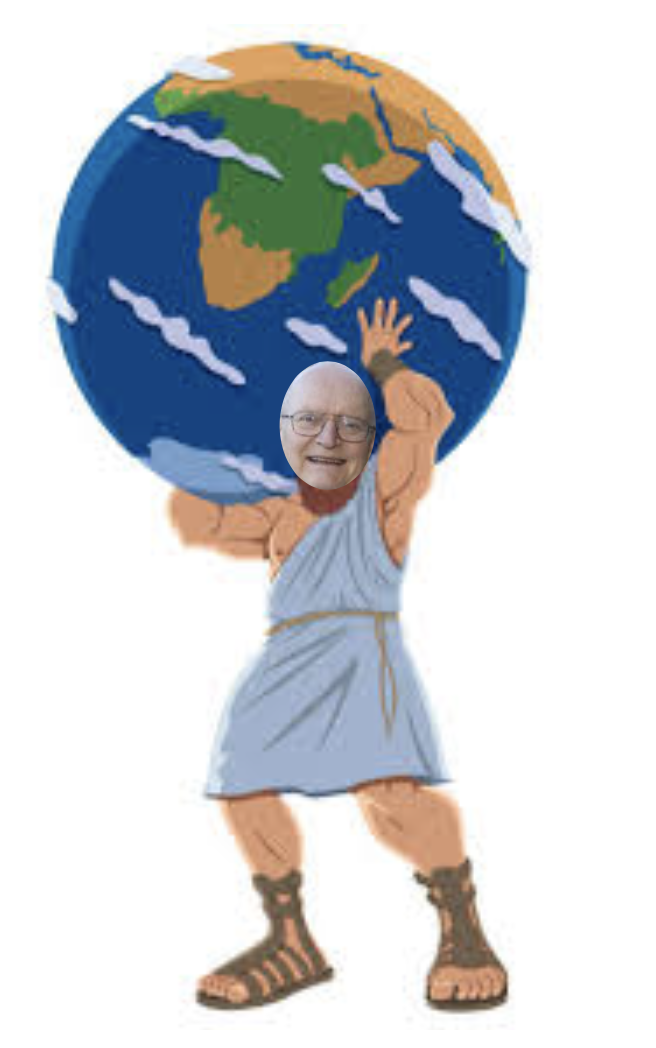
For years, cyber security experts have sounded the alarm about the serious threat posed by cyber warfare. From hostile foreign regimes to lawless nonstate actors, attacks on critical infrastructure, the theft of state secrets, or corporate espionage represent the new century’s national security threats.
This threat exploded into view late last year when it was revealed that the SVR, Russia’s foreign intelligence agency, hacked into an American software company named SolarWinds and slipped a “Trojan Horse,” or “backdoor” into an update to one of its software products used by dozens of U.S. government agencies and thousands of private businesses.
When SolarWinds’ customers downloaded and installed that corrupted update last year, they unwittingly gave SVR hackers access to their networks. This allowed the SVR to covertly maneuver around the compromised networks, steal data, access emails, download software, and perform reconnaissance.
Compromised networks included those of the Departments of State, Treasury, Justice, Energy, Commerce, and Homeland Security. Agencies such as the National Institutes of Health and the National Nuclear Security Administration, which maintains the nation’s nuclear stockpile, were also hacked. So were some of America’s leading technology companies.
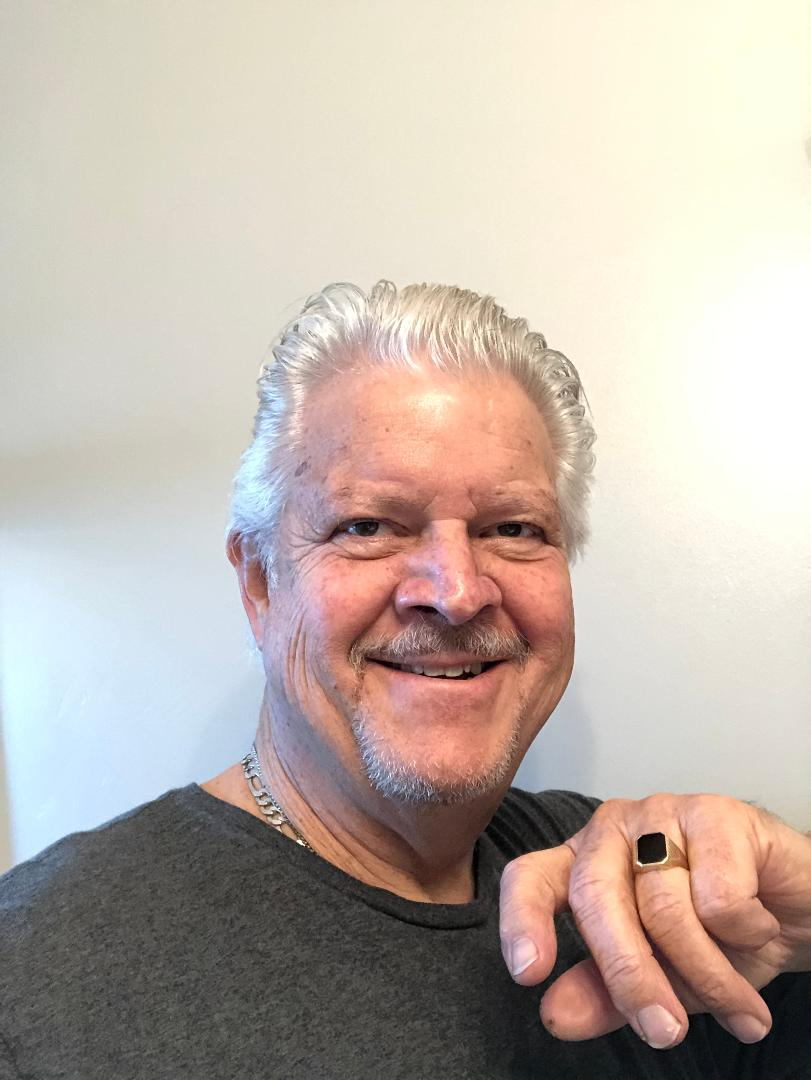
In this talk, Mark Randol will shed light on this massive cyber security breach, addressing these questions:
How did the Breach Happen?
What Went Wrong?
Who Was Compromised?
What Can We Do About It?
BIOGRAPHY
Mark Randol retired from the government in May 2011 after 35 years of military and Federal civil service and moved to Oakmont.
Following government service, he has taught college courses in domestic terrorism and counterintelligence; lectures at the University of Southern California’s Viterbe School of Engineering on aviation security; and teaches U.S. Coast Guard-certified maritime security courses. He is also a member of the board of advisors for International Scholar, an international organization of next-generation professionals in international affairs and public policy. He also provides security consulting services for, among other clients, the Bank of Canada (Ottawa), United Airlines, the Phoenix Department of Aviation, the Palo Alto Jewish Community Center, and several independent schools.
In his last government position, Mark served as the senior specialist in domestic intelligence and counterterrorism at the Congressional Research Service (CRS) in Washington, D.C. CRS is a part of the Library of Congress and its mission is to provide Congress with comprehensive and non-partisan research and policy analysis.
Prior to CRS, Mark was the Director of Counterterrorism Policy at the Department of Homeland Security (DHS) where he was responsible for coordinating interagency counterterrorism plans and policies. In that role, he represented DHS at the National Security Council’s Counterterrorism Security Group, charged with overseeing U.S. Government counterterrorism efforts.
Other professional assignments include serving as one of the original cadre of Transportation Security Administration (TSA) Federal Security Directors. He has 14 years of experience as a civil aviation security manager, inspector, and intelligence analyst with the Federal Aviation Administration in Washington, D.C. and Brussels, Belgium. He also served as a Senior Aviation Security Officer with the International Civil Aviation Organization in Montréal, Canada.
Mark served for 8-1/2 years in the U.S. Air Force, with assignments in Taipei, Taiwan; Stuttgart, Germany; Osan, Korea; and the National Security Agency, as well as 3-1/2 years as a civilian on the Army Intelligence Staff at the Pentagon.
He is a graduate of the University of California at Berkeley, earned a Master’s degree in Government from Georgetown University, and completed all Ph.D course work and comprehensive exams in World Politics at the Catholic University of America in Washington D.C.
While residing in Oakmont, Mark served for six years as the president of the Oakmont Sunday Symposium, a non-sectarian, non-partisan organization which provides weekly intellectually-stimulating and educational presentations to community residents and their guests. He has also made presentations at Sunday Symposium on homeland security, intelligence, terrorism, cyber, immigration, and historical topics.
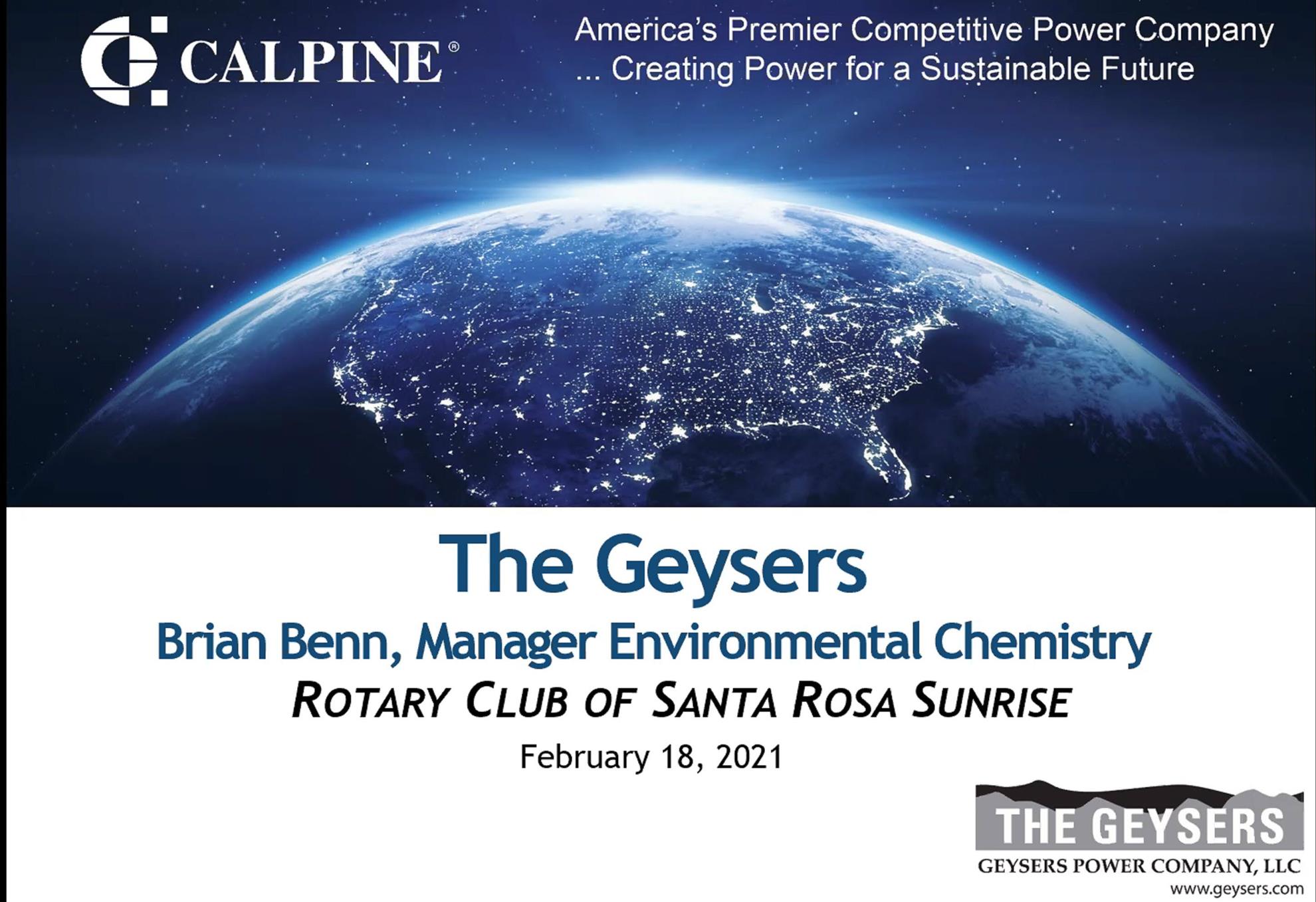
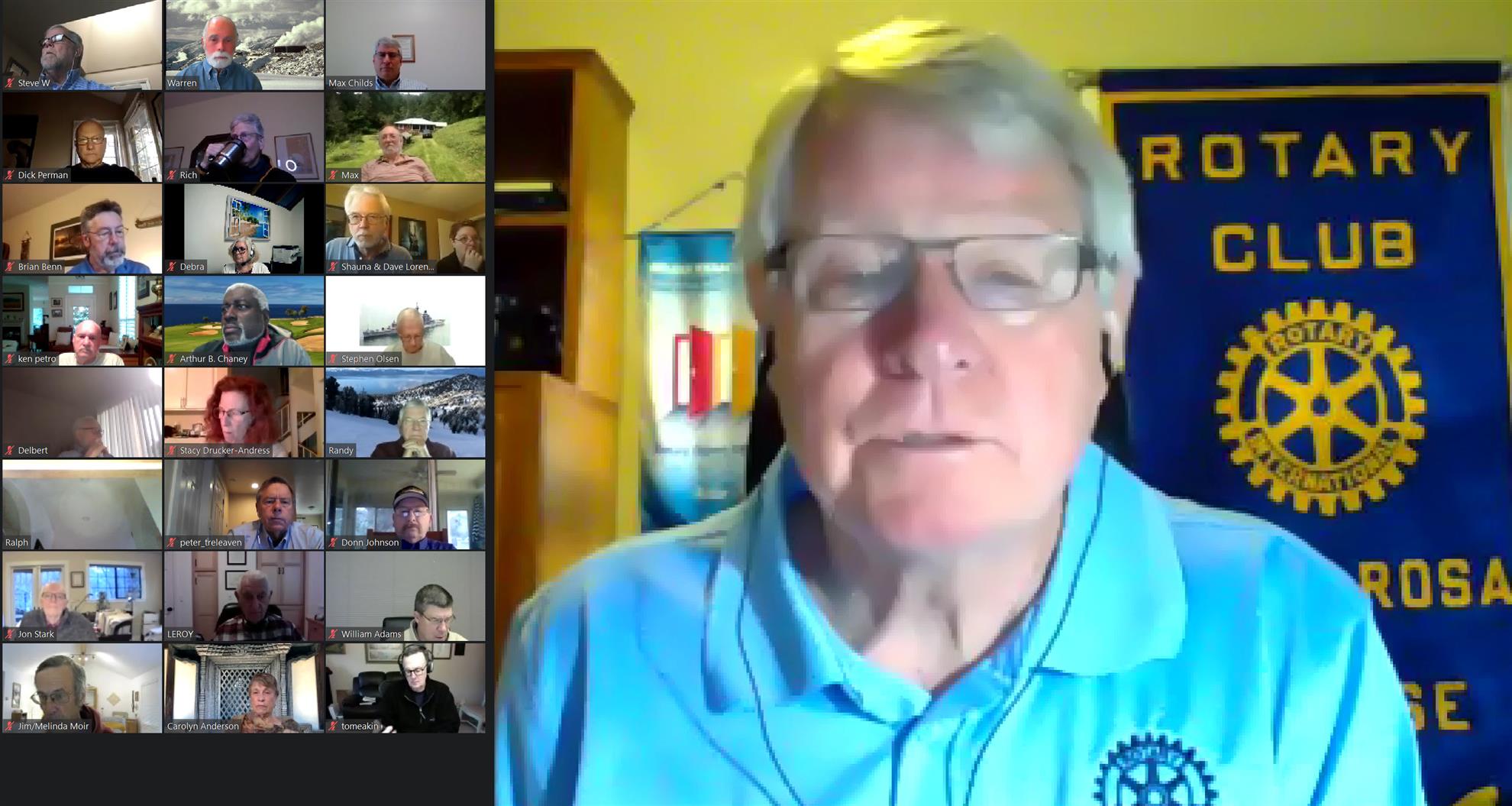
Our Speaker for February 18, 2021 was Brian Benn, the Manager of Environmental Chemistry for Calpine at the Geysers Power Company. Brian has been working at the Geysers for 43 years! The Geysers spans 45 square miles on and around Cobb Mt., the highest point in Sonoma County at 4,500 ft. above sea level. The Geysers is the largest single geothermal resource for electricity in the world. The Geysers 2020 average steam production per well is 38,104 lbs. per hour. Calpine’s 13 plants produce 725 megawatts, enough to power all of Sonoma, Lake, Napa, and Mendocino Counties. Brian explained that the Geysers is not aptly named because there is no flying water, just steam.
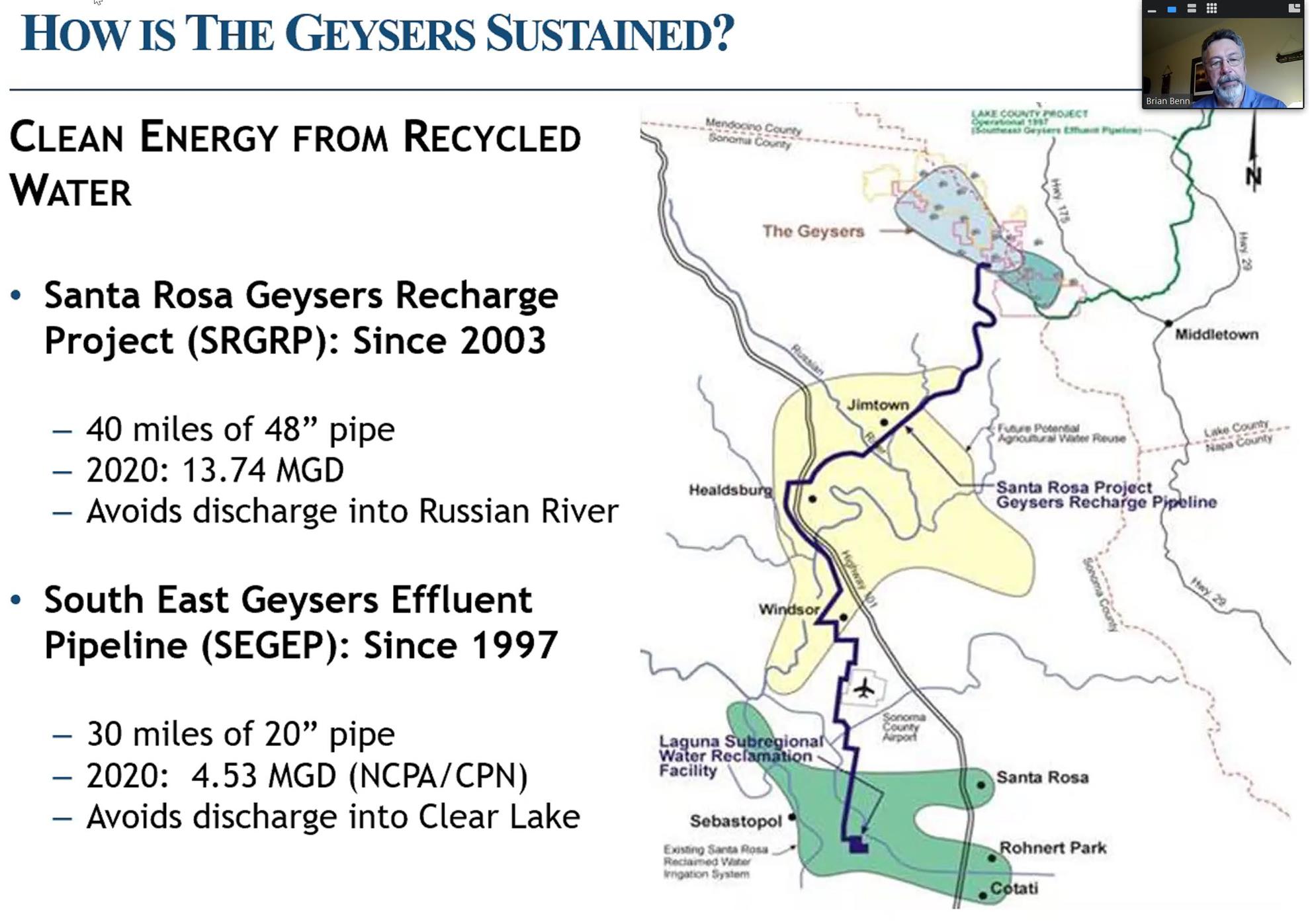
Electrical power was first generated in the U.S. at the Geysers in 1922. The first modern well was installed in 1954. PG&E sold the Geysers to Calpine in 1999. Steam in the Geysers’ fields is the result of the convergence of tectonic plates creating an impermeable steam reservoir with no natural connection between the reservoir and the surface. The steam is created by intense heat from magma and is trapped by caprock. The average depth of a steam well at the Geysers is 8,500 ft. Steam production at the Geysers wells peaked in 1987. The decline is being addressed by reinjecting water used for cooling the turbines into the wells. The Geysers also injects treated wastewater from Santa Rosa to help reverse the decline in steam (and to deal with the disposal of wastewater!). Calpine’s Geysers operations also prevent the emission of 2.4 million tons of CO2 each year (the equivalent of removing 430,000 cars from the road)!
Electricity generated at the Geysers is delivered to the Western Power Grid, as well as to other California utilities, including P.G.&E., Sonoma Clean Power, Southern California Edison, and San Diego Gas & Electric. The Geysers is the largest taxpayer in Lake County and the second largest taxpayer in Sonoma County. One of Brian’s jobs at the Geysers requires him to deal with significant environmental regulations and permitting due to the potential to impact water and air.
Fantastic job, Brian, and thank you for the very insightful and interesting glimpse into an operation that is so important and beneficial to our area!
On a regular basis, our resident photo pro Warren Smith, submits pictures of what is going on at the weekly meetings. You can always find the most recent pictures at the websites photo journal called "Meeting Sighting" Please note that all the meeting photos for the entire Rotary year are at this location with the most recent on the last page.
Thanks for all the great pictures Warren!Link to Meeting Sightings. The most recent are on the last page!
As Coach Harry said today, “We’re on the 2-yard line and we got to push it through!” This is the last week to sell tickets for next week’s Big Drawing. If you have any names left on your lists, now’s the time to act! Any birthdays coming up in the family? We need to have all of the ticket stubs and funds to the Team Captains no later than next Sunday, February 28 so they can turn them in Monday. By any measure this is going to be a homerun fundraiser- very low cost to revenue dollar received, less work and a smaller team needed to host than previous fundraising schemes and lots of good natured fun with the Team competition (thanks Team Captains, you all rock!). We are very close to our pie-in-the-sky goal of averaging 20 tickets per Sunrise member but whether we hit the goal or not it will be a great benefit for our work in the local community. Thanks Sunrise!
Cupid's council had a hard time deciding who to shower the grand honor for sweet script upon. To be in harmony with our beloved 4-Way Test criteria, and sustain domestic tranquility in all participants, Cupid's decision will be announced in person at this Thursday's meeting. Each entrant will be notified and invited to present their entry in their own voice.
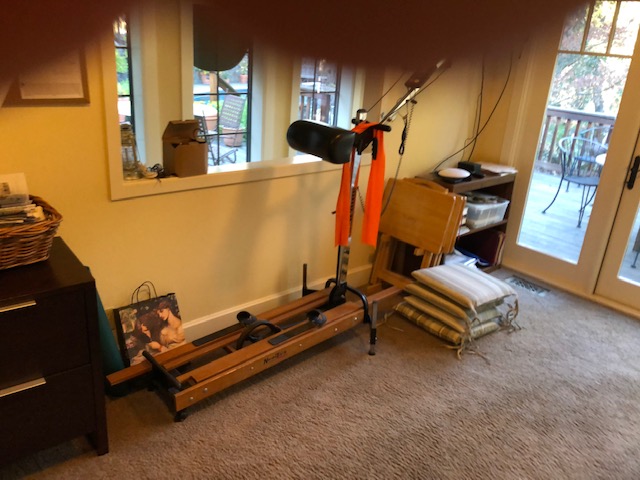
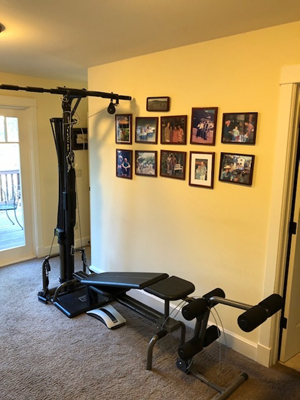
Sunrise Nonagenarian Jon Stark shares his fitness support staff from his home gym. A longtime advocate of Nordic Track and Bowflex, Jon credits his recent rapid recovery from COVID-19 largely to his overall fitness. His medical team seconds his hypothesis and provides us all a reminder of the value of consistent exercise.
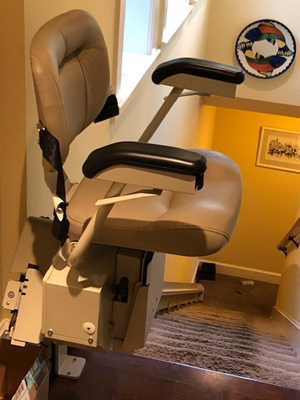
Jon's equipment also includes a stair lift from the garage to kitchen area, protecting him and Terry from hazardous steps with arm loads of groceries!!
What does it mean if a bolt is "galvanized"? Who the heck is Galvan?
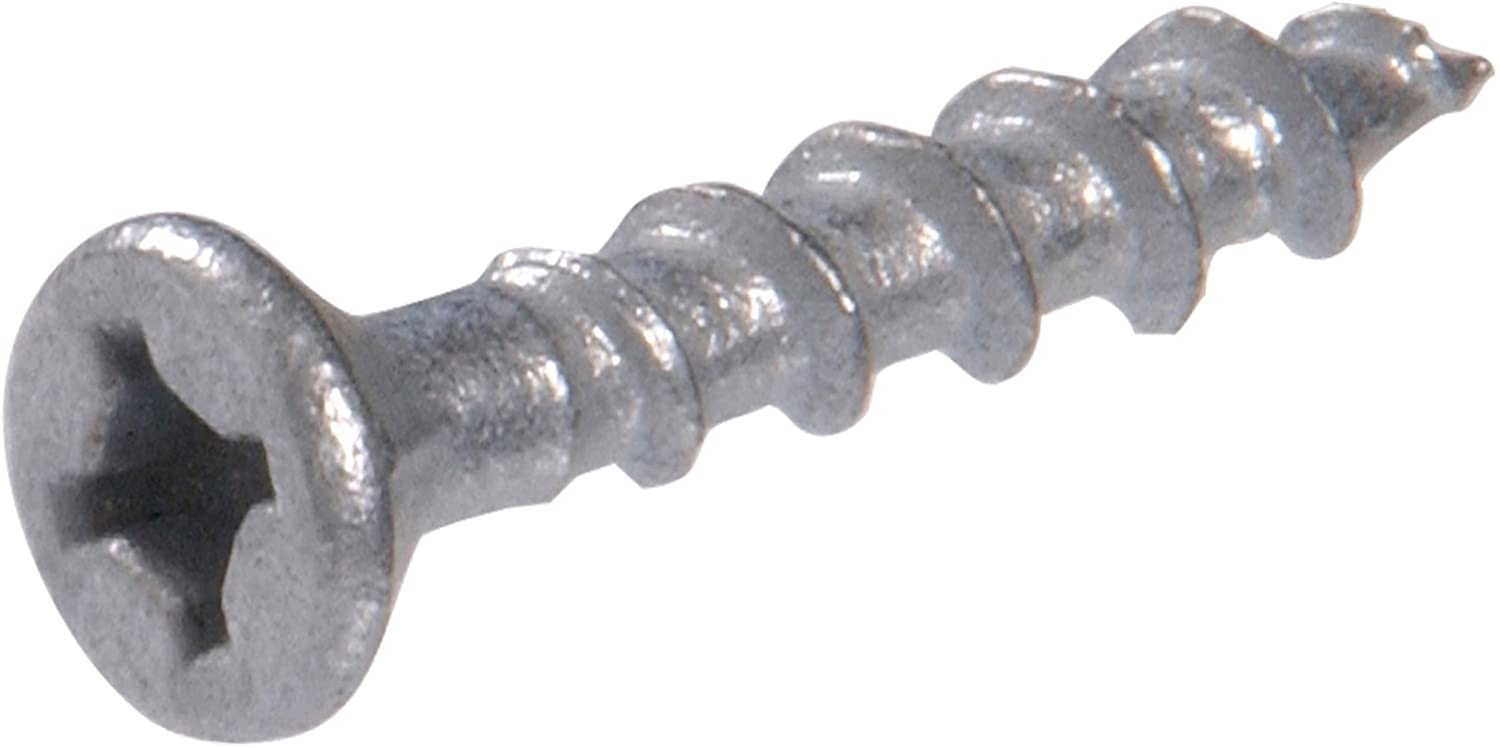
On a recent stop at the hardware store, I had to get some screws for a railing on my deck. It was one of those humbling experiences where I stand there dumbstruck looking at hundreds of boxes of bolts and screws with names like 3/8" by 4" galvanized lag screw. Got me wondering, what does "galvanized" mean exactly? I remembered that it was usually a good thing, but that it wasn't always a good thing and sometimes could be a problem. But when? I couldn't remember the important details, and the helper at the hardware store wasn't really well versed on the finer points of metallurgy. So I did some homework, and here are the key points:
· Fasteners like bolts and screws and nails are usually made of steel or iron.
· Galvanized fasteners are coated with zinc, which makes them rust resistant for up to 50 years.
· Galvanized fasteners do very well even underground and can even last 10 years in sea water.
· "Zinc-plated" fasteners are also coated with zinc, and they look shinier. But don't be fooled. The galvanized fasteners have zinc coating that is about five times thicker than the zinc-plated ones and that makes them work way better, especially for outdoor projects.
· Watch out for copper or some other metals that can react with the zinc in galvanized hardware. The light fixtures in my front entry are copper, and when I lost one of the screws I used a galvanized replacement, and it has never been the same. Generally, it is best to connect similar metals to each other, e.g. copper to copper. If you connect dissimilar metals, do some homework first to avoid issues.
Now, we get to the fun part: Who the heck is Galvan? Actually, galvanization is named in honor of Luigi Galvani, who was an Italian physician, physicist, biologist and philosopher, who discovered animal electricity. In 1780, he and his wife Lucia discovered that frog's legs would twitch when an electrical shock was applied. He is generally recognized as the first person to demonstrate the role of electricity in nerves and muscles. Luigi and Lucia didn't actually do anything with fasteners, but when it came to needing a name for zinc coated metals, I guess they were able to galvanize the necessary support!
The Name Game, musical groups have a difficult time coming up with a name, the “Right” name that represents themselves and hasn’t been used by any other group or organization who might take offence or worse, sue them for copyright infringement! Take for example the band known as “Chicago”, originally called the “Big Thing” until James Guercio, their new manager, renamed them the “Chicago Transit Authority” after having to ride the local bus system in the northwest side of Chicago to get to school. As the bands new manager, there wasn’t any discussion regarding this soon to be historic alteration…not until then mayor Daley representing the entire city of Chicago threatened litigation!
Guercio wasn’t aware that the name change would cause such uproar stating that he was in control of marketing, producing and managing the band…”and I was a little too autocratic…Anyway I did not want to change the name, but people where saying “it’s too long, nobody’s going to remember it”… I wasn’t convinced until my buddy, David Griffin, from the mailroom days at the William Morris Agency, talked me into it. He said, “just call them “Chicago”, why are you hanging onto “CTA”…you’re getting sued by the city!”
After talking with the band, convincing them that their new name was to be just “Chicago”…and after I had designed all of the logos and marketing material, well… they fired me on the spot…took the name and put their collective picture on the cover of their next release!
Quotes from my daughter Madeleine’s 6th grade Science students on an exam:
- Water is composed of two gins, Oxygin and Hydrogin. Oxygin is pure gin. Hydrogin is gin and water.
- When you breathe, you inspire. When you don’t breathe, you expire.
- To collect fumes of sulphur hold a deacon over a flame in a test tube.
- When you smell an odorless gas it is probably carbon monoxide.
- Mushrooms always grow in damp places so they look like umbrellas.
- The tides are a fight between the Earth and the moon. All water tends towards the moon because there is no water on the moon, and nature abhors a vacuum. I forget where the sun joins the fight.
Rotary Foundation receives highest rating from Charity Navigator for 13th consecutive year
By Rotary International
For the 13th consecutive year, The Rotary Foundation has received the highest rating — four stars — from Charity Navigator, an independent evaluator of charities in the U.S.
The Foundation earned the recognition for adhering to sector best practices and executing its mission in a financially efficient way, demonstrating both strong financial health and commitment to accountability and transparency. Only one percent of the organizations Charity Navigator evaluates have received 13 consecutive 4-star evaluations.
"Your achievement and 4-star rating will enhance your organization’s fundraising and public relations efforts,” says Michael Thatcher, president and chief executive officer of Charity Navigator. "This exceptional designation sets the Foundation apart from its peers and demonstrates to the public its trustworthiness."
The rating reflects Charity Navigator's assessment of how the Foundation uses donations, sustains its programs and services, and practices good governance and openness.
16-Dec-2020
Rotary Club of Santa Rosa Sunrise - Founded June 30, 1986


.png)

.jpg)