
Volunteers root out an invasive plant with a fiery nature
by Mary Catherine O’Connor
10 Sept 2026
As a kid in the 1960s, Don McEnhill could tell there was something different about the thick bamboo-like stands of vegetation he and his friends would crash through on their path to the Russian River. “You’d have no bugs on you. No spiders, no anything,” he remembers.
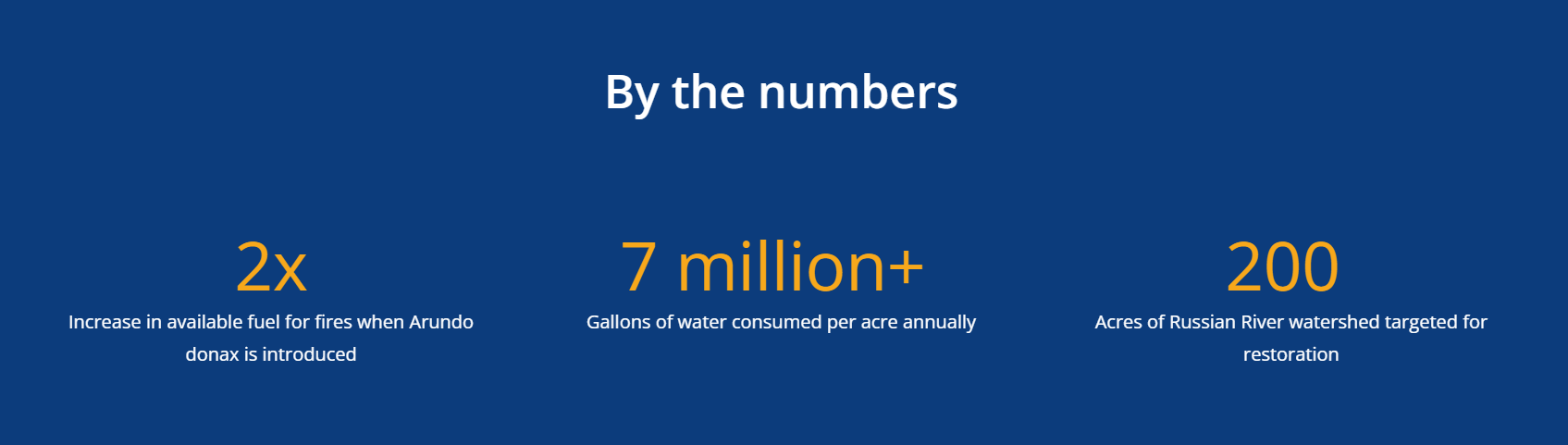
He didn’t know it at the time, but the lack of insects was a signal that this mysterious plant was not native to the northern California waterways around his family’s cabin in Healdsburg. It wasn’t until the early 2000s, when he started working with Russian Riverkeeper and other local conservation groups, that he learned all about this invader, Arundo donax, commonly called the giant reed. It guzzles more water than any other plant on the river. It outcompetes native plants and trees. And it possesses another unwelcome attribute: In a region increasingly prone to wildfires, the giant reed is extremely flammable.
Winding for 110 miles through California’s wine country and redwood groves on its way to the Pacific Ocean, the Russian River is a treasured waterway for fishing and recreation. Boisterous partiers float down it in inner tubes. Daredevils fling themselves into it from rope swings. Churchgoers dressed in white baptismal garments dunk themselves in its waters. The vast watershed supports Chinook and coho salmon as well as steelhead trout and river otters. Its woodlands and grasslands are home to coyotes, bobcats, and mountain lions.
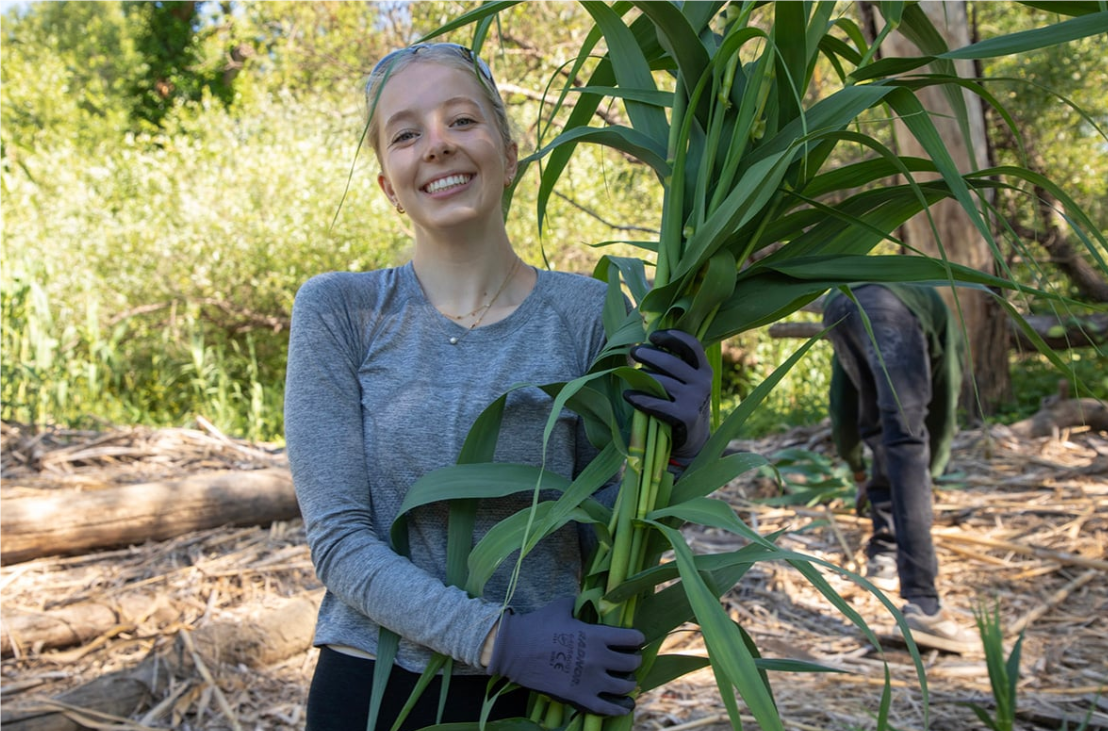
Rotary clubs have partnered with conservationists to remove the invasive giant reed from parts of California’s Russian River watershed where it poses the greatest fire risk.
Rick Tang Photography
Seeking to protect this habitat, environmental groups have taken aim at the giant reed, a fast-growing perennial that can reach 30 feet in height. Rotary clubs across Sonoma and Mendocino counties have partnered with conservationists for the past few years, contributing volunteers and funds for equipment.
On a Saturday morning early this summer, about 30 Rotarians, Interactors, and other community members gathered along the river to root out Arundo donax. Fanning out across a section of river, the volunteers pushed through thick brush to slice through the stalks with loppers. Then others gathered up the piles of what looked like bundles of sugar cane to be fed into a wood chipper.
“It’s everywhere you look,” says Milo Kluse, a 16-year-old Interactor from Healdsburg. “It’s pretty crazy.” Kluse, the new president of the Interact Club of Healdsburg High School, says that the club has made good headway on reducing trash along the river and was in need of a new challenge. The Arundo was happy to oblige.
Russian Riverkeeper’s education and restoration director, Birkin Newell, pointed out a cottonwood tree and a willow on either side of a freshly cut giant reed stand. “These are the true native riparian tree species that we want to have here,” he says. Unlike Arundo, the tree canopies provide shade, keeping the water cool. “They provide great food and habitat for wildlife and the Arundo provides none of that. If you’re a deer, you can’t move through [it] to browse and eat.”
Outside its native ranges in the Mediterranean and Asia, Arundo donax has vexed land managers for decades. Spanish colonists likely brought the plant to what is now California in the 18th century. They “happily introduced it to the New World because it grows so fast. And back in those times, it was a really helpful building material,” explains McEnhill, who is now deputy director of Russian Riverkeeper. But its presence in this watershed is due to the U.S. Army Corps of Engineers, which planted it decades ago as a means of reducing erosion, he says. It was one of the Corps’ ecologically unsound approaches to erosion control at the time, which also included burying crushed car bodies along riverbanks.
A single acre of Arundo along the Russian River can consume more than 7 million gallons of water each year, McEnhill says. The giant reed is also tenacious, gaining ground by sending underground stems called rhizomes laterally. Lop off one stalk and another will sprout from its stems. A cut shoot left on the ground can resprout a single node and start anew. One that falls into the water can take hold downriver, starting a new colony that could cover many acres before being discovered.
Reducing the wildfire hazard presented by the stands is a big motivator for the volunteers. Just about everyone here has either needed to evacuate due to a wildfire or knows someone who has. Some know people who have experienced even worse. Arundo is highly flammable and burns exceptionally hot. In 2019, the Kincade fire lasted 14 days; it consumed more than 77,000 acres, destroyed more than 370 homes and other buildings, and forced residents of Healdsburg and nearby towns to evacuate.
That fire crossed the Russian River in two places, McEnhill says. When he and other members of Russian Riverkeeper investigated those spots after the fire, the native plants looked to have mostly survived. “But then we saw these giant ash heaps and big black spots. Those were Arundo stands. They helped the fire jump across the river,” he says.
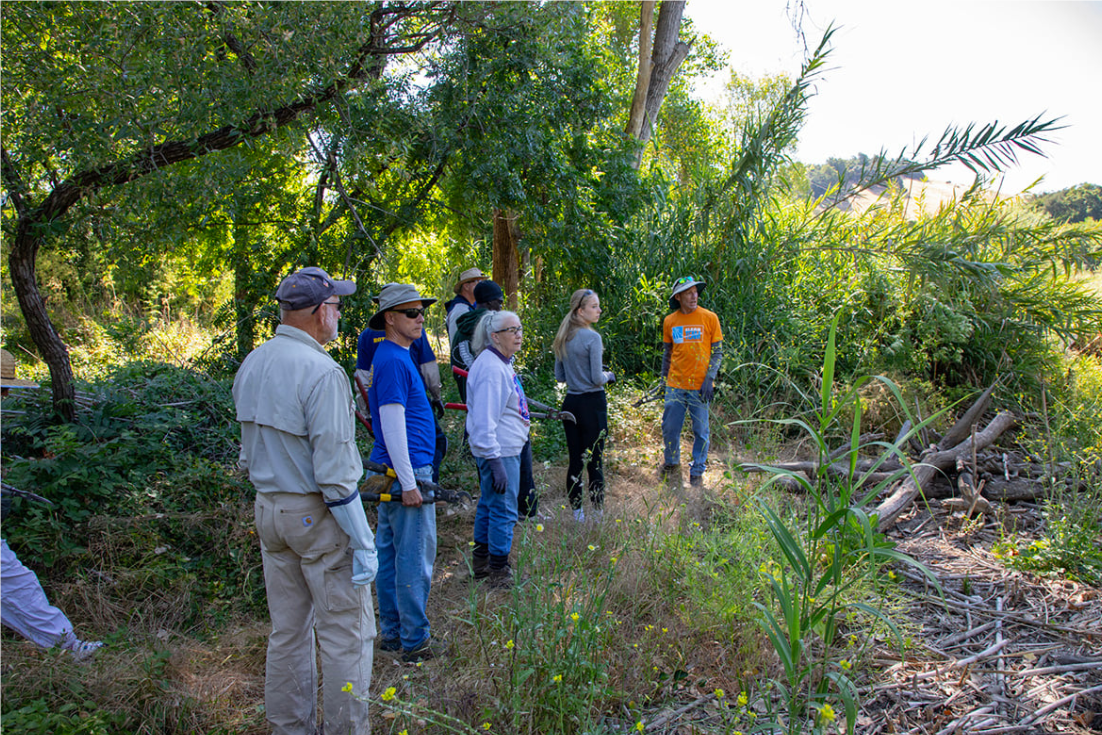
Around 30 Rotarians, Interactors, and other community members gather along the river to root out Arundo donax on a Saturday morning in June.
Rick Tang Photography
The next year, after a fire broke out near a stretch of the river in Healdsburg, the fire department became acutely focused on the giant reed, which had contributed to that blaze’s extreme heat. It burned so hot, the firefighters’ boots started to melt.
Linda Collister, who was then the town’s fire marshal, asked Russian Riverkeeper to help the department update its wildfire prevention plan by determining an environmentally friendly way to remove the stands that posed the greatest fire risk. That’s how the nonprofit began its concerted Arundo eradication efforts.
It focused its efforts on a 5-mile stretch of the river that threads around Fitch Mountain, a community of several hundred homes where the stakes couldn’t be higher. The main route through the area is a narrow two-lane road that was built in the 1920s. “It is the single highest risk area for human mortality in Sonoma County,” McEnhill explains. “If a fire gets going on that mountain, people will die.”
Down by the river, John Grech from the nearby Rotary Club of Sebastopol Sunrise couldn’t help but feel a little defeated. “So much of this was cut, but was never hauled out,” he says. “We’re cutting down the regrowth.” Amid dead reeds on the ground, pockets of green shoots have risen 4 or 5 feet in just a few months.
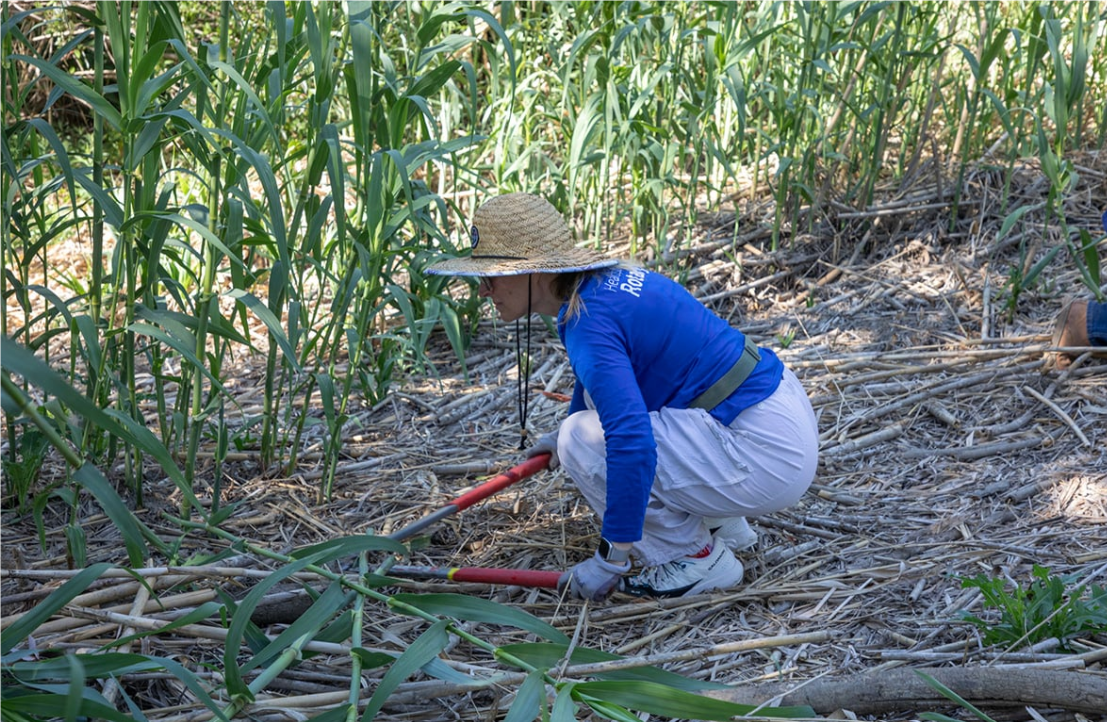
Volunteers cut down the giant reeds and haul them away to prevent regrowth.
Rick Tang Photography
After cutting the new growth, Newell and other Russian Riverkeeper staff swooped in with a bottle of a blue-tinted herbicide. They painted a small amount of the chemical on the nub of each freshly cut stalk sticking out of the ground.
Upstream, another group of Rotarians and Interactors hauled the last of their cut piles to the chipping site as the heat of the day built up. Many of them, including 17-year-old Lila Kreck, have joined past Arundo removal days. “It’s great to get the water-sucking non-native plants out of here,” she says. The increasing severity of wildfires has left an indelible mark on this community and her own family. “My grandparents’ house was like inches away from being burned,” she says.
The simple act of coming out to the river armed with a pair of loppers can give people here a way to channel their worries into action, says Barbara McChesney, a member of the Rotary Club of Windsor and chair of District 5130’s environmental committee. “It feeds your soul to do this kind of stuff.”
This story originally appeared in the September 2026 issue of Rotary magazine.
Rotary members make meaningful change in communities around the world.
Learn more