banner
Bulletin Editor
Max Childs
Sponsors
Interested in being a sponsor?
Download the website sponsorship guide
Meeting Responsibilities
This Week's Duty Roster
 
Presiding At Meeting
Rodrigues, Lori
 
Greeter
Amend, Steve
 
Pledge Leader
Floriani, Flo
 
Thought of the Day
Olsen, Steve
 
Microphone Usher
Amend, Steve
 
Sunshine Committee
Randolph, Rich
 
Web Site Editor
Lorenzen, Dave
 
Bulletin Editor
Childs, Max
 
Bulletin Notes
Randolph, Rich
 
Bulletin Notes
Shureen, Doug
 
Bulletin Notes
Tamanaha, Dicksie
 
Photographer
Smith, Warren
 
July Breakfast Team
 
Breakfast Captain
Drucker-Andress, Stacy
 
Breakfast Team
Herron, Steve
 
Speakers
Jul 24, 2025
Resilient Landscaping
Jul 31, 2025
Nut Tree: The Serendipity of a Successful Business
Aug 07, 2025
Peace Poles
Aug 14, 2025
How to Age Well
Aug 21, 2025
Life of an award winning Sonoma County playwright
Aug 28, 2025
The Magnolia Project
View entire list
Upcoming Events
July – Walk – Deer Island Preserve -- Novato
Jul. 26, 2025
9:00 a.m. – 12:00 p.m.
 
August – Hike – Islands in the Sky from Duncan Mls
Aug. 17, 2025
10:00 a.m. – 12:00 p.m.
 
September – Walk – Bartholomew Winery
Sep. 27, 2025
9:00 a.m. – 11:00 a.m.
 
October – Walk– Glen Oaks Ranch
Oct. 11, 2025
10:00 a.m. – 2:00 p.m.
 
November 2025 – Hike – Point Reyes
Nov. 08, 2025
9:00 a.m. – 3:00 p.m.
 
December  – Traditional Holiday Walk -- Healdsburg
Dec. 07, 2025
10:00 a.m. – 12:00 p.m.
 
View entire list
Birthdays & Anniversaries
Member Birthdays
Eric Johnston
July 8
 
Scott Holder
July 9
 
Steve Olsen
July 20
 
Katharine Anderson
July 24
 
Spouse Birthdays
George Reese
July 4
 
Venus Childs
July 9
 
Lynn Olsen
July 17
 
Kathleen Amend
July 22
 
Katharine Anderson
July 24
 
Anniversaries
Peter Treleaven
Marie Treleaven
July 19
 
Join Date
Marty Behr
July 1, 2011
14 years
 
Randy Seelye
July 1, 1980
45 years
 
Nancy Aita
July 20, 1989
36 years
 
Scott Holder
July 20, 1995
30 years
 
Links
Links
Club Website Tutorials
Sunrise Foundation Service Fund
What Are My Make Up Options?
How to Contact the Sunshine Committee
SR Sunrise Facebook Page
ESRAG - Environmental Rotary Action Group
Youth Exchange - District 5130
SCARC Meeting Schedule
Rotary International Business Portal
Latest "Rotarian Magazine"
Executives & Directors
President
 
President Elect
 
President Nominee / Speaker Bureau
 
Secretary
 
Treasurer
 
Past President
 
Rotary Foundation
 
Philanthropy Chair
 
Marketing
 
Service Projects
 
Membership
 
International Service Chair
 
Photo Albums
Meeting Sightings
* 2025 Debunking of President Cindy
* 24-25 Hike / Walks
* 2025 Raffle Party
* 24-25 Service Projects
* 2024 Veterans Day Celebration
* 2024 Christmas Party
* 2024 SRKSEP
* 2024-25 Meeting Sightings
Subscribe to Bulletin
Subscribe to our eBulletin and stay up to date on the latest news and events.
Stories

The Program for July 24th
 

Meeting for July 24, 2025

Hybrid Meeting

Jennifer Roberts
Resilient Landscaping

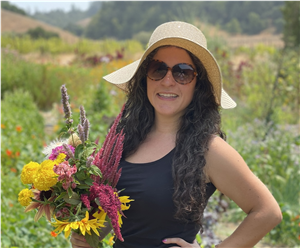
Jennifer Roberts is an accomplished Environmental Educator and Landscape Designer, proudly transplanted, and now firmly rooted, in the vibrant soils of Sonoma County.

Jennifer holds a B.A. in Environmental Studies from UC Santa Cruz and three A.S. degrees in Environmental Horticulture from Santa Rosa Junior College. She is also a UC Master Gardener of Sonoma County, Master Composter, certified California Naturalist, and Permaculture Designer.

She brings her sustainability expertise and passion for teaching into her landscape design work at Native Habitats Landscape Design, as well as through her roles with two Sonoma County-based nonprofits: The Habitat Corridor Project and the Resilient Landscapes Coalition, where she contributes sustainable design and project management.

Outside of her professional life, Jennifer tends her native garden and compost worms, and finds inspiration on the trail and behind the camera lens, pursuits that continually shape her creative approach to design. Most recently, she has taken on her most exciting endeavor, motherhood. 

LINK TO VIRTUAL MEETING INFORMATION

The Speaker From July 17, 2025

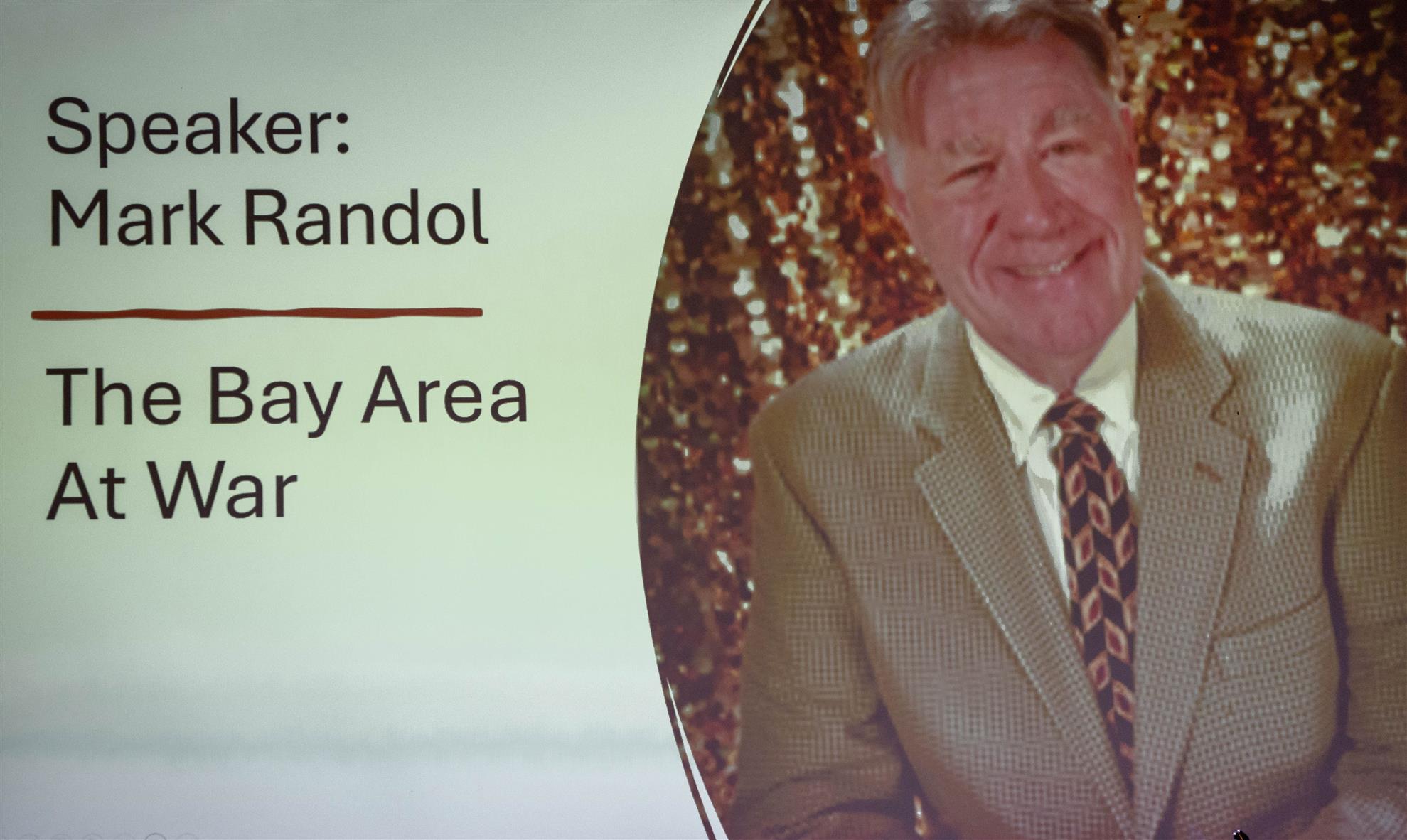
The Bay Area at War, by Mark Randol

Our speaker for July 17 was Mark Randol, whose topic was “The Bay Area at War.” Mark has 35 years of federal service, both in the Air Force and civil service, including the National Security Agency and the Army Intelligence staff. He also teaches a variety of security and counterintelligence topics and served as the Director of Counterintelligence Policy at the Department of Homeland Security. Mark graduated from UC Berkeley, has a master’s degree from Georgetown, and has completed all coursework for his PhD.

Mark’s presentation outlined the history of the Bay Area’s military involvement, starting with the interesting fact that the great 16th and 17th Century explorers, including Juan Cabrillo, Sebastian Vizcaino, and Sir Francis Drake, missed discovering the San Francisco Bay! The area first shows up in maps of the Vice Royalty of Spain in the 18th Century. By that time most of “Alta California” was part of the Spanish empire and a military garrison was established in the Bay after 1776, including cannon pointed outward to defend the bay from invading ships. California became part of Mexico in 1824. But, as Mark points out, the Mexicans had a severe illegal immigration problem, since settlers from the U.S. were moving in and claiming territory. California officially became part of the U.S. in 1846-47.

During the Civil War the U.S. desperately needed to protect the Bay from the Confederacy since almost all the U.S. gold came from California. The army built out various batteries and fortifications. Later, during the Spanish-American War, the U.S. added coastal fortifications around the Bay Area, including Battery Bluff in the Presidio. World War II triggered massive changes to the Bay Area. The War Department decided that the Bay Area was the perfect place to build the Navy. The Bay became the largest shipbuilding area in the world, with new or refurbished shipyards at Kaiser in Richmond, Marin Shipyard, Mare Island Naval Shipyard, Basalt in Napa, Hunters Point, the Naval Air Station, and Moore Dry Dock. As men left for service in the armed forces, women and Blacks (often from the south) worked in the shipyards in vast numbers. Kaiser alone employed 20k women! Mark also mentioned the Port Chicago disaster on July 17, 1944, in which a naval magazine exploded, killing 325 men, including 202 African American sailors.

The Bay Area also played a part in the end of the war in the Pacific, when the USS Indianapolis departed from San Francisco to Hawaii carrying components for the first atomic bomb, later dropped in Japan. Mark noted that the experience of women and blacks working in Bay Area industry during the war played a significant part in post-war social and political changes.

Click HERE to view a limited time recording of Mark's informative presentation.

Photo of the Week

Photo of the Week

On this Day in 2015

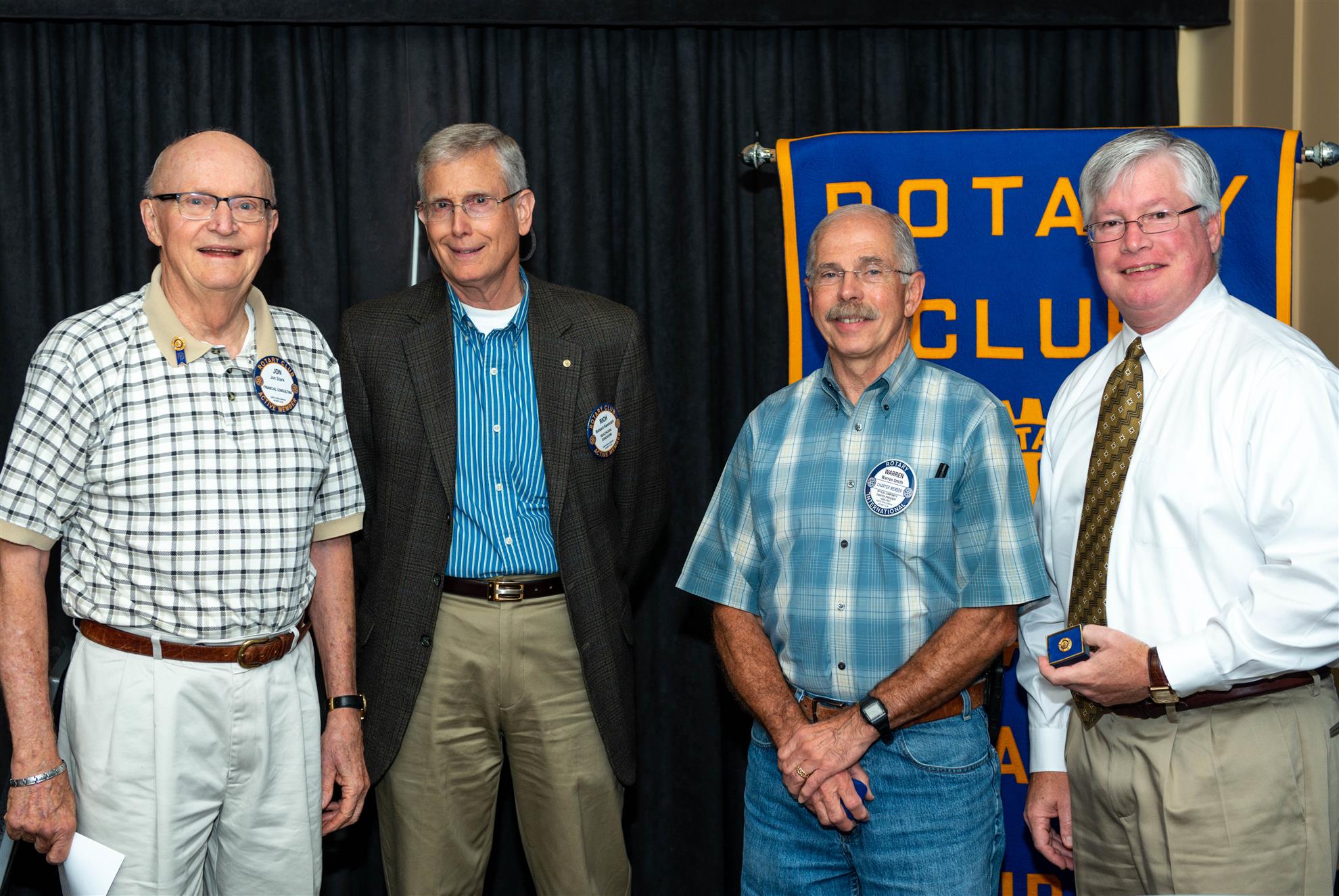
On a regular basis, our resident photo pro Warren Smith, submits pictures of what is going on at the weekly meetings. You can always find the most recent pictures at the websites photo journal called "Meeting Sighting" Please note that all the meeting photos for the entire Rotary year are at this location with the most recent on the last page.

Thanks for all the great pictures Warren! Link to Meeting Sightings. The most recent are on the last page!

Additional photos may be found on the SR Sunrise Facebook Page.
Check it Out on Facebook

As Seen This Week on Facebook!


Joke of the Week

The Week's Funny:

A man is interviewing for a new job:
“What is this big gap on your resume?” a recruiter asked.
“I went to Yale for 4 years,” he says.
The recruiter is impressed and offers him the position.
The man is excited and responds:
“That’s awesome, I am so happy about this because I badly needed this Yob.”

News From "The Rotarian"
A chat with 2025-26 Rotary International President Francesco Arezzo
RI’s new president talks about his top Rotary moments, his goals as president, and his love of olive oil and opera
By Etelka Lehoczky
Francesco Arezzo was sitting with a friend at his district conference when he received a call, asking him to leave the room and join a Zoom meeting with the Rotary International Board of Directors. A few minutes later, Arezzo learned that he’d been chosen as RI president for 2025-26, the third Italian and the first from southern Italy to lead the global membership organization. Since the news hadn’t been officially announced, he couldn’t tell anyone. But soon, he noticed phones coming out all over the room.
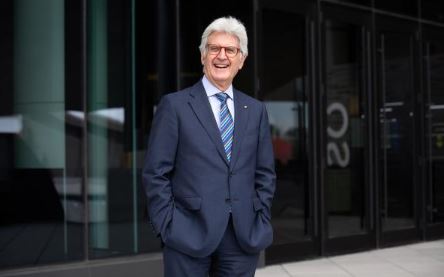
RI President Francesco Arezzo is a member of the Rotary Club of Ragusa in Sicily.
“When the news arrived on social media at about 11 p.m., we were in the middle of the gala dinner,” he says. “You can imagine more than 400 Rotarians all finding out on their phones. It was quite an unforgettable moment. All of a sudden, they all lined up to kiss me and offer their congratulations. I was deeply touched.”
A week after the Board held a special session in June to select Arezzo to lead Rotary, he flew to Calgary, Canada, for the 2025 Rotary International Convention. There, he was warmly embraced by members from around the world. Thousands of attendees interrupted during his speech with ebullient applause at the closing session as he was officially introduced.
A member of the Rotary Club of Ragusa in Sicily, Arezzo has been part of Rotary for more than three decades. He has served as vice chair of the Joint Strategic Planning Committee, RI director, and chair of the 2023 International Convention Committee for Melbourne, among other leadership roles. Throughout his Rotary journey, Arezzo has supported initiatives that strengthen RI’s impact and expand opportunities for engagement across generations. He has served as president of Fondazione Rotary Italia, a national initiative that makes it easier for Italian citizens to support Rotary’s humanitarian projects around the world.
The following interview was conducted during multiple conversations with Arezzo in Calgary — in the hallway during breaks, inside a minibus en route to a Rotary event, and at a makeshift office inside the convention hall, where Rotary members frequently stopped by to greet and hug him. Despite his packed schedule, he set aside time to talk with Rotary magazine about his life, his Rotary journey, his plans for the organization, and two of his other passions: opera and olive oil.
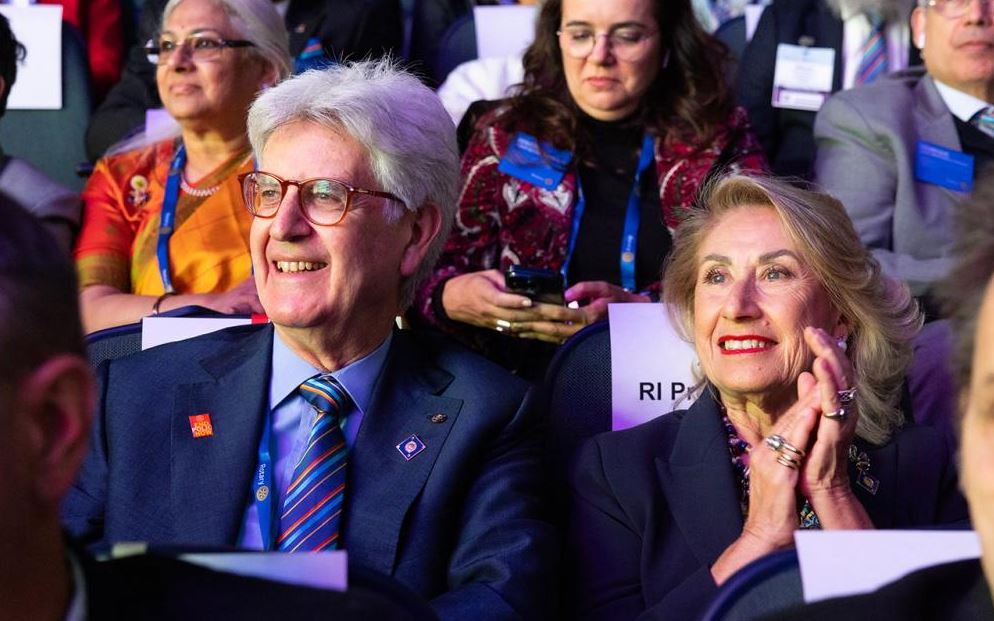
RI President Francesco Arezzo and his wife, Anna Maria, attend the 2025 Rotary Convention in Calgary, Canada, in June.
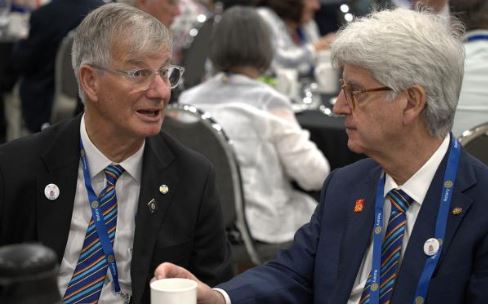
RI President Francesco Arezzo, right, talks with his presidential aide John de Giorgio, a member of the Rotary Club of Malta.
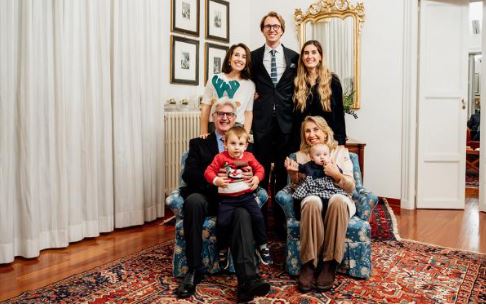
RI President Francesco Arezzo and his family pose for a holiday photo. Front row (from left): Arezzo, holding grandson Francesco; and Arezzo’s wife, Anna Maria, holding granddaughter Anna Maria. Standing (from left): Arezzo’s daughter Elena; his son-in-law Magnus; and daughter Raffaela.
Q: You’ve worked as an orthodontist for many years. Are there things about your job that make you an effective Rotarian?
A: I’ve been a practicing orthodontist for 46 years now. I work mainly with young people, and it’s very important to try to understand them before beginning treatment. You have to win their cooperation. Forging those relationships is one of the best aspects of my job.
Q: And you now have grandchildren of your own, right?
A: I have two wonderful grandchildren. The elder one, who’s three years old, has my name: Francesco. The younger is one year old, and she has my wife’s name. So we have another Anna Maria and another Francesco.
Q: You’ve been a Rotarian for more than three decades. Do you remember why you first wanted to join?
A: At the beginning, Rotary was just a place to meet new friends with different points of view. It wasn’t until I became club president that I began to really understand Rotary. Now, when I speak to Rotarians, I tell them to change the verbs they use. You don’t “go to” Rotary like you go to the cinema, where you sit and watch other people doing something. Rotary is something you do. You have to participate. And then you begin to grow.
Q: How have you grown in Rotary?
A: When my club first proposed that I become president, I didn’t want to accept. I had a stutter, so I was terrified of being obliged to address my club. But it wasn’t so bad. Then they invited me to be a district governor, and again, I didn’t want to accept. But once more, they convinced me. Now, when I think about the fact that I’m going to be the Rotary International president and speak onstage in another language, I understand how much Rotary has changed me in a positive and lasting way.
Q: How can Rotary convey a sense of this impact to members and potential members?
A: We have to improve our communications with club presidents, because they’re on the front lines of dealing with members. While we do a wonderful job of instructing district governors in the importance of membership and new clubs, the district governor often speaks with a club president only two or three times a year. There are too many club presidents who don’t have any idea why our membership goals are so important.
Q: What challenges do you anticipate you’ll face during your term as president?
A: I’m very conscious that I’m beginning very late. Even if I begin studying problems and setting goals now, I can’t do very much. Rotary isn’t a scooter that can change direction quickly. It’s like a big cruise ship: If you want to make a turn, you have to begin many kilometers in advance. I hope to work very closely with President-elect SangKoo Yun. I think SangKoo and I can create a two-year plan that will be really effective.
Q: What has been one of your most memorable moments in all your years in Rotary?
A: One moment that was very, very moving for me was when, as district governor, I organized a Rotary Youth Leadership Awards event for districts bordering the Mediterranean Sea: Italy, France, Spain, North Africa, Greece, Turkey. The problem was putting together Turkish and Italian young people, because they looked at one another as very different. The first day was tense; it was clear that they didn’t like each other. But after a few days, they began to discover that they had the same tastes and the same dreams.
When the last day came, they sang John Lennon’s “Imagine” together and performed a skit they’d written about the cultural differences between their countries. It was one of the most beautiful things I can remember.
Q: In your professional life, you’ve led trade organizations for dentists and for olive oil producers. What group is most difficult to unite in a consensus: Dentists, olive oil producers, or perhaps Rotary members?
A: From my experience, it’s the olive oil producers. Each producer of olive oil is strongly convinced that his olive oil is the best in the world. So they usually don’t want to cooperate sincerely with others.
Q: How long have you been producing olive oil?
A: My family has produced olive oil for more than a century now. I am the last, I fear, because my daughters are not interested in this field.
Q: I understand you love opera also. What’s your favorite opera or composer?
A: A composer I like a lot is Vincenzo Bellini. He was born in Sicily, and he died very, very young. He did only a few operas, but they are all of a very high quality. And of course, there are many other great composers — Puccini, Verdi, Mozart. It’s hard to pick one.
— July 2025
 
Related stories
Rotary Club of Santa Rosa Sunrise - Founded June 30, 1986