The Bay Area at War, by Mark Randol
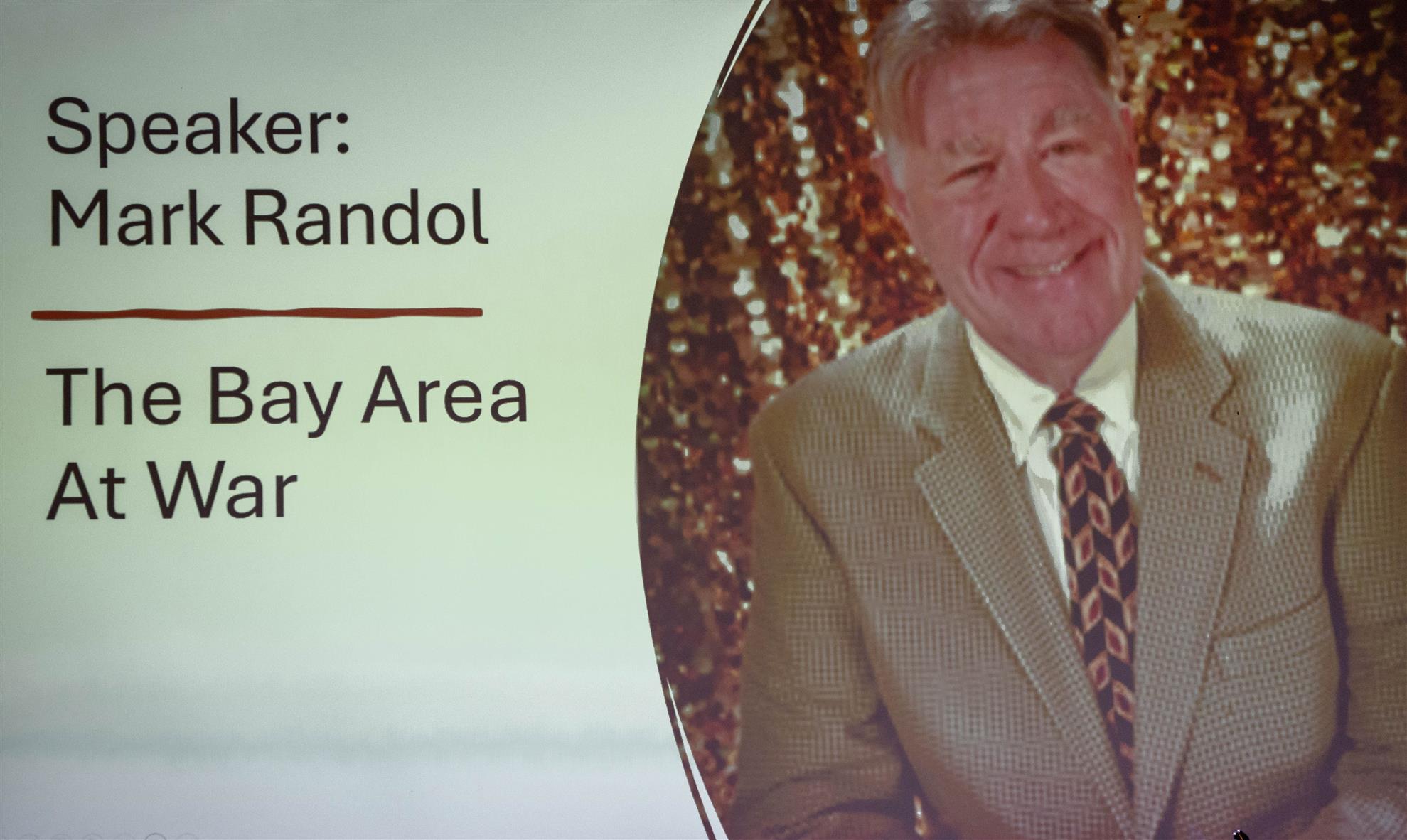
Our speaker for July 17 was Mark Randol, whose topic was “The Bay Area at War.” Mark has 35 years of federal service, both in the Air Force and civil service, including the National Security Agency and the Army Intelligence staff. He also teaches a variety of security and counterintelligence topics and served as the Director of Counterintelligence Policy at the Department of Homeland Security. Mark graduated from UC Berkeley, has a master’s degree from Georgetown, and has completed all coursework for his PhD.
Mark’s presentation outlined the history of the Bay Area’s military involvement, starting with the interesting fact that the great 16th and 17th Century explorers, including Juan Cabrillo, Sebastian Vizcaino, and Sir Francis Drake, missed discovering the San Francisco Bay! The area first shows up in maps of the Vice Royalty of Spain in the 18th Century. By that time most of “Alta California” was part of the Spanish empire and a military garrison was established in the Bay after 1776, including cannon pointed outward to defend the bay from invading ships. California became part of Mexico in 1824. But, as Mark points out, the Mexicans had a severe illegal immigration problem, since settlers from the U.S. were moving in and claiming territory. California officially became part of the U.S. in 1846-47.
During the Civil War the U.S. desperately needed to protect the Bay from the Confederacy since almost all the U.S. gold came from California. The army built out various batteries and fortifications. Later, during the Spanish-American War, the U.S. added coastal fortifications around the Bay Area, including Battery Bluff in the Presidio. World War II triggered massive changes to the Bay Area. The War Department decided that the Bay Area was the perfect place to build the Navy. The Bay became the largest shipbuilding area in the world, with new or refurbished shipyards at Kaiser in Richmond, Marin Shipyard, Mare Island Naval Shipyard, Basalt in Napa, Hunters Point, the Naval Air Station, and Moore Dry Dock. As men left for service in the armed forces, women and Blacks (often from the south) worked in the shipyards in vast numbers. Kaiser alone employed 20k women! Mark also mentioned the Port Chicago disaster on July 17, 1944, in which a naval magazine exploded, killing 325 men, including 202 African American sailors.
The Bay Area also played a part in the end of the war in the Pacific, when the USS Indianapolis departed from San Francisco to Hawaii carrying components for the first atomic bomb, later dropped in Japan. Mark noted that the experience of women and blacks working in Bay Area industry during the war played a significant part in post-war social and political changes.
Click HERE to view a limited time recording of Mark's informative presentation.