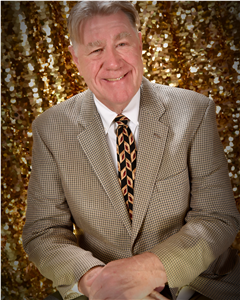
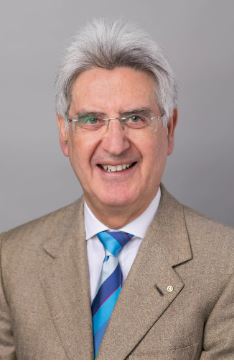
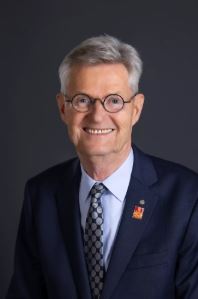
Mark Randol retired from the U.S. government in 2011 after 35 years of military and Federal civil service.
In the past 14 years, he has taught university courses in domestic terrorism and counterintelligence; lectures on aviation security at the University of Southern California and teaches a U.S. Coast Guard-certified maritime security courses. He also provides security consulting services for, among other clients, the Bank of Canada (Ottawa), the National Park Service, the Phoenix Department of Aviation, United Airlines, the Palo Alto Jewish Community Center, California’s Child Care Resource Center, and several independent schools.
In his recent U.S. government assignments, Mark was the Director of Counterterrorism Policy at the Department of Homeland Security. He also served as the senior specialist in domestic intelligence and counterterrorism at the Congressional Research Service (CRS) in Washington, D.C. Other professional assignments include serving as one of the original cadre of Transportation Security Administration (TSA) Federal Security Directors.
Mark served for 8-1/2 years in the U.S. Air Force, with assignments in Taipei, Taiwan; Stuttgart, Germany; Osan, Korea; and the National Security Agency, as well as 3-1/2 years as a civilian on the Army Intelligence Staff at the Pentagon.
He is a graduate of the University of California at Berkeley, earned a Masters Degree in Government (National Security Studies) from Georgetown University, and completed all Ph.D course work and comprehensive exams in World Politics at the Catholic University of America in Washington D.C.
Mark also gives talks to community groups on topics ranging from history, homeland security, intelligence, terrorism, cyber security, migration, immigration, and pandemic disease.
New President Lori Rodrigues Chairs the July Club Assembly!
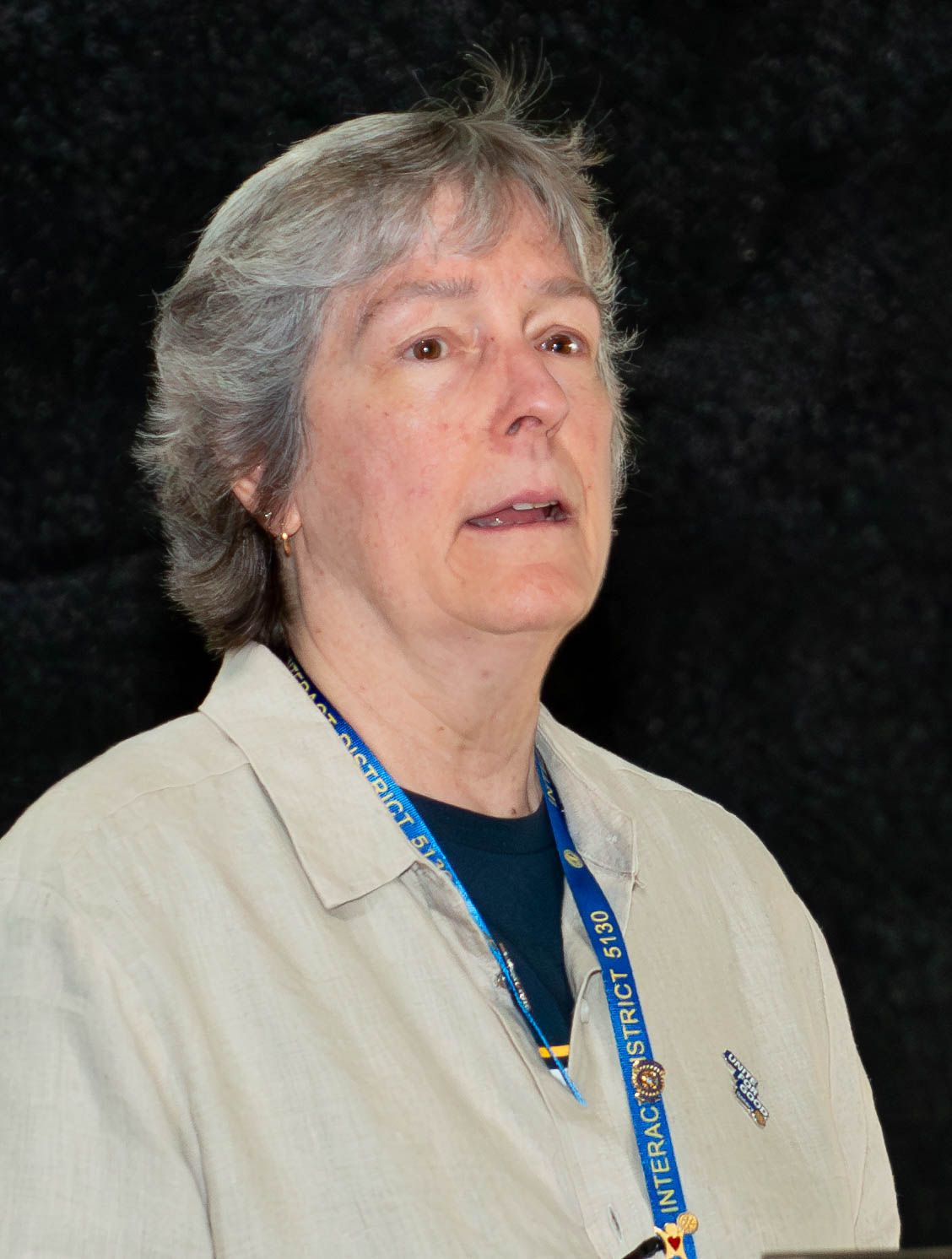
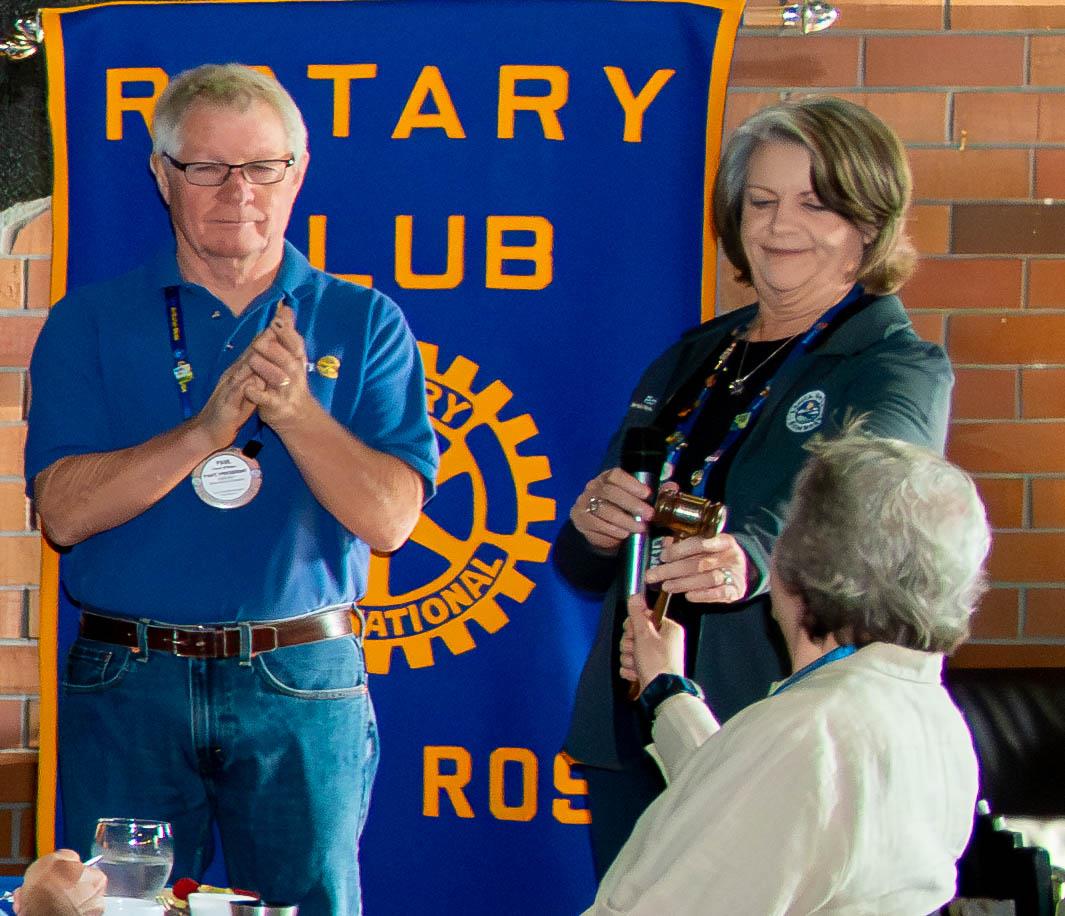
Newly ensconced Club President, Lori Rodrigues, chaired her first meeting as President on July 10, 2025. Lori also starred as presider-in-chief of the meeting’s semi-annual Club Assembly! Lori’s presentation was packed with great information. This year’s Rotary International theme is “Unite for Good.” The Rotary International President is Francesco Arezzo (who has taken over the role in place of Mario Cesar Martins de Camargo, who was unable to assume the title). The District 5130 president is Kristine Redko, a founding member of the Rotary Club of Rancho Cotati. DG Kristine’s District 5130 theme (aka “walk-up song” in baseball terminology) is “Rotary, the Music in Our Hearts.”
Lori introduced the club’s leadership team (which can be found on the Club Runner app). The team includes some new or newish faces, including Max Childs and Dan Rosaschi in their new capacities as President Elect and President Nominee, respectively, Bonny Landers (Foundation) and Rob Sanville (Club Service). We are still looking for Fundraising and Events chairs, so contact Lori if you are interested. Lori’s vision for this year is to grow the club, increase member engagement, and improve our visibility within our community. She has a couple of new activities planned, including “Coffee with the President” and a revamped, improved Progressive Dinner. She also envisions hiring a caterer to provide food for at least some of the Thursday meeting breakfasts. We will continue to offer hybrid meetings.
We also heard several reports about our club programs. Our philanthropy program will have slightly less money to give than last year. We will focus on food insecurity issues and on increasing opportunities to combine our financial resources with service projects for a more coordinated approach to helping small local nonprofits. The Fundraising team needs a chairperson so we can start assembling a planning group and assess future strategies, goals, and events. The Events team also needs a chair. Lori’s goal is to increase the number of events this year. We will be having a holiday party and a raffle party, but the new big event this year will be our 40th anniversary, scheduled for June 27, 2026 at Santa Rosa Golf and Country Club. This is going to be a really big show with lots of invitations to dignitaries and our current and historical partners, including partners from Japan. Because of the late June date for the 4th anniversary party, the debunking will take place in early July.
Lori has a goal of adding 9 new members to the club. To do that, she wants to improve opportunities to meet prospective members, secure at least one new corporate membership, and increase engagement with club members to identify and recruit new members. John Jones provided an update on the International section. Nicaragua is still out of reach. In fact, the Nicaraguan government has banned all Rotary clubs and activities in the country. Our Sabalos clinic, however, is still in operation! John is looking for other opportunities, including El Salvador, to restart our eyeglass program.
On a regular basis, our resident photo pro Warren Smith, submits pictures of what is going on at the weekly meetings. You can always find the most recent pictures at the websites photo journal called "Meeting Sighting" Please note that all the meeting photos for the entire Rotary year are at this location with the most recent on the last page.
Thanks for all the great pictures Warren!Link to Meeting Sightings. The most recent are on the last page!
A man is speeding down the highway when he sees flashing lights in his rearview mirror.
He pulls over, and a state trooper approaches his window.
The trooper says, “I’ve been waiting for you all day.”
The man replies, “Well, I got here as fast as I could!”
The trooper, trying to suppress a smile, asks for the man’s license and registration.
“Why were you speeding?” the trooper asks.
“Officer, I’m late for work.”
“Oh, and what do you do?”
“I’m a juggler in a circus.”
“A juggler? Well, that’s interesting. How about you show me what you do?”
The man agrees and gets out of the car, opens his trunk, and takes out some juggling balls.
He begins juggling right there on the side of the road.
Just then, another car speeds by, and the driver looks over, sees the juggling act, and says to himself, “I’m never drinking again! Look at the sobriety test they’ve got now!”
Francesco Arezzo is an orthodontist in private practice. He is active internationally as a member of the Italian, European, and American orthodontics associations. He is vice president of the National Association of Italian Dentists for the province of Ragusa and was the founder and head for seven years of the delegation for Ragusa of the National Trust for Italy. He is a Knight of Honor and Devotion in Obedience within the Sovereign Order of Malta.
A Rotary member for more than 30 years, Arezzo has served as vice chair of the Joint Strategic Planning Committee and as RI director, learning facilitator, and as district conference presidential representative.
Arezzo is a Major Donor and Benefactor of The Rotary Foundation. He is married to Anna Maria Criscione, an entrepreneur in the tourism field. They have two children.
You can find all prior "RI President's Messages" at this LINK
When you joined Rotary, chances are it was because you wanted to make a lasting difference. Arch Klumph felt the same way.
When he proposed The Rotary Foundation in 1917, he envisioned more than just a fund. He saw an enduring vehicle for Rotary members to serve their communities and create lasting change. More than a century later, that vision thrives, thanks to your dedication and to the Foundation’s unique structure, which empowers members to identify and solve global problems at every level.
Today, I am not asking you for a donation. Instead, I invite you to look at The Rotary Foundation with fresh eyes. Imagine a charity governed by its own members. A global mission carried out by those very members. A foundation that reflects the shared values of its members — ensuring clean water and literacy for all, eradicating the scourge of polio, building local economies through entrepreneurship, and making the world more peaceful through conflict resolution training.
Doesn’t this sound like an interesting charity? The Rotary Foundation is trusted around the world because we have earned that trust. After our successful Programs of Scale initiative in Zambia, the Gates Foundation and World Vision invited us to lead again — resulting in the $30 million Rotary Healthy Communities Challenge across four African nations.
We are efficient, strategic, and guided by dedicated professional staff and passionate volunteers. Our Foundation consistently receives top marks from Charity Navigator. And the Gates Foundation matches our $50 million annual commitment to polio eradication 2-to-1, depositing $100 million into our account each year. That is trust, delivered.
Even in conflict zones, we are there. In Gaza, a single confirmed polio case triggered a humanitarian pause in the war, allowing health workers to vaccinate children and quell an outbreak. Rotary helped fund that urgent response. Once again, we proved to be a reliable partner in a crisis.
We can be proud that we made a difference. Now we look ahead to our ambitious $500 million fundraising goal for 2025–26. We can reach it together, as we boldly support a Foundation that is doing bold things.
Rotary is not going anywhere, because Rotary is everywhere! That is our strength. That is our unique opportunity. Be part of the legacy of The Rotary Foundation. It is one that Arch Klumph would be proud of. It is a legacy that has changed the world and will continue to do so, as long as we are all part of it.
You can find all prior "Messages from the Foundation Trustee Chair" at this LINK
At their Chicago home, Rotary’s founder and his wife welcomed visitors from around the world
By Paul Harris
One winter day I was walking on Longwood Drive in a suburban district in Chicago. The drive skirts a hill spoken of as “the Ridge,” which extends for several miles in a southwesterly direction, an unusual feature in Chicago as most of the city lies on flat ground. The houses on the west side of the drive are built on the crest of the hill which parallels it.
On that particular day, the hill was covered with snow and many youngsters were coasting without regard to the property rights involved. No property owner, however, seemed disposed to question the rights of the youngsters to make common ground of their hillside lawns.
The picture seemed so true to the New England life I had known and loved that the thought came to me if ever I was to have a home of my own, it would be on the top of the hill on Longwood Drive. The time came sooner than expected. It was on one of the countryside hikes of the Chicago Prairie Club that I met a bonnie Scottish lassie who, dismayed by a rip in my jacket, offered to repair it for me. That was how she got in trouble for it wasn’t long after that when I persuaded Jean Thomson to become Mrs. Paul Harris.
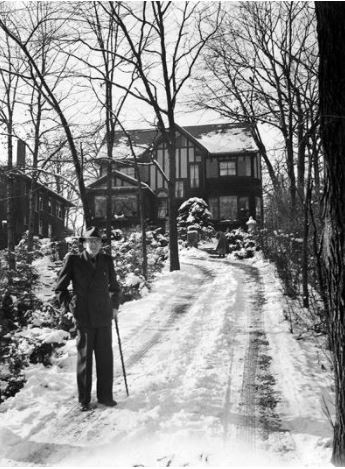
Paul Harris stands in front of Comely Bank, the home he and his wife, Jean, shared for 35 years.
I married my bonnie Jean in 1910, and two years later, acquired a home on the hill. We named our home “Comely Bank,” after the street in Edinburgh where Jean spent the days of her childhood and youth, and never, during the thirty-odd years of our ownership, has any boy ever been refused free use of our lawn when coasting times come.
How could I refuse them! Like my mischievous boyhood friends, they are rapscallions one and all! During this Second World War many of them have been fighting for us on foreign soil, on the seas and in the skies, far, far from home. God bless and protect the rapscallions of our beloved land!
The great city comes nearer and nearer to us as its population increases and, as the years roll on, we can almost feel its breath. We are still on the outskirts, however, and ten minutes in our motor car suffices to take us into the Illinois farming country where wheat and corn fields, pastures and woodlands give us a feeling of having made good our escape.
Diagonally across the drive from our home, there was, in the early years of our married life, an ideal bird refuge of which we were very proud. The entire block was covered with a growth of wild crab apple trees so dense and so studded with long, sharp thorns that it afforded the birds ample protection from cats and dogs. As a refuge, it was especially popular with the robins that remained there during the mating and nest-building period. Thousands of them made their appearance and took up temporary quarters each spring. The air would be full of song.
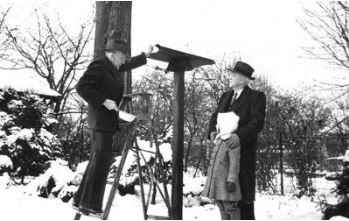
As neighbor Silvester Schiele watches, Harris fills his bird feeder.
Just why these discriminating creatures considered this Heaven-made protection undesirable for permanent residence, I have never been able to determine. No robin, to my knowledge, ever thought of building a permanent nest in the crab apple trees on Longwood Drive. They were all prospective papas and mamas and I imagine that the prospective papas like to give the prospective mamas the once over, and then, having made their selection, hie away with the ladies of their choice to find homes far from the madding crowd of robins.
One morning, after the birds had left on their home finding expedition, tractors dragged the trees out by their roots; not one remained as the day drew to a close. When the robins returned and witnessed the depredation committed during their absence, they were distracted. The tumult of whirring wings and their cries were deafening. One could imagine that in bird language, they were crying, “robbers! robbers! These rapacious humans have not only pillaged our houses but they have actually taken our houses along with them; did you ever hear of such things!”
Within ninety days from that time, an apartment building, affording homes for five hundred human beings, had been erected where once a bird sanctuary had been. The structure was beautiful and the property well landscaped, but where had our privacy and our feeling of being “country folks” gone? Well, we had to make the best of it and we did. We found compensation in the thought that nearly five hundred human beings had made their escape from the noise and confusion of the city and that the twinkling lights from scores of windows would throw out a certain friendliness of their own.
My wife and I have tried to make the best possible use of Comely Bank. We have entertained scores of Rotarians from all parts of the world, sometimes seating at our table guests from as many as eight different countries at one time. In honor of our guests, we have planted many trees in our friendship garden, and, in many instances, guests so honored have passed to the Great Beyond, but the trees still stand as memorials to our friendship.
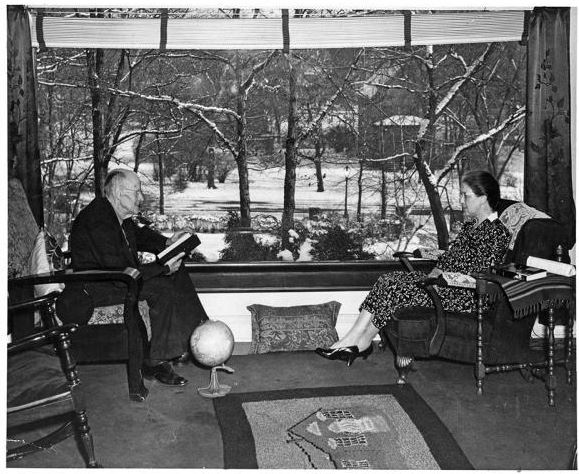
Paul and Jean enjoy a quiet moment at Comely Bank.
So here we are at the end of our journey, and Jean and I are sitting at our fireside drinking a cup of tea. One who marries a Scottish lady must acquire the habit of sitting at the fireside and drinking black tea, and indeed it is a delightful break in the cares and duties of the day. If the tea is good and the fire burns merrily, one enjoys recreation and rest. It’s a good way to end the day.
At our fireside scores of friends from all corners of the globe have delighted us by their presence. They have come as the result of my planting a sapling in 1905. The first Rotary club was that sapling. It has grown into a mighty tree in whose shade it is delightful to dwell.
Tonight my thoughts most naturally drift. No one knows how long such thoughts might have continued had not Jean’s voice broken in. “Why, I declare! I believe you have been asleep, Paul; wake up and drink another cup of tea; the fire is burning low and we must soon be in bed.” So goeth life at Comely Bank.
Adapted from My Road to Rotary: The Story of a Boy, a Vermont Community, and Rotary by Paul P. Harris, published posthumously in 1948. Access the original text at on.rotary.org/MRTR.
This story originally appeared in the July 2025 issue of Rotary magazine.
On your next trip to Chicago, visit Paul Harris home.


.png)