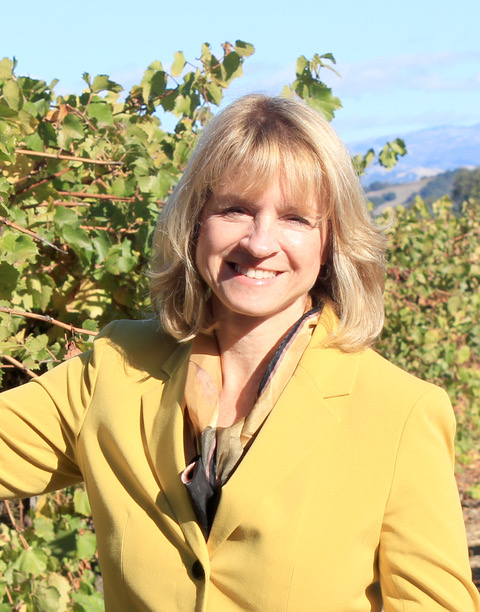
Claudia Vecchio brings more than 25 years in the destination and consumer marketing arena to her post as President/CEO of Sonoma County Tourism. During her three years with the organization, she has led the development a multi-year strategic plan now in its second iteration, launched a new destination brand: “Sonoma County: Life Opens Up” and evolved positioning to focus on sustainable travel and destination stewardship. Managing a series of crises including wildfires, flooding and the COVID-19 pandemic, Claudia has guided the regional tourism industry through the event and into successful recovery efforts.
Our guest speaker for March 11, 2021 was Dr. Phil Rasori, speaking on behalf of Village Hopecare International. Phil is the current and long-time medical director for Village Hopecare. He is also a Healdsburg resident and physician who became involved in 2000 with the founding of Village Hopecare. Village Hopecare focuses on public health and micro enterprises (providing small loans and business training for sustainable businesses) in Chogoria, Kenya. The company was started by Dr. Mugambi, Phil, 12 African women, and $5,000 right here in Sonoma County! The company currently has $300,000 clients, 831 employees and an annual budget of $1,200,000!
The original plan to hatch the company started at a wine tasting event near Oakmont when Phil and Dr. Mugambi got together to try to do something for an economically depressed area in Kenya. Phil flew to Africa with $5,000 to start a microenterprise bank patterned on a Rotary Plan. They loaned $400 to each of the 12 women, who used the money to jumpstart businesses. They received their first major donation of $42,000 from Rotary International! Nevertheless, the company struggled to continue its work. Things started to turn around in 2012. By 2014, Village Hopecare had 237 people working in its health programs, with a focus on clean water, food, and teaching villagers to use soap! By the time of the Covid shutdown in 2000, Village Hopecare had 200 community health workers. They launched a frontal attack on Covid, putting 237 people in the field to educate residents about how to prevent the spread of Covid, largely using a flip chart developed by Phil and others (including mostly his daughter!). The health care workers go door-to-door throughout villages and cities to show how to limit the spread, focusing on cleanliness, social distancing, and wearing masks. They have now had over 2,000 consultations in people’s homes!
They are taking Village Hopecare national throughout Kenya. The Ministry of Health assigned 600 additional health care workers to Village Hopecare, and they are continuing their door-to-door campaign, as well as using technology to create a virtual classroom for training purposes; how to use the flip charts and how to attack public health care problems.
Well done Phil. What a great and amazing enterprise and thank you for sharing your passion with us!
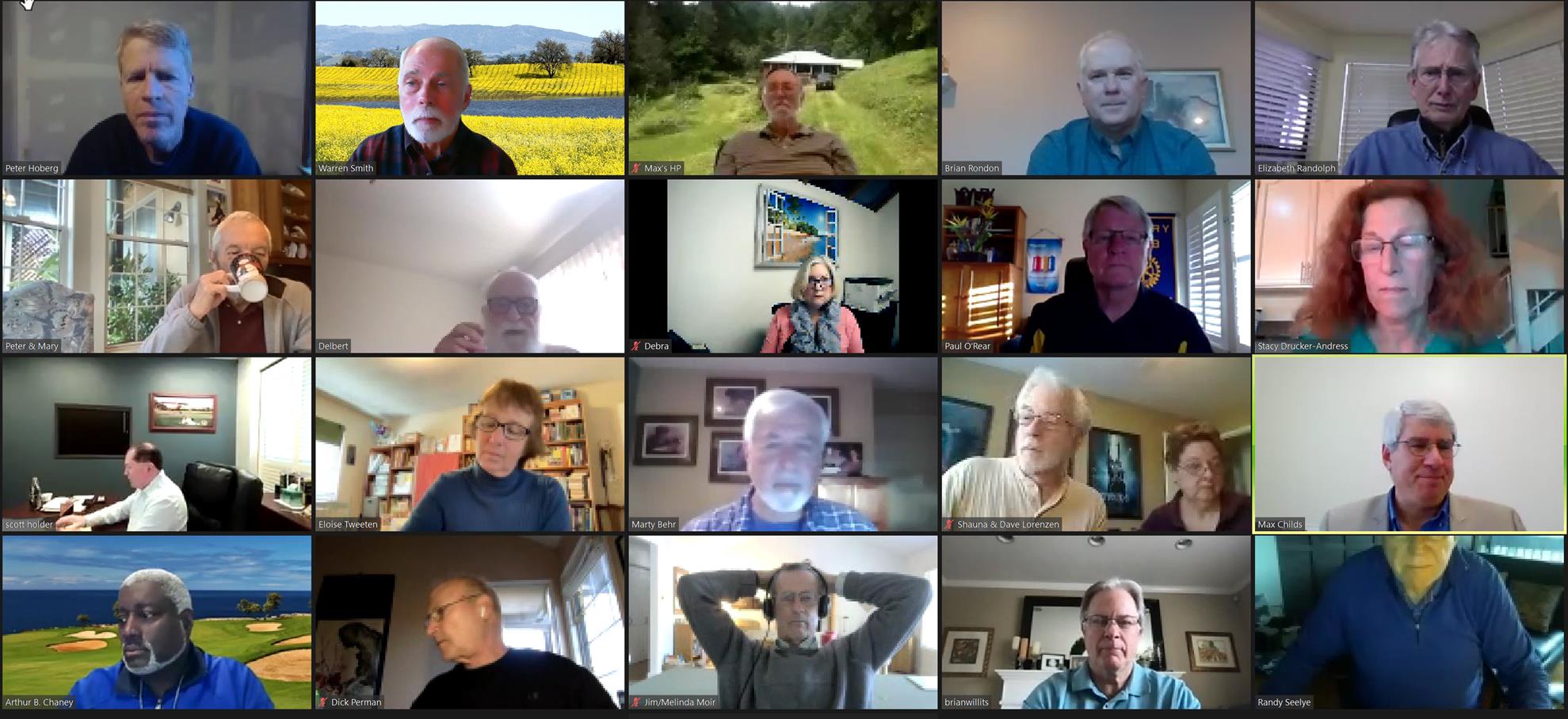
View the Zoom recording HERE! It will be available for the next week or so.
On a regular basis, our resident photo pro Warren Smith, submits pictures of what is going on at the weekly meetings. You can always find the most recent pictures at the websites photo journal called "Meeting Sighting" Please note that all the meeting photos for the entire Rotary year are at this location with the most recent on the last page.
Thanks for all the great pictures Warren!Link to Meeting Sightings. The most recent are on the last page!
Elsie Allen High School Teacher Grant Recipient says "THANK YOU"
Santa Rosa Sunrisers
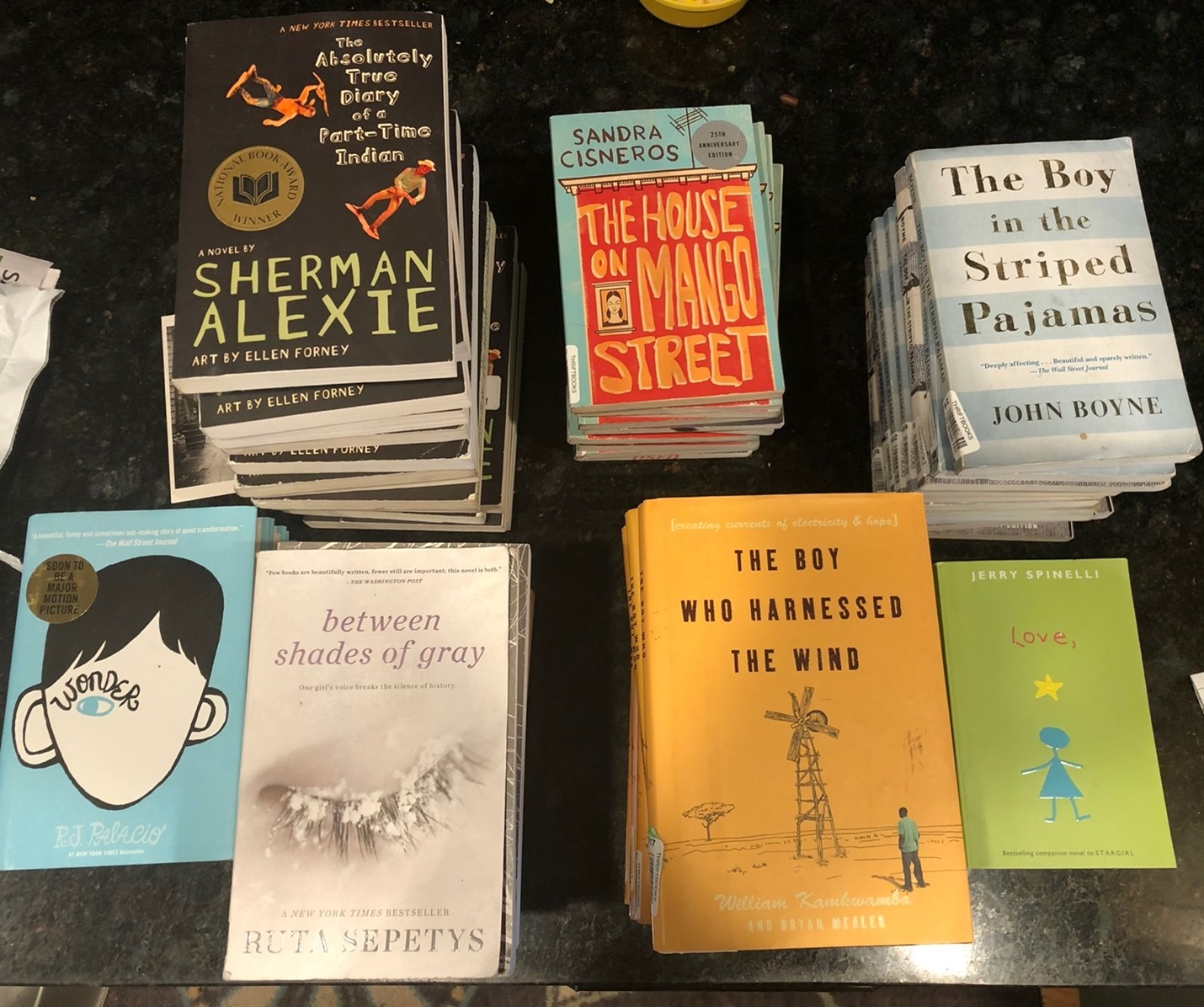
“I wanted to share this photo since a majority of my book order arrived today! I am so grateful for the (SRS Rotary) Teacher Grant, my heart is so full! I can’t wait to share these books with my students!
Thank you, again!”
Kristen Duerr, Education Specialist, Elsie Allen High School
Kristen Duerr - $500 | Special Day Class Novels & Book Support
Department: Special Education
My Special Day Class students hover between a 1st and 4th grade reading level and because of this it is very difficult to find books that are both interesting and accessible for our youth. This grant will help me purchase class sets of books that are high-interest and low readability in order to foster a love of books and reading. Many students in my class have never read a novel, let alone completed one on their own. I am hoping to broaden the range of topics I have available for students -- thank you Santa Rosa Sunrise Rotary!--
PS: To continue your support and learn more of our remarkable Education Partner join us for their FIESTA 2021 March 25 via Zoom!!
.MJ. Girard is currently an on air personality on KOWSfm.com His “Roots of Rock” is broadcast every Sunday morning at 7
A four octave range…unheard of in most singers, yet this singer could effortlessly reach the highs of opera stars and slide into mid range without batting an eye. Who is this amazing singer? This Caruso of Rock? One who signed up to Sun Records along with Elvis, Charlie Rich, Jerry Lee Lewis to mention just a few of his recording mates.
The Big “O” …Roy Kelton Orbison, singer, songwriter and musician, known for his impassioned complex emotional ballads. Although stage shy, wearing dark sunglasses to avoid eye contact with his adoring audience he sang from his very soul, touching his listeners deeply with his vulnerability.
Orbison began as a rockabilly and country western singer in high school in Vernon Texas, later signing with Sam Phillips, founder of Sun Records in 1956, his greatest success came however after signing with Monument Records in 1960. Twenty-two of Roy’s releases reached the Top 40 of Billboards charts. He wrote or co-wrote all of his Top Ten hits. “Only The Lonely” (1960), “Running Scared” (1961), “Crying” (1961), “In Dreams” (1964) and “Pretty Woman” (1964).
Roy suffered a string of personal tragedies in the mid sixties causing his career to falter, however, after other singers covered his songs in the 1980’s, Orbison experienced a resurgence in popularity, co-founding the “Traveling Wilburys” which included George Harrison, Bob Dylan, Tom Petty and Jeff Lyne.
Sadly, Roy Orbison died of a heart attack in December 1988 at the age of 52! His song “You Got It” released after his passing reached the Top Ten, his first in a quarter of a century.
Roy Orbison will be the featured artist 21 March. Everyday is a “Holiday”…waste not one moment!
Two hunters are out in the woods when one of them collapses. He doesn't seem to be breathing and his eyes are glazed. The other guy takes out his phone and calls the emergency services.
He gasps: "My friend is dead! What can I do?" The operator says: "Calm down, I can help. First, let's make sure he's dead." There is a silence, then a gunshot is heard. Back on the phone, the guy says: "OK, now what?"
Situated in the Thai highlands not far from Myanmar and Laos, Chiang Mai is home to around 130,000 inhabitants, and its balmy climate and low cost of living have made it a top destination for expatriates, including digital nomads and retirees. According to some estimates, there are about 40,000 expats living in the city, many of whom are from the United States.
Since 2012, Gordana Nardini, a retired English-language teacher who is originally from Croatia, has spent much of each year in Chiang Mai. She fell in love with the city, she says, because it is close to Myanmar, where she spent several years in her youth when her father worked as a trade promotion officer in the city of Yangon, and because Chiang Mai’s multinational populace allows her to use many of the seven languages she speaks.
Nardini had been a member of the Rotary Club of Zagreb-Centar, Croatia, since 2000. In Thailand, she began attending meetings of the Chiang Mai International club to keep up her attendance but eventually decided to join outright. “In Croatia, my club was well established, while the club in Chiang Mai was struggling with membership,” she says. “I saw that I could do so much here.”
A year ago, Nardini was planning to leave northern Thailand for a few months, as many of the region’s expatriates do at the beginning of what is known as the “burning season” — when farmers outside the city of Chiang Mai burn over their fields.
“We have some of the most polluted air on the face of planet Earth during burning season,” says Roger Lindley, the current president and a charter member of the Chiang Mai International club. “They burn the fields and the surrounding forests for mushroom production.”
But realizing that Thailand was doing much better than Europe when it came to controlling COVID-19 infections, Nardini changed her mind at the last minute. “I canceled my flight,” she says.
As it turned out, many flights were canceled. In June, Nardini managed to get a rare flight out, but then she couldn’t get back. Neither could five other members, who were stranded in places like Grenada, Portugal, and the U.S.
Vital statistics
1930
Year Rotary started in Thailand; Purachatra Jayakara, prince of Kampaenbejra, was the charter president of the Rotary Club of Bangkok
1296
Year Chiang Mai, which means “new city,” was founded by King Mangrai
“Open access to Thailand did not exist,” says John Schorr, a past club president and a retired professor of sociology at Stetson University in Florida, whose wife is from Thailand. “Many of our members chose to leave in March and April with the intention of coming back in May or June.”
In April, the club began holding its regular meetings online — and those virtual meetings turned out to be a lifeline for a club that has always struggled with membership.
“Chiang Mai is a big retirement community for Westerners,” says Nancy Lindley, club treasurer. Lindley and her husband, Roger, both mechanical engineers who ran a specialty greenhouse in Michigan before retiring, moved to Chiang Mai in 2008. “So we have a very transient population. There are people who are here just for a year or two. Every year we have quite a turnover in our membership, which other Thai clubs don’t have to deal with.”
“That’s a challenge for maintaining continuity, leadership, and our sense of purpose,” adds Roger Lindley. “At one point, we were at almost 50 percent turnover per year.”
Recently, the club addressed the problem by instituting a special passport membership that allows people who have an interest in the club’s mission, or a connection to Chiang Mai, to join whether or not they live in the city. Even after the Thai government eased its lockdown to allow in-person gatherings at reduced capacity in late June, the club waited till July to start meeting in person again. It also opted to keep one monthly Zoom meeting so that passport members, along with members stranded abroad, could attend.
The club focuses on improving children’s health and education in northern Thailand, which falls under Rotary’s Area of Focus, saving mother and children.
Since its beginning, the club’s focus has been on improving children’s health and education in northern Thailand. After chartering in 2014, the club raised funds to support a clinic that provides medical care for some of the nearly 100,000 migrants who have fled conflict between the government in Myanmar and eastern ethnic groups. Members also worked with the BEAM (Bridging Educational Access to Marginalized People) Education Foundation and started a vision screening program in local schools. But perhaps one of the club’s most important projects is also one of the simplest: teaching local children how to swim. “It may not sound like an important thing,” says Schorr, “but drowning is the leading cause of death for children in Thailand, more than dengue fever, more than anything else.”
So far, some 2,000 kids have learned to swim through the program, which makes sure every fourth grader in Chiang Mai municipal schools gets 15 hours of swimming instruction. The program has been so successful that the Rotary Club of Patong Beach on Phuket, an island in southern Thailand, has adopted it; seven schools in the nearby Phrao district of Chiang Mai province are also participating, with the help of the club and funds from the local British community.
When they expanded the program to the Phrao district, members learned that two students had drowned there just weeks before, Roger Lindley says. “That kind of gets to you,” he says. “When you think about how kids can’t swim, and they’re drowning in drainage ditches and canals, with one kid trying to save another, or parents trying to save their kid, you know you’re doing some good. You know we’re making a difference.”
— FRANK BURES
• This story originally appeared in the March 2021 issue of Rotary magazine.
Rotary Club of Santa Rosa Sunrise - Founded June 30, 1986

.png)

.jpg)