Rotaract: 50 years of changing lives
50 years ago, the first Rotaract club was formed to give young adults a place to connect and take action for good. Rotaract members from each decade share what the program was like and how it shaped their lives.
By Arnold R. Grahl
The year is 1968.
A wall divides East and West Berlin, as the Cold War rages on. The U.S. and the Soviet Union are locked in a space race, and Apollo 8 becomes the first manned spacecraft to orbit the moon, sending back pictures of Earth from deep space.
And Rotary members in North Carolina, USA, charter the first Rotaract club, to provide young people opportunities for service.
A half-century has passed since those first Rotaract clubs began inspiring young leaders to take action to improve their communities. The world has changed, as has the way Rotaract members connect with one another. But the underlying values of the program, and what attracts people to it, remain remarkably the same.
To celebrate Rotaract’s 50th anniversary, we asked former Rotaractors from six decades to share their experiences of the program and explain how it shaped their lives.
Here are their stories.
1960s
Geetha Jayaram, a pre-med student in Bangalore, India, became charter secretary of an early Rotaract club in 1968. Her father was an influential businessman in the city, and he and his friends believed the program was the perfect place for their college-age children.
“They encouraged us to join as a group,” recalls Jayaram, who met her husband, Jay Kumar, the charter president, through the club. “We were all very happy to do it, because we were medical students, engineering students, and students of other vocations who got together and planned what projects we wanted to do. What enabled us to stick together was that on weekends we went around collecting funds for our projects and worked together.”
Within a year, Rotaract was already so established in India that a district conference in 1969 drew thousands. Jayaram believes the program took off so fast there because the need for helping others was so evident.
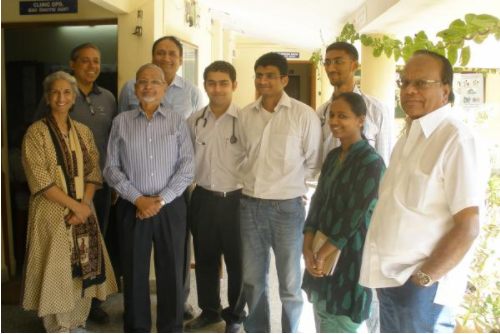
Geetha Jayaram, left, pictured at one of the health clinics she founded in India, was a charter secretary of a Rotaract club in 1968.
“It was visible, tangible,” she says. “It was not something you thought about doing for somebody in some faraway country. It was right there in front of you.”
Rotary’s Four-Way Test, with its reference to “the truth,” also appealed to young people.
“We were post-independence children and Gandhi followers, and speaking the truth was a big thing in those days,” she says.
Jayaram says Rotaract benefited from Rotary’s reputation as a well-respected organization in India. People felt proud to belong to it. Participating in Rotary was a family activity, so many young people grew up experiencing Rotary events.
“Every time we’d go to some picnic or concert or competition, there were always adults with children involved with all of the games and activities and food preparing,” Jayaram says.
After finishing her bachelor’s degree, Jayaram came to the United States to pursue advanced degrees in medicine. She joined a Rotary club in Maryland in 1997 and founded the Maanasi Clinic in Mugalur, Karnataka, India, to provide mental health services to indigent women there. A former recipient of a Rotary Grant for University Teachers, she was awarded the Rotary Global Alumni Service to Humanity Award in 2014-15. She is an associate professor in the departments of psychiatry, public health, nursing, and the Armstrong Institute for Patient Safety and Quality at the Johns Hopkins School of Medicine in Baltimore.
“I’m really proud I’m a Rotarian,” she says. “At Johns Hopkins, I always talk about my humanitarian work and how Rotary has enabled me to do so much with very little overhead. It’s hard to find that anywhere else.”
1970s
Lunar rovers explore the surface of the moon. Skylab begins orbiting the Earth. The Vietnam War comes to an end. In Sudan and Zaire, the first outbreak of the Ebola virus occurs. On the entertainment front, the movie Star Wars premieres. The first videocassette recorders enter the market, and Sony introduces the Walkman. Disco becomes popular.
John Skerritt helped charter the Rotaract Club of Carlingford, New South Wales, Australia, in 1978, after reading a newspaper advertisement placed by local Rotarians wanting to start a Rotaract club.
“That was the way you did it before the internet or cable TV,” Skerritt says.
The new club drew young people from many backgrounds. In Australia in the 1970s, Skerritt says, a significant number of teenagers left high school early to pursue a job in the trades, and fewer than today went on to college. And for economic reasons, many tended to live with their parents until they married or had established themselves in a career.
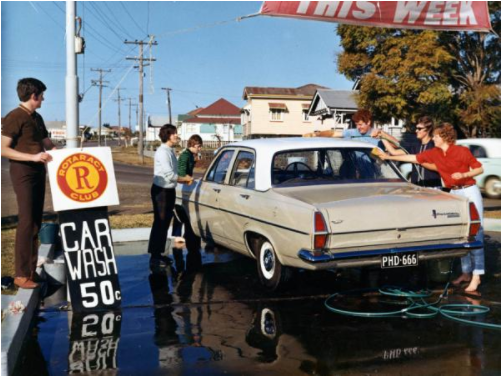
The Rotaract Club of Ipswich, Queensland, Australia holds a car wash as a club fundraiser in the early 1970s. Rotaract drew young people from many backgrounds.
“The area where we chartered was on the border of an affluent area, where most of the kids went on to college, but also an area that was more working class,” he recalls. “One of the exciting things about it was you actually got to meet people outside the social circles of your own suburb or high school.”
Another interesting aspect, he says, is that the club functioned as matchmaker. “We had probably seven or eight couples get married,” says Skerritt. “We had a pretty even number of boys and girls. I wasn’t one of the seven, but I went to many of their weddings and served as best man in some.”
In some ways, he contends, young people had more freedom then. He recalls two club fundraisers, one where Interact members sat on a platform on top of a pole for 100 hours, and another where the Rotaract members drove cars in a demolition derby.
“Can you imagine a club doing that now?” he asks.
But it wasn’t all social. Members were also keenly interested in helping their community. “Bringing in speakers was a great way of exposing people to things, especially our members who’d had a more sheltered upbringing,” he says. “We had a speaker from a charity that looked after homeless people, and that was actually a great eye-opener. Many times we’d follow up with a fundraiser, like tossing burgers at the mall to raise money for the homeless.”
One charity his club supported ended up having a big influence on his career. The organization helped people with hard-to-treat epilepsy who lived in a specialized care community. Skerritt went on to research seizure medications as part of his doctoral studies, and today he is therapeutic goods administrator in Australia’s Department of Health.
1980s
Ted Turner announces the creation of CNN. IBM begins releasing personal computers. India Prime Minister Indira Gandhi is killed by two of her bodyguards. Mikhail Gorbachev becomes leader of the Soviet Union, and the policies of glasnost and perestroika transform world politics. A nuclear accident occurs at Chernobyl. The Berlin Wall falls in 1989. Arcades are jammed with people playing Pac-Man, while elsewhere folks fiddle with the Rubik’s Cube.
In Colombo, Sri Lanka, in the early 1980s, most things shut down by 7 p.m. TV was still relatively new, and people did not own their own computers. As a result, young people turned to Rotaract for their nighttime entertainment.
Nafeesa Amiruddeen and her husband were invited to join Rotaract by another young couple they knew. “I lived with my in-laws, and they would look forward to having this group of young people over,” says Amiruddeen. “Almost every evening, we would sit for two or three hours, having little bits of snacks and tea, sometimes a meal. You formed bonds that never go away. It’s been almost 40 years now, and we still pick up where we left off.”
At the time, since they were in the same district, Rotaract members from Sri Lanka and southern India traveled back and forth between the countries for regional assemblies and training events. This promoted cross-cultural understanding. Rotaract also served as a unifying force during Sri Lanka’s civil war.
“As Rotaract members, we were able to rally around and help quite a bit,” Amiruddeen recalls. “A lot of our members were affected by the conflict. But we were so close that although we all belonged to different minority groups, you could never tell it. We helped each other, we helped other clubs, we helped the community at large by organizing groups to go out and take food to families that could not go out of their homes.”
“When you think about it today, we, as a nation, are all about reconciliation, forgiveness, putting it in the past,” she says. “I think in Rotaract, we were doing it almost as soon as the conflict happened.”
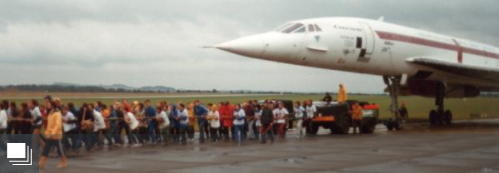
Rotaractors in England pull the Concord down a runway as a fundraiser and publicity effort.
In the early 1980s, Richard Blackman witnessed some of those unifying forces as a member of the Rotaract Club of Dover, England. His favorite memory involves helping a group of Rotaractors from the Netherlands cross the English Channel in their unique amphibious vehicle. The event was a fundraiser for Rotary’s relatively new campaign to eradicate polio, and it involved a large vehicle that seated more than two dozen Rotaractors who provided pedal power for propulsion.
Blackman helped make arrangements for the Dutch Rotaractors in London and put them in touch with a Rotarian who could get them access to the Hover port in Dover so they could get their vehicle into the water.
“There was a piece in one of the magazines with a picture of them cycling across the English Channel, and talking about this group of Rotaractors who didn’t understand that it couldn’t be done,” Blackman recalls. “And that pretty much summed up Rotaract. We rarely took no for an answer. In my experience, both then and now, Rotaractors are very forward thinking and very much have a can-do mentality.”
“Most young people, in my experience, want to help others,” he adds. “It’s a case in a lot of instances of not knowing how to do it. Rotaract is an ideal opportunity to enable them to do something that they want to do but don’t know how.”
1990s
German reunification in 1990 ends 45 years of separation. Lech Walęsa becomes the first president of Poland since the end of World War II. The Soviet Union collapses on Christmas Day 1991. Nelson Mandela is released from prison and becomes president of South Africa four years later. The Hubble Space Telescope is launched. Pathfinder sends back images of Mars. The internet grows exponentially. Every kid wants a Furby, and Pokémon and Power Rangers rule.
Two monumental world events shaped Cyril Noirtin’s experience with the Rotaract clubs of Nancy and Paris Royale in France: the opening of Eastern Europe after the fall of the Berlin Wall in 1989, and the advent of the internet.
The Rotary district in western Europe was in charge of extending Rotary into Ukraine, and Noirtin was asked to establish Rotaract there.
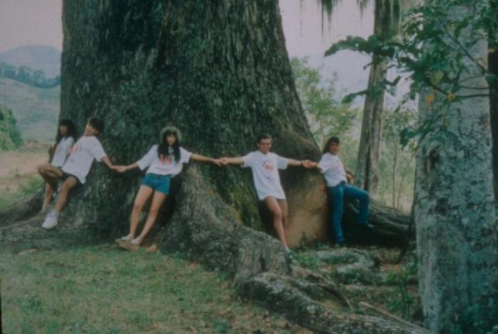
Rotaractors in Brazil circle a tree in 1993 for World Rotaract Week.
“We started from nothing,” he recalls. “We met first in Ukraine, which was just discovering the free world. It was interesting to build something together from scratch and see it evolve. They were eager to get in, and motivated like no one else I’d seen.”
The internet also began to connect the world. “When I joined, to communicate with other countries, you sent letters. If you were lucky, you had a fax,” Noirtin said. “By the end of the decade, most clubs had websites and email, and people were starting to speak of social media.
“It’s helped us reach out to others,” he adds. “Rotaract was almost a secret from Rotary. Most Rotarians didn’t know we existed, and I would meet some Rotarians who didn’t think Rotaract was a good idea. Ten years later, nobody questioned the value of the program.”
CEO of a private university in France and a Rotary representative to UNESCO, Noirtin says his experience in Rotaract benefited his career.
“I am convinced I would not be where I am today without my Rotaract experience,” he says. “It has also helped me as a manager and leader. And it has been a great opportunity to meet people from different cultures and make friends I would never have met otherwise.”
2000s
The Y2K bug is less devastating than predicted. Russians and Americans work on the International Space Station. A working draft of the human genome is published. Terrorists attack the World Trade Center and the Pentagon. The U.S. invades Afghanistan. The euro is introduced in 12 countries. Facebook is founded by Harvard student Mark Zuckerberg, YouTube and Twitter launch, and Apple releases the iPhone.
Andrea Tirone recalls cozy meetings in the Hart House student center during her early years as a Rotaractor at the University of Toronto.
“You stay together after the meeting and just talk about things that interest you, whether it’s Rotary-related or about your classes or work,” she says. “And you form friendships easily with these people you probably wouldn’t have met otherwise.”
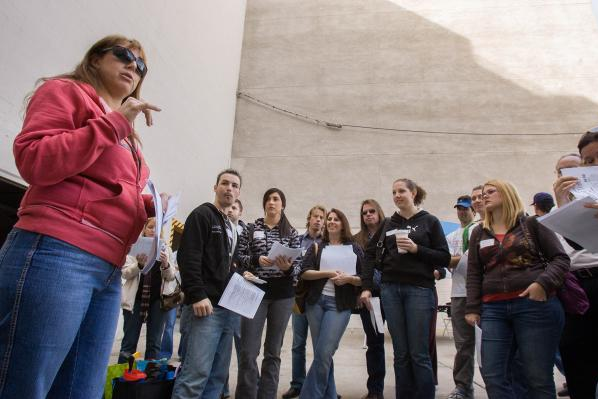
The Rotaract Club of Downtown San Diego, California, USA, prepares for a life skills event in 2008 that provides professional development and leadership training.
Selected for an Ambassadorial Scholarship to South Africa in 2009-10, Tirone helped charter the Rotaract Club of Berea while there. But before she left, she attended the 2008 Rotary International Convention in Los Angeles, which changed her perspective of the organization.
“It was almost like a different chapter of Rotary started for me after Los Angeles,” she recalls. “I think being in LA and seeing the truly global reach of Rotary made me realize that it doesn’t matter where I am in the world, I can still be a part of Rotary.”
Social media and smartphones began to transform Rotaract in Tirone’s later years with the program. “When I started, Facebook had only just come into existence and was still very exclusive,” she says. “There were no pages or groups. No Twitter or Instagram. Certainly social media and the ability to be connected so quickly and easily with others has opened up new opportunities for projects and project ideas. Whether you are working as partners or forwarding ideas, it is completely different. With the connections I have now, I am never not next to my good friends in Rotaract.”
2010s
As it begins its second half-century, Rotaract remains as appealing as ever to young people, says Laura Verdegaal, who, as a member of the Rotaract Club of Gooi- en Vechtstreek in the Netherlands, participated in a panel in December via Facebook on the state of Rotaract.
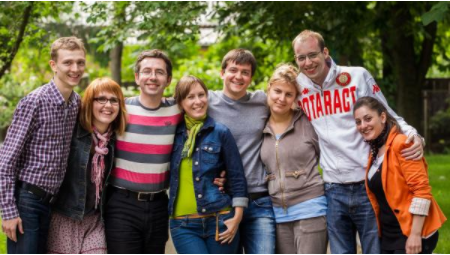
Rotaractors in Ukraine in 2012.
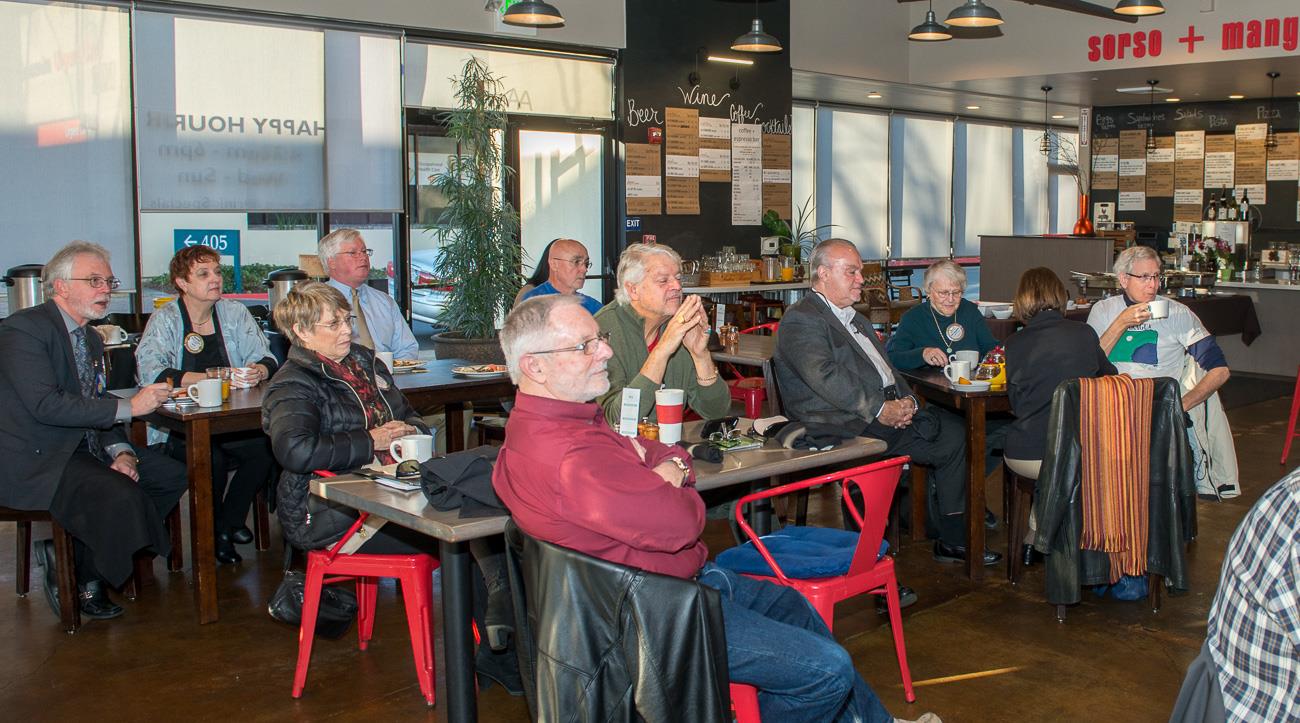
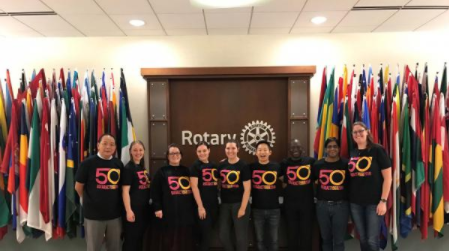
Members of the Rotaract and Interact committee wear their 50th anniversary celebration shirts for a committee meeting in 2017.
“I think in ways it’s even more relevant, as there is a movement back from globalization to knowing where your food and goods come from and knowing people in your local community who share your values,” she says.
Verdegaal sees Rotary and Rotaract clubs enjoying a more equal and fruitful partnership, one in which members of Rotaract collaborate in decision making and planning, rather than serving in a subservient role. She cites a large project in her district where Rotaractors with web skills provided the main direction for the design and content of the project’s website.
“If you want to serve your community on a local level, Rotaract is for you,” says Verdegaal. “When you want to develop your leadership, presentation, or organization skills, or if you are into traveling and meeting people from different cultures and backgrounds, it’s a great opportunity.”


.png)
.jpg)
.jpg)

.jpg)
.jpg)




.jpg)
.jpg)
.jpg)