Tani Cohen was the featured speaker at our meeting on January 28, 2021, presenting “The Evolution of Technology in Baseball.” Tani is employed by Major League Baseball as its Manager of Data Quality. He has spent his professional career in various baseball-related jobs, including working as an advance scout and in player development for the Boston Red Sox and New York Yankees. He also worked in advanced analytics for teams and for a private company, TrackMan. He is the nephew of Dick Perman, who introduced him for the presentation.
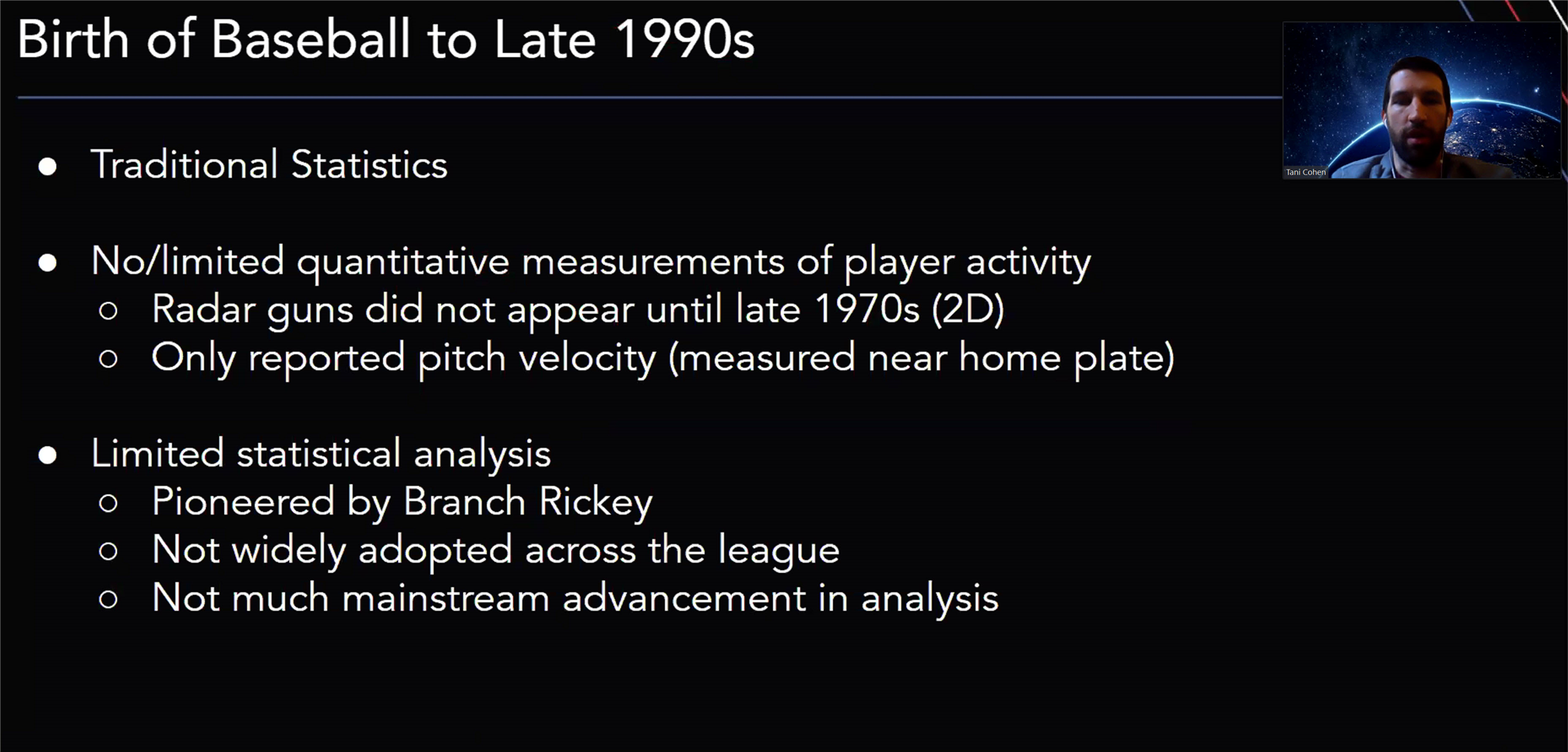
Tani jumped right into the evolution of data technology in baseball, from the beginning of the modern age to the present. Traditional statistics such as Earned Run Average and Batting Average were the focus during the early days of baseball. In the 1970’s radar guns were introduced but were not yet 3D. Radar guns gave only the speed of a thrown pitch at one specific point in the baseball’s path. Branch Rickey, a Brooklyn Dodger’s executive (who signed Jacky Robinson), was one of the first baseball executives to pioneer advanced analytical data. Rickey is credited with creating the “Moneyball” approach later made famous by the Oakland Athletics in 1991. The Moneyball approach was made possible with new computer technology that could quickly analyze data. Due to the mainstream use of data analysis after Moneyball, there was a renewed focus on putting players in situations to succeed instead of putting out a lineup of nine guys everyday- situational optimization.
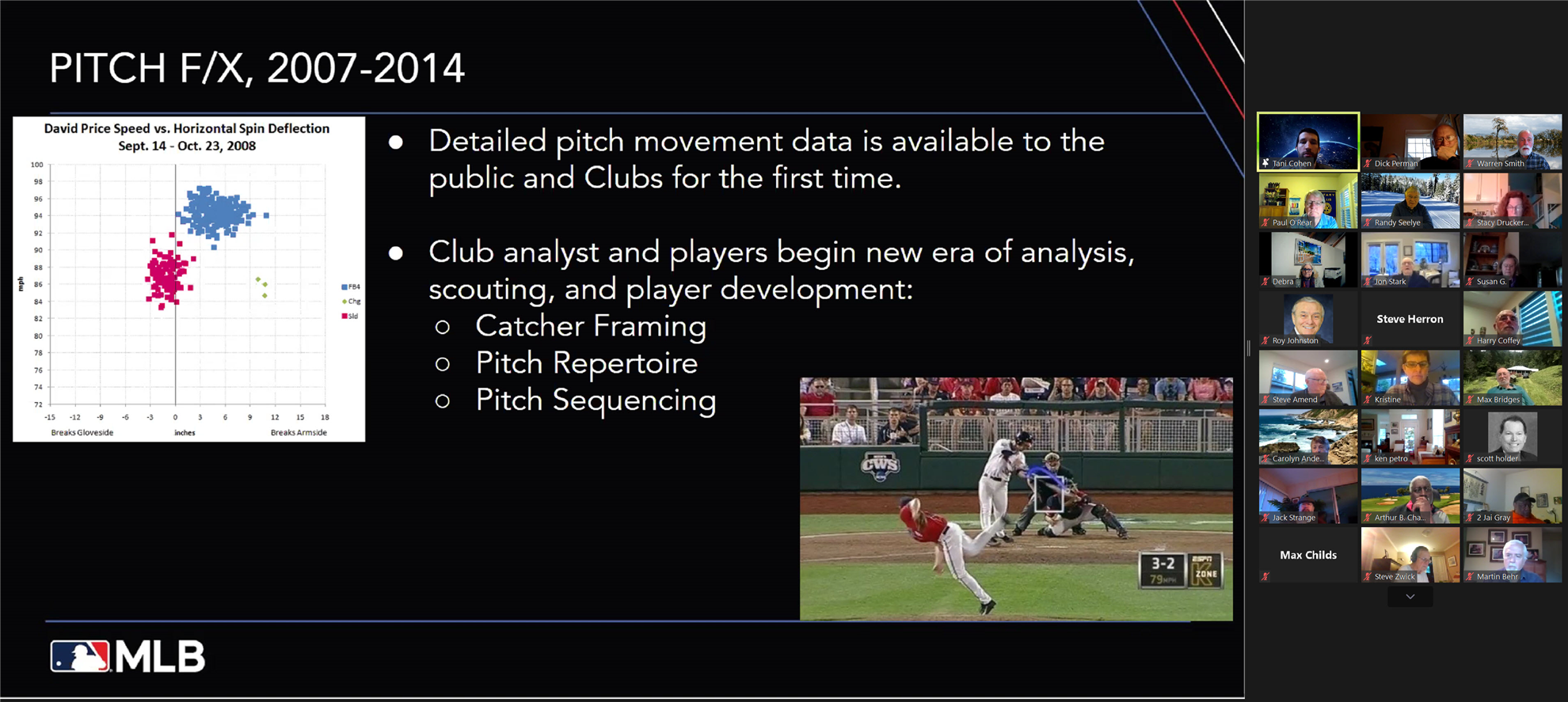
In 2007 MLB launched called PITCH F/X, which was the first ball tracking technology in widespread use. The system used 2 cameras in every stadium capturing pitch trajectory and detailed pitch movement. The system also made data available to the public and clubs for the first time. PITCH F/X brought more information about pitch design and started a new era of analysis, scouting, and player development, as well as the effective evaluation of concepts like catcher framing, pitch repertoire, and pitch sequencing (some pitch combinations are more effective than others, especially when used against specific batters!).
During these developments there was a continuing argument between front offices and players and coaches about using data rather than scouting. Front offices argued that data helped them make more informed decisions and helped players improve, while players and coaches often argued that analysts have never played baseball and that traditional scouting is more effective. From 2011 to 2015, front offices wanted more data about their players, and developed new ball tracking technologies, such as hit trajectory, full pitch trajectory, and player tracking.
MLB introduced Statcast in 2015. Statcast is a 3D Doppler radar that can track actual pitch release and ball path. The system includes six additional cameras for tracking. Statcast introduced entirely new data sets to clubs, including ball spin rate, pitcher extension, exit velocity, fielder reaction time, and arm strength. It helped to standardize data across different ballparks despite variations. Statcast automated data recordation to avoid manual data input. Other key statistical data includes pitch and hit location, sprint speed to 1st base, and catcher “pop” time. All of this new data changed the economics of baseball: raw skills became more important, veterans became riskier investments, and homeruns and bases on balls became more valued. In short, the ancient wisdom of coaches and scouts lost its preeminent position as predictors of baseball success! Statcast 2020 provides even greater levels of detail and innovation!
Thank you so much, Tani, for all the great information. Your presentation helped all of us understand how technological developments have changed the grand old game! Well done!
On a regular basis, our resident photo pro Warren Smith, submits pictures of what is going on at the weekly meetings. You can always find the most recent pictures at the websites photo journal called "Meeting Sighting" Please note that all the meeting photos for the entire Rotary year are at this location with the most recent on the last page.
Thanks for all the great pictures Warren!Link to Meeting Sightings. The most recent are on the last page!
Past district Governor Bob Rogers is this year’s District PolioPlus Chair; most of you are aware of how passionate he is about Rotary’s campaign to st Deradicate polio being a survivor himself. Bob sends out an informative newsletter once a month which is based on figures he receives from the World Health Organization; if you’d like a copy let me know and I will forward. As you may recall the African continent was declared polio free in 2020, being free of cases for five years. In this month’s communication WHO reports that so far there have been no cases of the virus in either Pakistan or Afghanistan, the only two remaining countries with the virus in the community. Of course we are only a few weeks into 2021 but it is worth noting that no new cases have been reported in Pakistan since November 23 and no cases in Afghanistan since October 19- that is something to cheer about! To put in perspective, Pakistan had 84 cases in 2020, down from 136 in 2019, while Afghanistan had 56 cases, up from 29 in 2019. If you are interested in being a part of the final push to victory, one way is to be part of the PolioPlus Society which is Rotarians who commit to contribute at least $100/year to PolioPlus until the job is completed. Contributions are matched 2 to 1 by the Bill & Melinda Gates Foundation and count toward Paul Harris recognition as well. Three clubs in the District are already at 100% PolioPlus Society participation- wow!
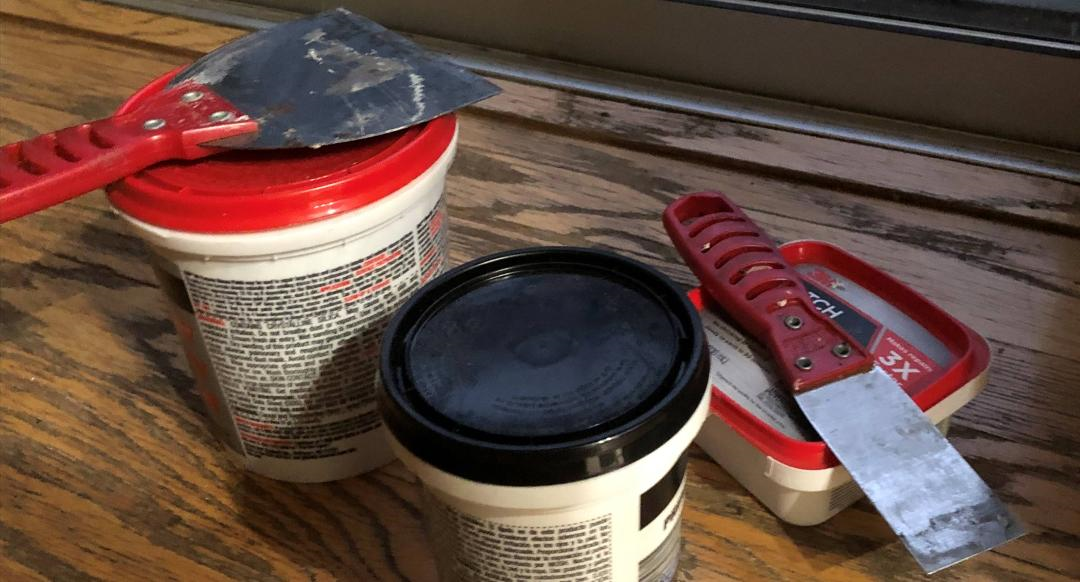
What is spackle exactly? My dad used to have it around for lots of painting and home repair projects. Not only did he like to use it a lot, but I also think he just liked saying "spackle". Anyway, on a recent paining project I had some holes and cracks to repair, so I was trying to remember when to use spackle. I found myself wandering aimlessly through the paint section of the hardware store looking at hundreds of containers, many of which looked like the ones Dad used to use. The labels all seemed to say the same things, like "fill cracks and holes" or "Won't shrink or stretch" or "Ready to paint".
But what is spackle exactly? And when am I supposed to use it? How is it different from putty, plaster, joint compound, wood filler, and caulk? Well, luckily, the internet is available to get expert information and opinions about spackle. Which confused me further. But here are some of my takeaways.
· Spackle is a drywall joint compound used in construction.
· Spackle contains hydrated calcium sulfate, glue, and gypsum plaster. (That meant nothing to me either!)
· Spackle is generally used for filling holes and gaps in drywall and plaster, and can be used for other surfaces, including wood.
· For wood surfaces, painter's putty or wood filler may be a better choice for filling holes and gaps. The wood filler can do bigger holes or gaps than the putty, and both end up smoother than spackle.
· Spackle, putty, and wood filler can all be painted over, although the drying times differ and some require priming.
Maybe Dad didn't know all this, because it seemed like he used spackle for everything. How can I blame him, "spackle" really is pretty darn fun to say.
I hope these nerd notes about spackle have filled some gaps in your knowledge. Was that too tacky? Sorry!!
Click this YouTube link for a remarkable 1,500 mile life changing trip;
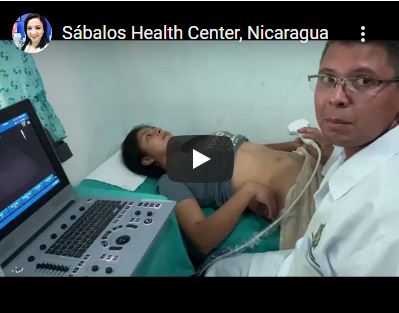
The Doctor is in, and seeing patients in very new and contemporary views.
Thanks to generous partners here and abroad, this young patient at the Sabalos Clinic may hope to reach well beyond her current 20's. In part to the diagnostic advances afforded by the availability of this Ultrasound machine and trained physician, hundreds of Nicaraguans in the Rio San Juan region have access to 21st century standards of care.
On the horizon next will be Xray equipment. Would you like to join the advance? Contact Sunrise Rotary International Director John Jones or President Paul. You will be a life saver!
In Rotary, 23 February is our anniversary, and February is also the month when we focus on promoting peace. There is a reason for this: Contributing to peace and international understanding has been a high priority for us since our earliest days.
We are often asked: “How can we get involved in peace now?” There are many paths to peace in Rotary. Our youth programs point us in the direction of Positive Peace, as does the work of intercountry committees and the Rotary Action Group for Peace.
Another path is the Rotarian Peace Projects Incubator (RPPI), an inspirational collaboration among Rotarians, Rotaractors, and Rotary Peace Fellows and alumni. Led by Rotarians in Switzerland and Liechtenstein, RPPI has designed 48 global projects that any club can support, either directly or through Rotary Foundation global grants. Nino Lotishvili and Matthew Johnsen, alumni of the Rotary Peace Center at Chulalongkorn University in Bangkok, Thailand, are two of the many volunteers.
During my Rotary peace journey, I have learned how personal resilience helps build inner peace and create sustainable outer peace. This was the inspiration behind the Women Peace Ambassadors for the South Caucasus project, which is based on my field research in Georgia. The RPPI team of Rotarians and peace fellows recognized the incredible potential of women from mixed-ethnicity families who live on borderlands to be role models for peace within and beyond their communities. Through workshops on building inner and outer peace that draw on the power of storytelling, 40 participants will be sharing their stories and reaching around 400 extended family and community members. These inspiring but marginalized women will reclaim their inner strength as peacebuilders at the grassroots level. In this way, we will take steps toward the sustainable, peaceful society we need so much, not only in our region, but throughout the world. — Nino Lotishvili
I was excited to join the peace incubator project and to further strengthen my ties with Rotary’s peace community by working with past and current peace fellows to develop these proposals. My team wrote five proposals — three in Bangladesh, one in Iraq, and one in Poland — that focus on the arts and on education to generate dialogue across religious divisions and avert the radicalization of young people. I was inspired by how, despite the pandemic, we came together via technology with a vision to develop, test, and strengthen ideas and to produce workable solutions that clubs across the world can support to advance peace. I am excited to work with Rotary’s peace community to transform these visions into reality. — Matthew Johnsen
Here is further proof that in Rotary, we prefer action to words. This is Rotary at its best. I encourage you to visit rppi.ch to explore the projects and support them.
We have lasted 116 years because of our strong ethics, our passion for Service Above Self, and our unique approach to problem-solving. One of our greatest strengths is how we reach across our communities and across national, ethnic, religious, and political divisions to unite people of all backgrounds and to help others. This month, let’s celebrate our history and the many ways that Rotary Opens Opportunities to advance world understanding, goodwill, and peace, our ultimate mission.
Giving is more than an activity. It is a way of life and a beacon in the search for hope in troubled times. There is great turmoil today, but these are not unusual times, not in the span of human history. The wisdom of the ages is especially important to help us set our path and purpose.
Such wisdom comes from the 12th-century philosopher known as Maimonides. Born in Córdoba, Spain, he and his family went into exile in Morocco to escape religious persecution. As a young man, he mastered Aristotle, astronomy, and later medicine. After moving to Cairo, Maimonides became known as the city’s greatest rabbi, producing tomes of commentary on the Torah, and he lived out his final days as a renowned doctor.
But his greatest gift to humanity captured his thoughts about giving itself. His Eight Levels of Charity is a masterpiece that teaches us about what giving means and what motivates us to do it.
The bottom rung of Maimonides’ ladder is giving out of pity or grudgingly. The next step up is giving less than one should, but doing so cheerfully. Climb up to the fifth rung and you are giving before being asked. Further up the ladder is giving in a way that the receiver does not know who the giver is. The eighth and highest level of charity is to anticipate distress and giving to avoid or prevent it.
When we immunize children against polio, we are anticipating potential illness. We do so with other efforts, such as Rotary projects that reduce the incidence of malaria or cervical cancer.
When we teach someone a profession that enables them to earn a living, we apply the eighth step. From microfinance to education, The Rotary Foundation helps us give the gift of self-reliance.
All of this good work awaits us, as does the work of supporting newborns, cleaning water sources, recovering from the COVID-19 pandemic, and countless other efforts we lead.
I am proud to say that many Rotary members climb to the top of Maimonides’ ladder. Many of them do so anonymously. Whoever they are and for whatever reason they share their gifts with the Foundation, I thank them.
As an organization, Rotary climbs that ladder as well. Every one of your donations helps us reach higher levels. As we climb this ladder as one, we gain a wider perspective. We see all those who need to be uplifted as well as the countless opportunities we have to help them in Rotary. And as we do so, we find our own meaning and purpose.
In communities with no services, incremental steps can go a long way
When Rotary members tried to bring toilets to a remote island, the population wasn’t ready
by Diana Schoberg
In many remote places, toilets that are connected to sewers or septic tanks are the exception, not the rule. In those areas, toilets that operate without water seem like an ideal solution. So-called dry, or urine-diverting, toilets feature two or three holes: one for urinating, one for defecating, and, in some models, one for washing. They don’t cost much to operate, and they don’t smell. And both the urine and the solid waste can be treated and used as fertilizer. What’s not to like?
But when a group of Rotary members tried to bring these toilets to a remote island in Indonesia, the community wasn’t ready for technology that the Rotarians thought of as no-frills, but the intended recipients saw as overly complicated. “The community didn’t want it, and in fact the project had to be redesigned. It cost the project a couple of years,” says Mark Balla, president of the Rotary Club of Box Hill Central, Australia, and vice chair of the Water, Sanitation, and Hygiene (WASH) Rotary Action Group. “People thought it was a great idea but didn’t think about the cultural appropriateness. That’s so important when developing a project.”
Part of the problem was that the project made too ambitious a leap. One tool that could help is the sanitation ladder, a graphic representation of levels of sanitation service that might exist in a community. “It helps you visualize the progressive steps to take to raise up a community from having absolutely no services to having the highest quality and most reliable services,” says Erica Gwynn, the WASH area of focus manager for The Rotary Foundation. Developed by the World Health Organization/UNICEF Joint Monitoring Programme for Water Supply, Sanitation, and Hygiene, the sanitation ladder concept can help Rotary clubs design a needs assessment, understand a community’s sanitation level, and set goals for a project.
The United Nations Sustainable Development Goals, which were adopted by UN member states in 2015 as a blueprint to a sustainable future, include the ambitious target of providing universal access to safely managed water and sanitation services by 2030. The target is easier to reach if sanitation services are assessed in gradations, rather than simply labeled as unimproved or improved. And the standard, well-defined service levels described on the sanitation ladder make it easier to compare progress in different countries.
At the bottom rung of the sanitation ladder is open defecation, whether it takes place in a field, forest, body of water, or other outdoor area. “A rainstorm is going to carry those feces across a wider range of space,” Gwynn says, “and with that comes the transmission of diseases.” Every two minutes, somewhere in the world, a child under five dies as a result of poor sanitation, poor hygiene, or unsafe drinking water.
“The impact of being at that bottom rung is drastic,” Balla says. On a business trip to India in 2012, he saw how the level of sanitation facilities can have all sorts of impacts beyond disease transmission, including contributing to educational disparities for girls, who may leave school when they reach their teens if there are no toilet facilities.
One step up is “unimproved” — that’s the disposal of feces in a pit or bucket. It’s more contained, but an unlined pit is still in contact with soil, and a heavy rainstorm will transmit diseases. And poop in a bucket has to be emptied somewhere. “It’s not really contained — it’s temporarily contained,” Gwynn says.
At the next step up the ladder are latrines that are shared among households; on this rung, facilities are designated as “limited.” This is an improvement over the two previous steps, but shared facilities are often detached from homes, which can lead families to feel less ownership and responsibility for maintaining the latrine. “It ends up filling up quicker, or sometimes one family can’t afford to pay to empty the latrine,” Gwynn says. “Often, we see long-term management of these facilities that is not optimal.”
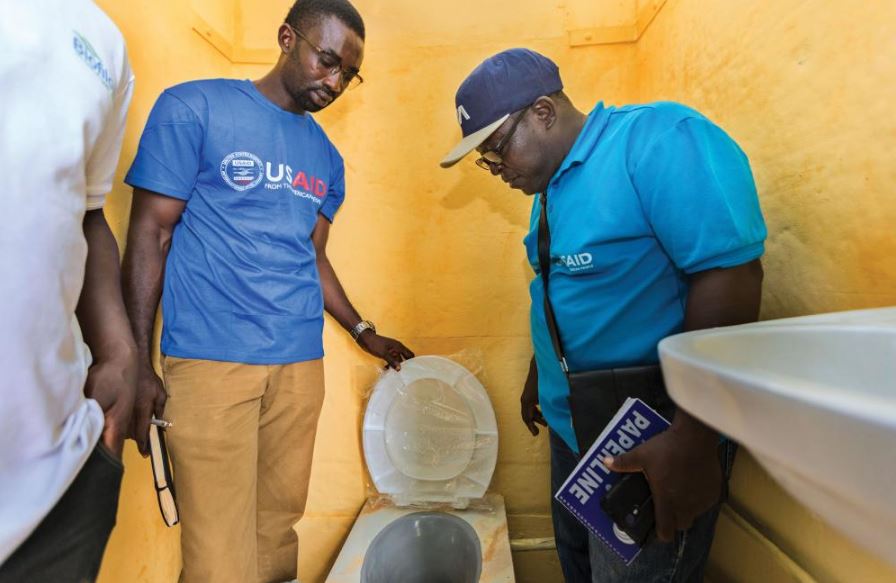
Rotary members are helping improve sanitation in schools in Ghana through a partnership with the U.S. Agency for International Development (USAID). The Partnership combines the business skills and local community leadership of Rotarian volunteers with the technical expertise of USAID.
Image by: Andrew Esiebo
“Basic” facilities, the next step up, include improved facilities that are not shared with another household. This goal looks at safety as well as access: latrines with lined pits that help minimize the spread of fecal matter and safe platforms such as concrete slabs that users can stand on without the risk of falling in.
At the top rung on the sanitation ladder, and the target of the sanitation-related Sustainable Development Goal, are “safely managed” facilities. At this level, not only does a household have access to its own toilet, but the waste is safely collected and treated. “Now we’re talking about the full cycle of what happens to your feces,” Gwynn says. Safely managed facilities solve many of the problems caused by shared facilities such as a pit latrine in a slum. That pit latrine may be lined and have a nice slab on it. But it fills up fast, and the way the waste is collected and disposed of is unsafe — somebody has to go into the hole and bring the waste out, and then it is dumped into a nearby river. “How are we protecting anybody any differently than if we did open defecation?” she asks.
Balla and Gwynn stress the importance of a needs assessment — a step that is required by The Rotary Foundation for any global grant application — to determine where a community lands on the sanitation ladder and where residents aspire to be. The community needs to drive the project in order to arrive at the most sustainable solution.
While the Foundation will not fund projects on the “unimproved” rung of the ladder, Rotary clubs that are interested in doing sanitation projects should be wary of jumping too many steps at a time. “We don’t always have to aim for the ultimate rung on the ladder, which is ‘safely managed,’” Gwynn says, although she notes that the final goal is to get there. “But sometimes it’s much more feasible and affordable to go one or two rungs up the ladder at a time. Behavior change is very difficult if you take too big of a jump.”
Balla also advises against chasing perfection. “Even in the United States, your toilet gets blocked sometimes. Perfection doesn’t exist,” he says. “It’s about continuous improvement. If you chase perfection, you’ll never start your project.”
• This story originally appeared in the January 2021 issue of Rotary magazine.
Rotary Club of Santa Rosa Sunrise - Founded June 30, 1986


.png)

.jpg)