Tani Cohen Talks Baseball (data)

Tani Cohen was the featured speaker at our meeting on January 28, 2021, presenting “The Evolution of Technology in Baseball.” Tani is employed by Major League Baseball as its Manager of Data Quality. He has spent his professional career in various baseball-related jobs, including working as an advance scout and in player development for the Boston Red Sox and New York Yankees. He also worked in advanced analytics for teams and for a private company, TrackMan. He is the nephew of Dick Perman, who introduced him for the presentation.
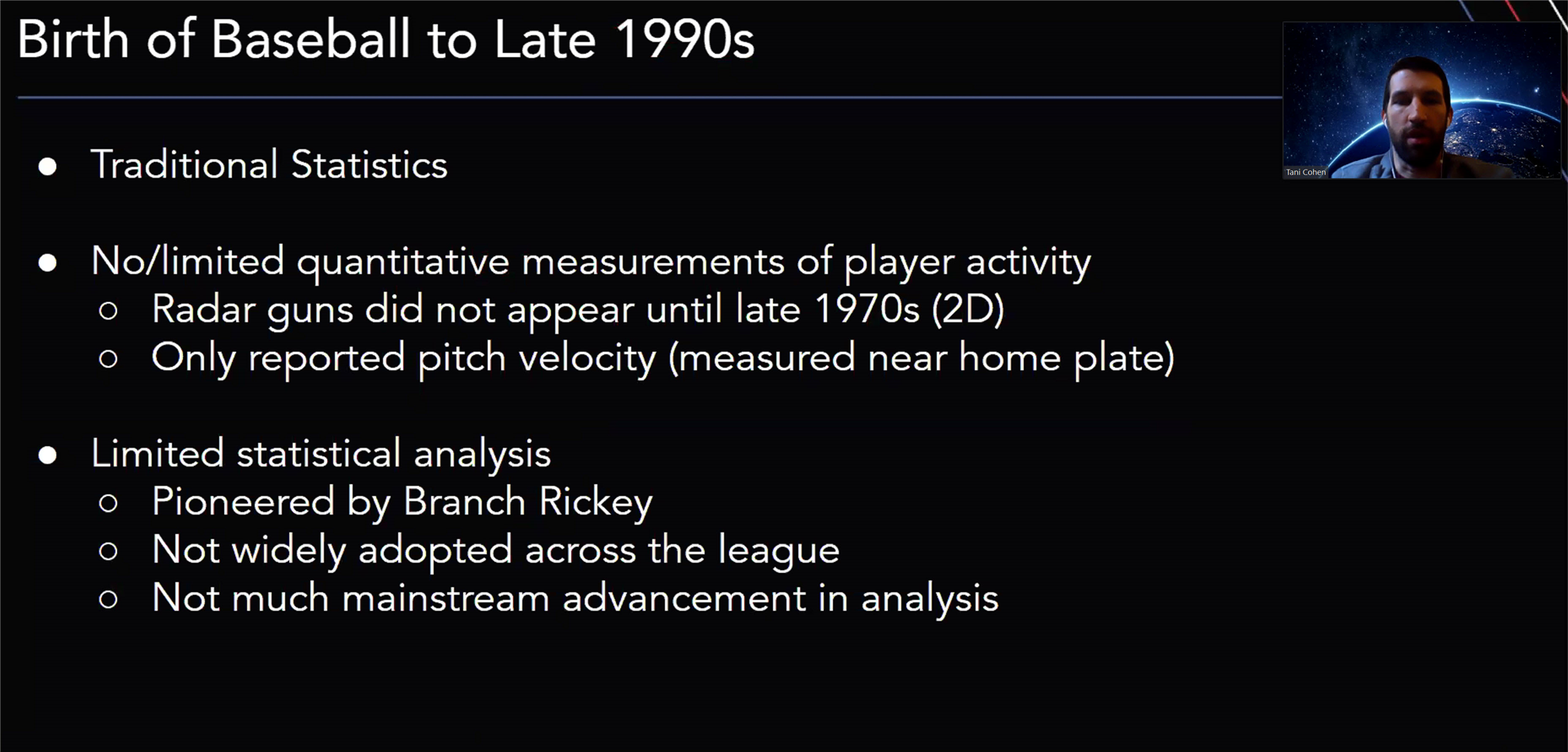
Tani jumped right into the evolution of data technology in baseball, from the beginning of the modern age to the present. Traditional statistics such as Earned Run Average and Batting Average were the focus during the early days of baseball. In the 1970’s radar guns were introduced but were not yet 3D. Radar guns gave only the speed of a thrown pitch at one specific point in the baseball’s path. Branch Rickey, a Brooklyn Dodger’s executive (who signed Jacky Robinson), was one of the first baseball executives to pioneer advanced analytical data. Rickey is credited with creating the “Moneyball” approach later made famous by the Oakland Athletics in 1991. The Moneyball approach was made possible with new computer technology that could quickly analyze data. Due to the mainstream use of data analysis after Moneyball, there was a renewed focus on putting players in situations to succeed instead of putting out a lineup of nine guys everyday- situational optimization.
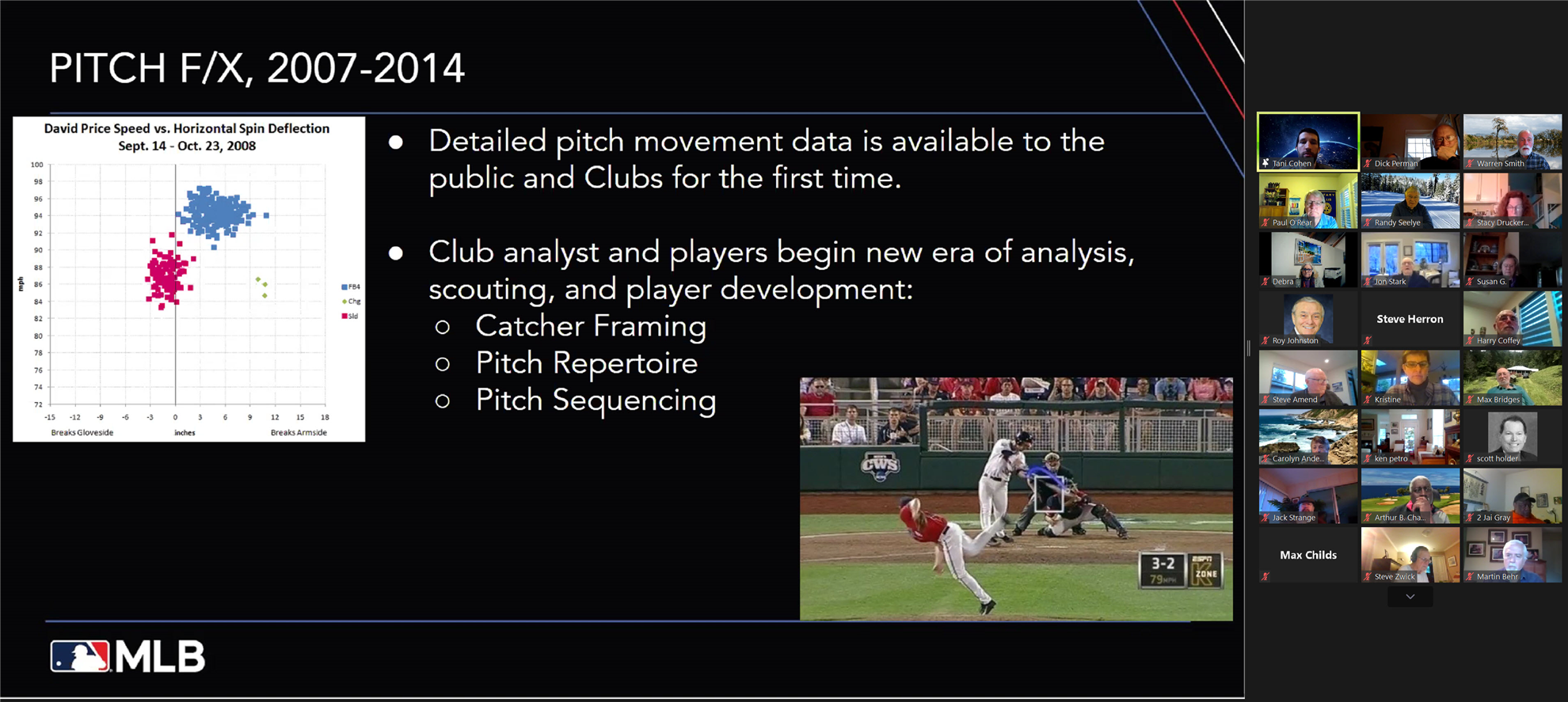
In 2007 MLB launched called PITCH F/X, which was the first ball tracking technology in widespread use. The system used 2 cameras in every stadium capturing pitch trajectory and detailed pitch movement. The system also made data available to the public and clubs for the first time. PITCH F/X brought more information about pitch design and started a new era of analysis, scouting, and player development, as well as the effective evaluation of concepts like catcher framing, pitch repertoire, and pitch sequencing (some pitch combinations are more effective than others, especially when used against specific batters!).
During these developments there was a continuing argument between front offices and players and coaches about using data rather than scouting. Front offices argued that data helped them make more informed decisions and helped players improve, while players and coaches often argued that analysts have never played baseball and that traditional scouting is more effective. From 2011 to 2015, front offices wanted more data about their players, and developed new ball tracking technologies, such as hit trajectory, full pitch trajectory, and player tracking.
MLB introduced Statcast in 2015. Statcast is a 3D Doppler radar that can track actual pitch release and ball path. The system includes six additional cameras for tracking. Statcast introduced entirely new data sets to clubs, including ball spin rate, pitcher extension, exit velocity, fielder reaction time, and arm strength. It helped to standardize data across different ballparks despite variations. Statcast automated data recordation to avoid manual data input. Other key statistical data includes pitch and hit location, sprint speed to 1st base, and catcher “pop” time. All of this new data changed the economics of baseball: raw skills became more important, veterans became riskier investments, and homeruns and bases on balls became more valued. In short, the ancient wisdom of coaches and scouts lost its preeminent position as predictors of baseball success! Statcast 2020 provides even greater levels of detail and innovation!
Thank you so much, Tani, for all the great information. Your presentation helped all of us understand how technological developments have changed the grand old game! Well done!