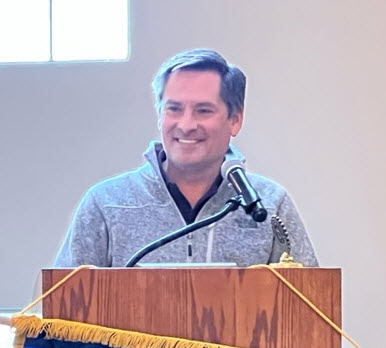
Speaker Alan McCullough
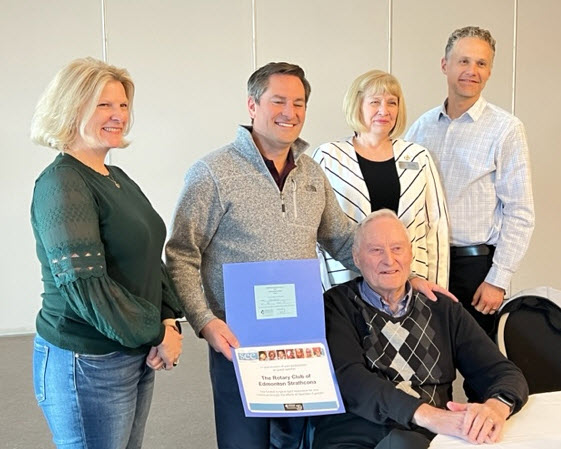
Club President Heather de Kok with the McCullough Family
This week we heard from award-winning writer and executive producer Alan McCullough. Alan is the son of long time Rotarians Ron and Brenda McCullough. Alan has worked in Canadian television for the past twenty years and has a long list of television credits to his name, including drama series, science fiction, kid’s programs, and animation. Alan told us that he first fell in love with theater in high school and at first he pursued an acting career. He trained as an actor both in Edmonton and New York for a total of six years. Alan admitted that he was not a very good actor, and after a few years of trying to make it as an actor he decided that maybe he should look into another film related role. He checked out directing, editing, producing and writing and soon found that he loved writing.
He then enrolled in the Canadian Film Center and transitioned into the film industry. He said that he was very lucky when he landed a job as a writer that it was with a long running television series, Stargate.. He said that his time with this show was a true gift as it gave him good teachers to learn from and a steady income, which is a rarity in the film industry. Stargate involved producing forty episode a year for several years. Writing also meant he had to get up, get dressed and go somewhere to interact with other people every day.
Alan explained to us that in Canadian television, the writers are the ones who control the production of a show. The lead writer, also known as the ‘show runner’ is the executive producer for the series, and the assigned writer for each separate episode receives credit ae the producer of that episode. He said that all those producing credits that run by at the beginning of an episode are the writers on that episode. The show runner is in charge of it all, the director plays a smaller role.
He said that when a show goes into production the whole writing team gets together and works out the outlines for each episode. The episodes then get assigned to individual writers to produce a first draft. This is reviewed by the show runner and changes are made to form a second draft. Any change can affect cost or time it takes to prep, shoot, edit and finalize. The writer must know how to stage a scene to reduce cost and time and is normally on set for the shooting as it can often require last minute rewrites to accommodate unexpected changes. Sometimes the shoot location is bigger or smaller than originally planned for, or even worse, sometimes the lead actor is not available, for whatever reason.
Alan told us that before the rise of streaming television services, a broadcaster would normally order twenty episodes per year of a series. Nowadays that is down to ten, with streaming services usually only ordering six. The streaming services order less as they do not have the need to keep the audience coming back to watch in order to bring in advertising income, they already have their money from the subscribers. He said that the average cost for production of a series in Canada is two to three million dollars per episode. He said that Canadian writers are paid a fee per episode based on the series budget which is usually higher than American writers. American writers may also be paid residuals when or if a series is replayed at a later date. Streaming services do not pay residuals at all. The rise of streaming services has hit the industry hard in Canada and the US, making earning a steady income very precarious, but it has hurt the Americans harder as they also rely on residuals.
Most recently Alan created and show ran the mystery procedural The Spencer Sisters which is currently airing on CTV, Crave and the CW network. Prior to that he show ran the hit Canadian procedural Private Eyes (GLOBAL/ION) for three seasons, winning the 2020 Golden Screen Award for the most popular Canadian series. He has also written and produced episodes for Rookie, Blue, Reign, Cracked, Lost Girl, Stargate:SG-1, Stargate Atlantis, Stargate Universe and Sanctuary and has won many awards for his work. We would like to thank Alan for his very interesting and enlightening talk and wish him well in any of his future endeavors.