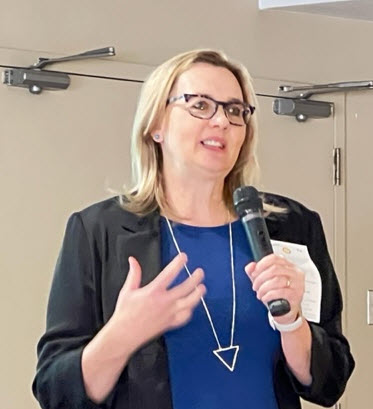
This week we welcomed Dr Denise Larsen, who is a Professor of Counselling Psychology with the Faculty of Education at the University of Alberta and a Fellow of the Canadian Psychological Association. She is also a co-director of Hope Studies Central along with Dr. Rebecca Hudson Breen. Hope studies Central is a thirty-one-year old research unit at the University of Alberta dedicated to understanding and effectively using hope in education, counselling therapies, and health contexts. Dr Larsen has published over 100 articles and books, has offered invited lectures around the world and works with a team of scholars, professors, graduate and undergraduate students. Dr. Larsen said that hope is the ability to envision a future in which we wish to participate, but which we are not sure may actually happen. It is something about which we are pessimistic. She said that we all need hope in some form to be able to face a sometimes difficult reality. It has been found to be associated with life satisfaction and even with better grades in academic studies. Hope is one of the most commonly used words in the English language. Things we hope for are something that are easier for people to talk about than hard goals, but at the same time they are something to keep looking forward to or working towards. Hope can help people find a way to live meaningfully. Hoped for things can be large or small. Hope can be many different things. We may not hope for things we know are not possible such a surviving a terminal disease but still hope for small things such as a visit from a friend. Hope Studies Central has several different programs that teach others about hope and the use of hope in educational and health care settings. SHARP (Strengths, Hope and Resourcefulness Program) is one of those programs developed for use by teachers for use in grade 2 to 9 classrooms. It was developed to provide sustainable, effective mental health programming in schools. They have found that even very young children can have a pretty good concept of hope in their lives. Some of the activities they use to build hope are having children make collages of pictures showing things that they hope for, writing short messages of hope using sidewalk chalk on the entry sidewalk to their school and writing down the hopes that family members may have for them. All of these things have been found to create and build hope. These things can also serve as a reminder of hope for better times when they are feeling down in the future. In health care settings they have found that fostering hope can help people living with chronic pain and disability find a way to live meaningfully in spite of their difficulties. We would like to thank Dr. Larsen for her very interesting and enlightening talk on the changes that having hope can make in our lives. |








.png)