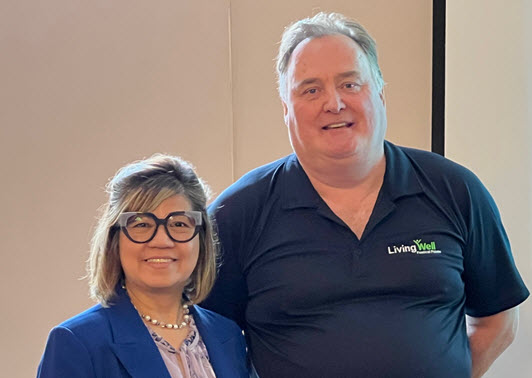
President Elect Loida Lumanlan with Terry Collier
This past Tuesday we heard from Terry Collier, a gerontologist who has studied seniors housing since 1986. Terry has studied, taught and worked in the area of seniors and their housing in both California and Alberta and is very familiar with what works and what does not. He feels that he has a good understanding of what seniors at various stages of their lives need, like and do not like about their housing and he often works with developers to design seniors complexes that will work well.
Terry told us that there are several things about seniors housing that people appreciate, the biggest one being a sense of community. Terry said that nearby amenities such as a clubhouse, party rooms, coffee shops, hair salons, exercise, craft and games rooms are important as they give people a place to get together and help to create that sense of community. These are things that older people should look for when choosing a place to live.
Affordability is the second most important concern. There is a lot of housing for people who can afford to pay more than three thousand dollars per month, and some subsidized housing for low income seniors but it is the people in the middle who struggle the most. He said that often people think they can afford to purchase a unit but they do not consider the ongoing monthly costs such maintenance fees and special assessments which go up over time. Terry said that it is important for seniors complexes to continually maintain, remodel and refurbish. He also said that one big cost that continually goes up for complexes with housekeeping or food service is staffing. He has actually seen cases where a senior whose spouse has died and they can no longer afford their monthly costs will move in with another senior they don’t even like all that well just to be able to stay in the same housing complex.
Terry said that for many seniors their concept of value for price fixes on a value within five years of their retirement and their concept of how much something of value is worth falls further and further behind reality as they age. This can create issues for developers and managers of seniors complexes. Value can also mean different things to people of different generations, to people born between 1920 and 1940 who feel they are not getting value for their money get very territorial over who sits where in the dining room and often over eat, people born between 1940 and 1965 want to ensure that their food is locally sourced.
He then went on to explain the various levels of care and the costs involved in delivering these, relative to the fixed amount that the Alberta government legislated many years ago. The designated supportive living care level and subsequent cost goes up as you need help with more things. The basic list in increasing order of care needed is bathing, dressing, toileting, transferring, continence and feeding.
The rules have not changed in so long that the current maximum cost to the patient is twenty two hundred per month, while the actual cost per month now is about ten thousand. He said that the cost is so prohibitive now that the Alberta government placed a moratorium on building new facilities several years ago and there is now quite a large shortage of beds as well. He said that in order to manage the shortage, if there is even a hint that a family member might help, (and thus may be willing to look after you) your name will never make the wait list. The system is broken.
He said that eventually seventy percent of older Albertan’s will need home care ( the lowest level of care). The delivery system for this is currently quite costly as it includes travel time for a care giver to come to your home to deliver the care. Terry said that we currently have 127,000 people in Alberta getting home care.
This type of care could be delivered much more cost effectively if we had more designated seniors apartment complexes ( Congregate Living Environments) where people could rent their own suite (with one or two bedrooms, bathroom, full kitchen, dining and living area) but there would also be a full time on-site worker to co-ordinate home care for the residents. The home care giver could spend less time travelling and the care could be more consistent with the same person providing the care each time.
For higher levels of care, with shared living spaces where infection control becomes an issue, he said that a proven way to control this is better air flow, specifically the use of continuous air surface pathogen removal (CASPR) which relies on a complete change of room air every fifteen minutes. This can be costly but it is proven to be every effective. Our priorities should be updating our legislation
In closing he advised us to get out into our community and get to know the various senior living facilities and the people there. Learn some of the tricks to get yourself or others onto the wait list. He said that we can help by volunteering to help seniors with downsizing as this is one the the most stressful things that seniors must do. He also said to be prepared for more non-profit seniors housing initiatives, developed and managed by groups like ours. We would like to thank Terry for his very interesting and informative presentation.














.png)