Thanks for visiting our site! The first ClubRunner site in District 5370
"The Friendly Club"
Tuesdays at 12:15 PM
Woodvale Facility and Golf Clubhouse
4540 - 50 Street NW
Edmonton, AB T6L 6B6 Canada
Our Club meets every week with a twist. The first three weeks of each month on Tuesday at the Woodvale Club and the last week for a meeting and social at a location, date and time to be determined. Members will be notified by email of the details.
It is with sadness that we announce the passing of one of our Charter and long-time members, Hugo Lehman, on Oct 2, 2023, at the age of 92.
We send our condolences to his wife Lucie and family. He will be missed. Hugo Lehmann was a charter member of the Rotary Club of Edmonton Strathcona, 1974. Hugo served as a director for two terms and was active in several committees. He was a Paul Harris Fellow +1 and also had perfect attendance for eleven years. Hugo and Lucie were married for a remarkable 66 years. Hugo owned and operated Freeway Autobody for a number of years.
His funeral will take place at Trinity Lutheran Church, 10014-81 Ave on Tuesday, Oct 10 at 11:00 a.m. Club members can leave their tributes and remembrances of Hugo on the www.glenwoodmemorial.com website.
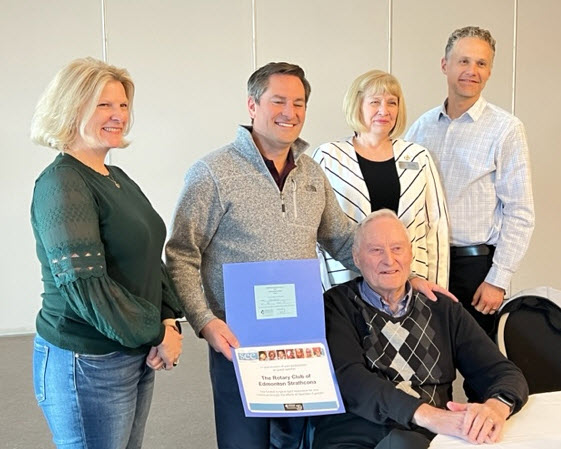
Club President Heather de Kok with the McCullough Family
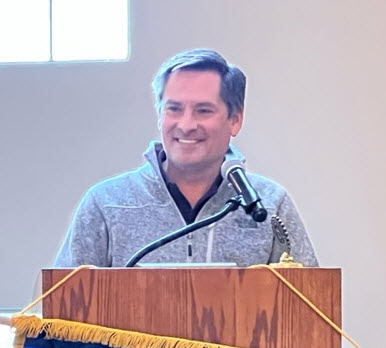
This week we heard from award-winning writer and executive producer Alan McCullough. Alan is the son of long time Rotarians Ron and Brenda McCullough. Alan has worked in Canadian television for the past twenty years and has a long list of television credits to his name, including drama series, science fiction, kid’s programs, and animation. Alan told us that he first fell in love with theater in high school and at first he pursued an acting career. He trained as an actor both in Edmonton and New York for a total of six years. Alan admitted that he was not a very good actor, and after a few years of trying to make it as an actor he decided that maybe he should look into another film related role. He checked out directing, editing, producing and writing and soon found that he loved writing.
He then enrolled in the Canadian Film Center and transitioned into the film industry. He said that he was very lucky when he landed a job as a writer that it was with a long running television series, Stargate.. He said that his time with this show was a true gift as it gave him good teachers to learn from and a steady income, which is a rarity in the film industry. Stargate involved producing forty episode a year for several years. Writing also meant he had to get up, get dressed and go somewhere to interact with other people every day.
Alan explained to us that in Canadian television, the writers are the ones who control the production of a show. The lead writer, also known as the ‘show runner’ is the executive producer for the series, and the assigned writer for each separate episode receives credit ae the producer of that episode. He said that all those producing credits that run by at the beginning of an episode are the writers on that episode. The show runner is in charge of it all, the director plays a smaller role.
He said that when a show goes into production the whole writing team gets together and works out the outlines for each episode. The episodes then get assigned to individual writers to produce a first draft. This is reviewed by the show runner and changes are made to form a second draft. Any change can affect cost or time it takes to prep, shoot, edit and finalize. The writer must know how to stage a scene to reduce cost and time and is normally on set for the shooting as it can often require last minute rewrites to accommodate unexpected changes. Sometimes the shoot location is bigger or smaller than originally planned for, or even worse, sometimes the lead actor is not available, for whatever reason.
Alan told us that before the rise of streaming television services, a broadcaster would normally order twenty episodes per year of a series. Nowadays that is down to ten, with streaming services usually only ordering six. The streaming services order less as they do not have the need to keep the audience coming back to watch in order to bring in advertising income, they already have their money from the subscribers. He said that the average cost for production of a series in Canada is two to three million dollars per episode. He said that Canadian writers are paid a fee per episode based on the series budget which is usually higher than American writers. American writers may also be paid residuals when or if a series is replayed at a later date. Streaming services do not pay residuals at all. The rise of streaming services has hit the industry hard in Canada and the US, making earning a steady income very precarious, but it has hurt the Americans harder as they also rely on residuals.
Most recently Alan created and show ran the mystery procedural The Spencer Sisters which is currently airing on CTV, Crave and the CW network. Prior to that he show ran the hit Canadian procedural Private Eyes (GLOBAL/ION) for three seasons, winning the 2020 Golden Screen Award for the most popular Canadian series. He has also written and produced episodes for Rookie, Blue, Reign, Cracked, Lost Girl, Stargate:SG-1, Stargate Atlantis, Stargate Universe and Sanctuary and has won many awards for his work. We would like to thank Alan for his very interesting and enlightening talk and wish him well in any of his future endeavors.
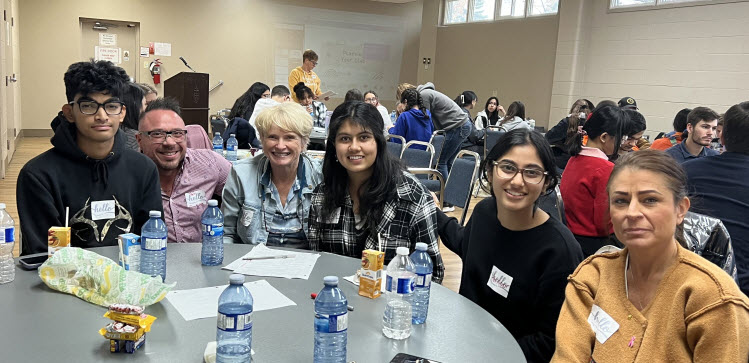
Over the weekend we attended RYLA (Rotary Youth Leadership Awards) - a Rotary youth leadership seminar with members of our W.P. Wagner High School Interact Club. Our group consisted of Carin (Youth Chair), Ben Gomez (Youth Committee Member), Rhonda Smith (Community Committee Member) and three students. The seminar was attended by students from various high schools from District 5370 and the respected members of their sponsor Rotary Clubs. Also, in attendance were Rotaract members from various universities.
The seminar had various Rotary club members speaking about what the true meaning of Rotary is; what it means to be a Rotarian (Service about Self); highlighting the seven pillars of Rotary and showing the global reaches of the amazing work we do worldwide and in our local communities. They also had a session on how to plan and execute a project.
There was strong emphasis on how they as our youth of today can make change and with that said gave them the tools on how to approach and implement their ideas with the help of their sponsoring Rotary club and its members to make their visions a reality. It was truly inspiring seeing the collective “want to make change”. The students there were asked to brainstorm their ideas on what areas our communities are in need. Not only did they have an acute knowledge of the real struggles today’s societies are facing but they also had concrete ideas on how they want to make a difference. They were extremely aware of the mental health struggles that our youth of today are facing from bullying, hunger, mental health, and abuse. It was astonishing how driven and determined they were to reach out to different organizations on these issues and do their part. As a Rotarian I felt a sense of pride and humility knowing that we are “in good hands” with these future Rotarians. It reiterated the reason I became a Rotarian. I wanted to work with our youth and help guide them to achieve the core values we as Rotarians live to serve by.
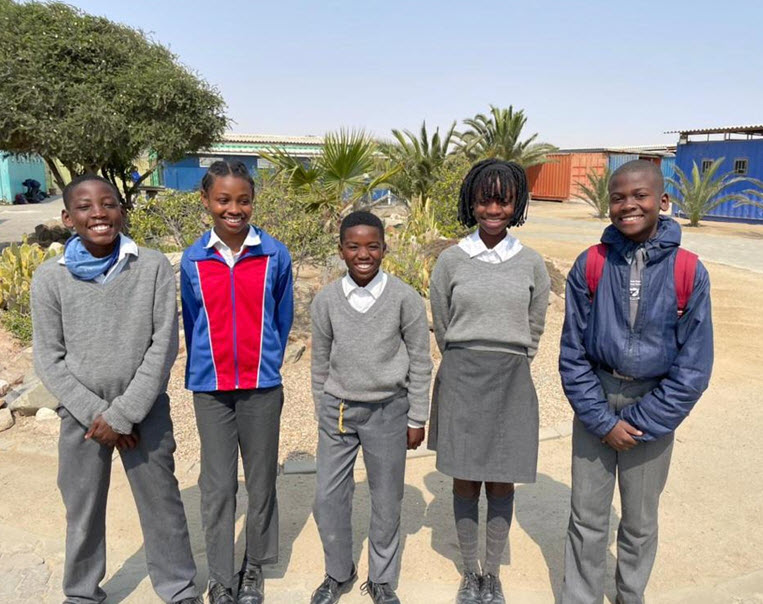
MYO Learners, Frans, Naambo, Romance, Fransina and Tangeni
We have recently received letters from the five learners Frans, Naambo, Romance, Fransina and Tangeni that our club has recently sponsored through Mondesa Youth Opportunies (MYO) in conjunction with the Rotary Club of Edmonton Riverview.
MYO is a well-known and intensive after-school education program located in Mondesa Township, Swakopmund, Namibia. It is the flagship project for the Rotary Club of Swakopmund, Namibia.
It has been operating for almost 20 years. Their focus is on learners from disadvantaged backgrounds who deserve better education than they have access to. Thus, learners with potential but little support at home. At MYO, 120 learners ranging from Grade 4 to 8 receive extra instruction in English, Mathematics, Reading, Life Skills, Computers, Sports, and Music.
They cultivate positive thinking and high self-esteem to lay the path for a future generation of forward-thinking Namibian leaders. Their aim is not only to enhance the education of their promising learners but also to guide them into being responsive, confident, and well-rounded individuals.
MYO is a non-profit organization, and their learners participate in their programme free of charge. They rely exclusively on donations from their community and the wider world to sustain their operations.
Their letters are in photo format and can be viewed in the Photo Album below titled MYO Learners.
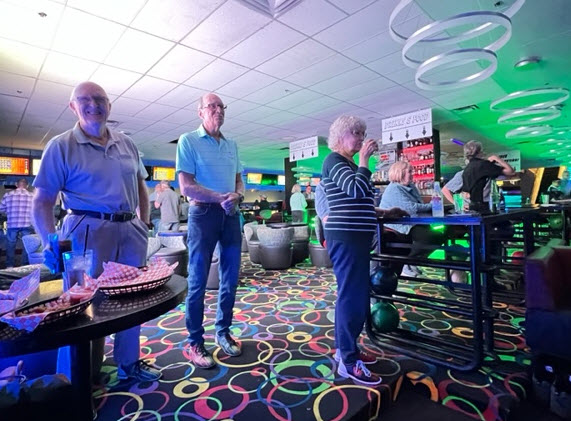
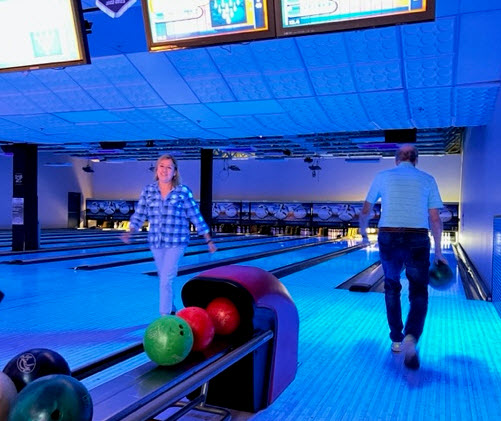
Members of our club recently enjoyed an evening of ten pin bowling at Gateway Lanes. It was definitely a new way to experience an old sport, with the black lighting and musical background. Everyone enjoyed themselves with plenty of cheering and a little bit of rivalry as well.
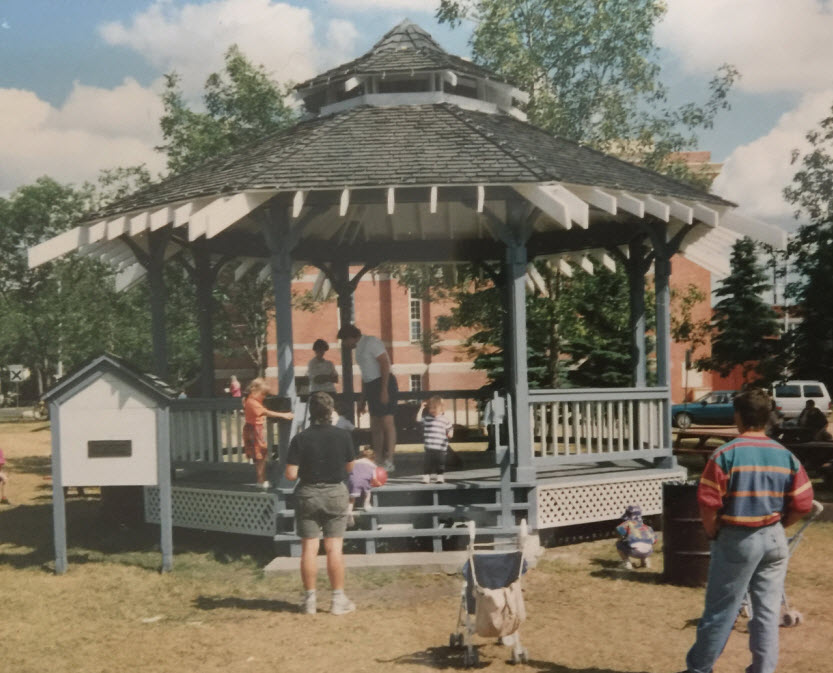
In 1977, shortly after the beginnings of the Edmonton Strathcona Rotary club, while Henry Neufeld was President, some members suggested that they should do something for the Strathcona neighborhood by building a bandstand similar to one that had existed there around 1910. They could then sponsor bands to play there on holidays and for special occasions. The bandstand was designed by architect Larry Taylor and was intended to be a replica of a band shell that stood near 102 St and 82 Ave. in 1910. Club member Peter Fairbridge was the committee head. The bandstand was a joint venture with the Old Strathcona Foundation, whose mandate was to restore and retain the history of the area, which supplied the land.
The location chosen was a small park next to the Strathcona Library branch near 104 St and 83 Ave that was informally known as Library Park. The bandstand stood in the middle of the park. It was also built to coincide with the 75th anniversary of both Rotary International and the Province of Alberta.
As the original plans for the bandstand were a little pricey, the project was put on hold and was revived in the fall of 1979, under President Hans Granholm. Over the winter of 79-80, materials supplied by club members were cut and painted at the home of a club member. In the spring of 1980, the bandstand was assembled by club members in place in the park.
The band stand opened in the summer of 1980, under outgoing club President Hans Granholm and special guest Alderman Buck Olson, the bandstand along with a commemorative bronze plaque was presented to the City of Edmonton, followed by a brass band concert by the Old Strathcona Town Band.
It was soon hosting summer brass band concerts which could be heard throughout the neighborhood. The park was renamed in 1981 to McIntyre Park in honor of Wilbur McIntyre, the first Member of Parliament to represent the Strathcona area. With the advent of the Fringe in 1982, which suddenly brought thousands of people to this small park in Strathcona, the bandstand was used constantly.
In 1991, under President Hugh Faulkner and project leader Hans Granholm, our club repainted the bandstand, followed by a very enjoyable champagne lunch.
By the year 2000, the park was in need of refurbishment with changes to drainage and an updated electrical supply. During these changes in 2001, the band stand was moved by the City of Edmonton from the center of the park to the south-east corner. During the move the bronze plaque that had been with the original bandstand disappeared.
Our club attempted to have the city replace the plaque, but they declined, so our club had a replacement plaque made and installed and our bandstand/ gazebo is still standing and in use to this day.
Please add mailservice@clubrunner.ca to your safe sender list or address book.
To forward this email to your friends, click here.
To view our privacy policy, click here.
ClubRunner
905.829.5299
102-2060 Winston Park Drive, Oakville, ON, L6H 5R7









.png)