Jonathan Schaeffer, The Games Computers, and People, Play
On Tuesday we were treated to a very well presented and humorous talk from the Dean of Science, and Professor of Computing Science at the University of Alberta, Jonathan Schaeffer. He talked about his research over the years, and how computing science has evolved in that time, by using his research into games. He started by stating that computers have forced people to rethink what it means to be able to think. Computers can give us the illusion that they are able to think, but in reality they are actually very simple minded. In the past thirty five years we have learned that computers are actually very good a some things we used to think only people could do, like driving cars, spell checking, flying airplanes and winning at games of strategy like Checkers, Chess and Go.
His research, and that of his colleagues from the U of A has covered the game of Checkers, in 1995, in a game between world expert Marion Tinsley vs the U of A Chinook computer, the game of Chess, in 2007 with chess expert Gary Kasparov, against the IBM Deep Blue computer, and in 2016, the game of Go with expert Lee Sedol against the Google Deep Mind computer team. He used the humorous comparison of the two different computing models, the biological model (the human brain) vs. the computer model, with tables comparing physical and mental age, height, weight, years of gaming experience, number of synapses vs CPUs, speed of computation, and the number of possibilities that can be learned. The Chinook computer was better because it could store forty trillion possible positions in it’s memory. By 2007 computers could store all five hundred billion billion possibilities and became perfect at the game of Checkers. The Deep Blue computer was better at Chess, with ten followed by forty five zeros possible positions, because it could perform computations at the speed of two hundred million possible moves per second, and the Deep Mind computer was able to learn, by rote repetition, all of the possible moves ( one followed by one hundred zeros) that would lead to failure in the game of Go.
These comparisons highlighted the things that give computers an edge in these games, such as rote memory, speed of computation, and the ability to doggedly perform the same task over and over many millions of times in order to ‘learn’ the best moves. These are all tasks that the human mind would never be able to, or even want to perform. He then talked about how the human mind can easily take in so many more things, all at once, such as sight and language, and perform feats of learning and reasoning that are well beyond that of even the most modern computer. The fact is, as he stated, humans and computers are more complementary, than they are alike.
He spoke of how studying the field of gaming has contributed to the overall development of computers and of the field of artificial Intelligence and machine learning. He also emphasised how the U. of A has had a part in so many of these developments. Technology from these fields is being applied in all kinds of other fields such as bioinformatics, GPS systems and scheduling systems. The U. of A. department of Computing Science was a pioneer in this field, and is now ranked second in the world in the field of Artificial Intelligence and Machine Learning. As part of the Pan Canadian Artificial Intelligence Strategy, it has recently been the recipient of twenty five million dollars, with the promise of a further fifty million dollars to continue their research in this field.
As a result of this, we can look forward to many more contributions from them in the future.
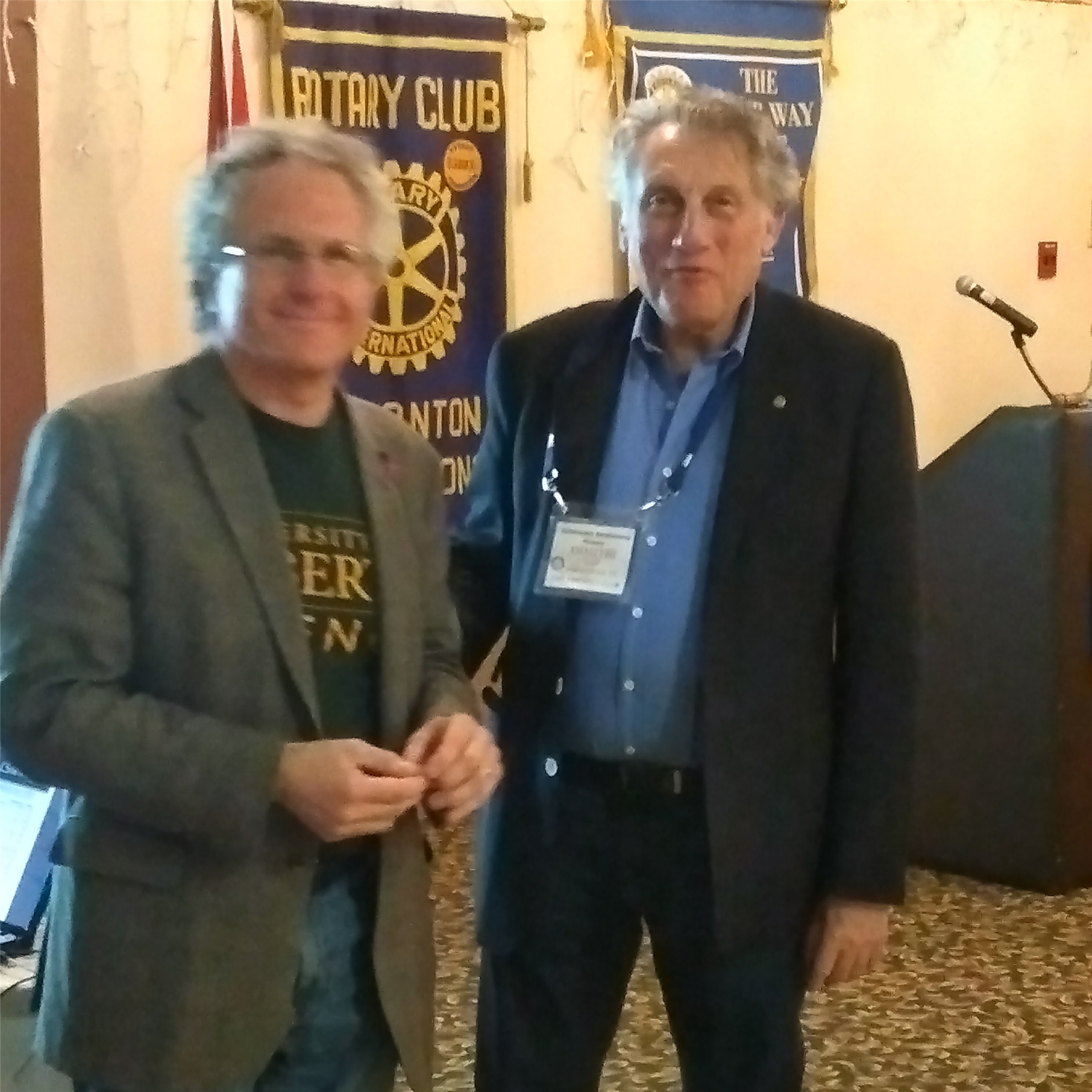
Professor Jonathan Schaeffer and President Dimitri