On Tuesday we were given the pleasure of hearing from Dimitri Papanicolas, the fascinating story of how his Albanian Greek family ended up in the Belgian Congo, and of their many trials and successes there. His father was born to a Greek family in a small village in Albania, just over the border from Greece. In 1936, at the age of nineteen, with a grade two education, he immigrated to the Belgian Congo as an indentured worker/employee . This meant he had to work to repay his cost of passage, before being freed to work on his own Within a few years he was joined by his brother and together ventured in running a grocery back in the jungle. The business started to prosper and his father returned to Greece in 1949 to look for a wife. There he met and married Dimitri’s mother. They returned to the Belgian Congo where as a wedding gift a concrete floor was placed to the dirt floor of their first home. Dimitri was born in 1951, in the southern province of the Belgian Congo. His father and his uncle prospered in their grocery business and started buying corn, manioc, peanuts, honey, and packaging them for sale. They opened several more groceries in the bush to expand their purchasing power from the locals. In 1956, his family moved to Elisabethville (now Lubumbashi) for Dimitri to start school and to operate the flour mill and packaging facility that the Papanicolas brothers had built. The ex-Belgian Congo went though several coups and civil wars, during the 1960’s and Dimitri remembers well seeing dead bodies and people being hacked up in the streets during these uprisings. In December of 1960 he was evacuated to N’Dola in Zambia, and it was several months before he could return home to the southern Congo.
He remembers his early school years as being marked by mediocrity and his father worried about is future, and was thinking on how he will include him in the the family business. He was fluent in Swahili (the local language) and also Greek but struggled learning French. Fortunately, in Junior High, Dimitri came into his own with his introduction to math and science. He never looked back after that, and was soon popular as a study mate with both the boys and the girls. Another political uprising occurred while he was in High School and his father decided it would be safer to send him to a boarding school in Belgium. Dimitri had never experienced life in such a free society where he could walk around, chat and socialize with anyone. Unfortunately, he enjoyed himself too much, and failed the entrance exams for Engineering. His father recalled him to the Congo, where he lived at home for four months until one day his father made a pronouncement. He would have to go into the bush (about 800 km away from civilization) to manage one of the family businesses, and they would also travel to Greece to find him a wife. Dimitri did not think this was what he wanted so he made a deal with his father to return to school to become an engineer, this time in the Congo. During his time in University, in 1971, a university student manifestation took place and all Universities were shut down. Nearly all of Dmitri’s fellow students had to hide out in the jungle initially, that is when Dmitri smuggled them food and supplies to survive. Later they were forced to join the army.
Dimitri eventually graduated, but in 1974 his father’s businesses were nationalized and his family returned to Greece. Dimitri tried to find work as a mining engineer in the Congo (now called Zaire), but they would not hire him as he was not black, so he tried to get a job with the Belgian mining companies, but they told him they only hired Belgians. At this point he decided it might be best to get some advanced training and applied to several Universities in England and the US. Language again became a challenge as he had to learn another new language, English, before he would be accepted as a student. He managed to quickly become fluent enough in English to be accepted at Imperial College in London. He then tried and succeeded in getting a job as a mining engineer in Greece. He worked for several different mining companies but found that their ethical standards were not to his liking. His son Kosta was born in 1978 in Greece. He and wife decided that a move to either the US, Canada or Australia would be best. They ended up in Canada, in Wetaskiwin, Alberta in 1980, where they stayed with a cousin, helping out in his restaurant until Dimitri found a job. He was hired by Thurber Engineering, in Edmonton, three weeks after arriving in Canada. Over the years, Dimitri worked his way up in the company and had the opportunity to work on many different projects. They ranged from bridges, to tunnels, to buildings such as the EPCOR tower. Along the way they also became specialists in Environmental Engineering. Dimitri rose into management and led the company to expand from twenty-five employees in 1993, to over one hundred in 2002. He married Nicoletta in 1993. It was during his time that Dimitri became a Rotarian, and greatly enjoyed a chance to meet and get to know people outside the field of engineering. Dimitri is also the recipient of two Engineering awards, the Stan Thompson Award from the Geotechnical Society in 2013, and in 2017, the Lieutenant Governors’ Award from the Consulting Engineers Association.
His closing words were of appreciation for the standards of excellence and support that his family had provided him with, he thanks Canada for what it provided to his family, and the admonition to appreciate what you have, as it may not be there tomorrow.
For information, a movie on Netflix called “The Battle of Jadotville” ,gives a good appreciation of the situation in the Congo in the 1960’s. Our newsletter has also a video of Dimitri’s Lieutenant Governor Award acceptance.
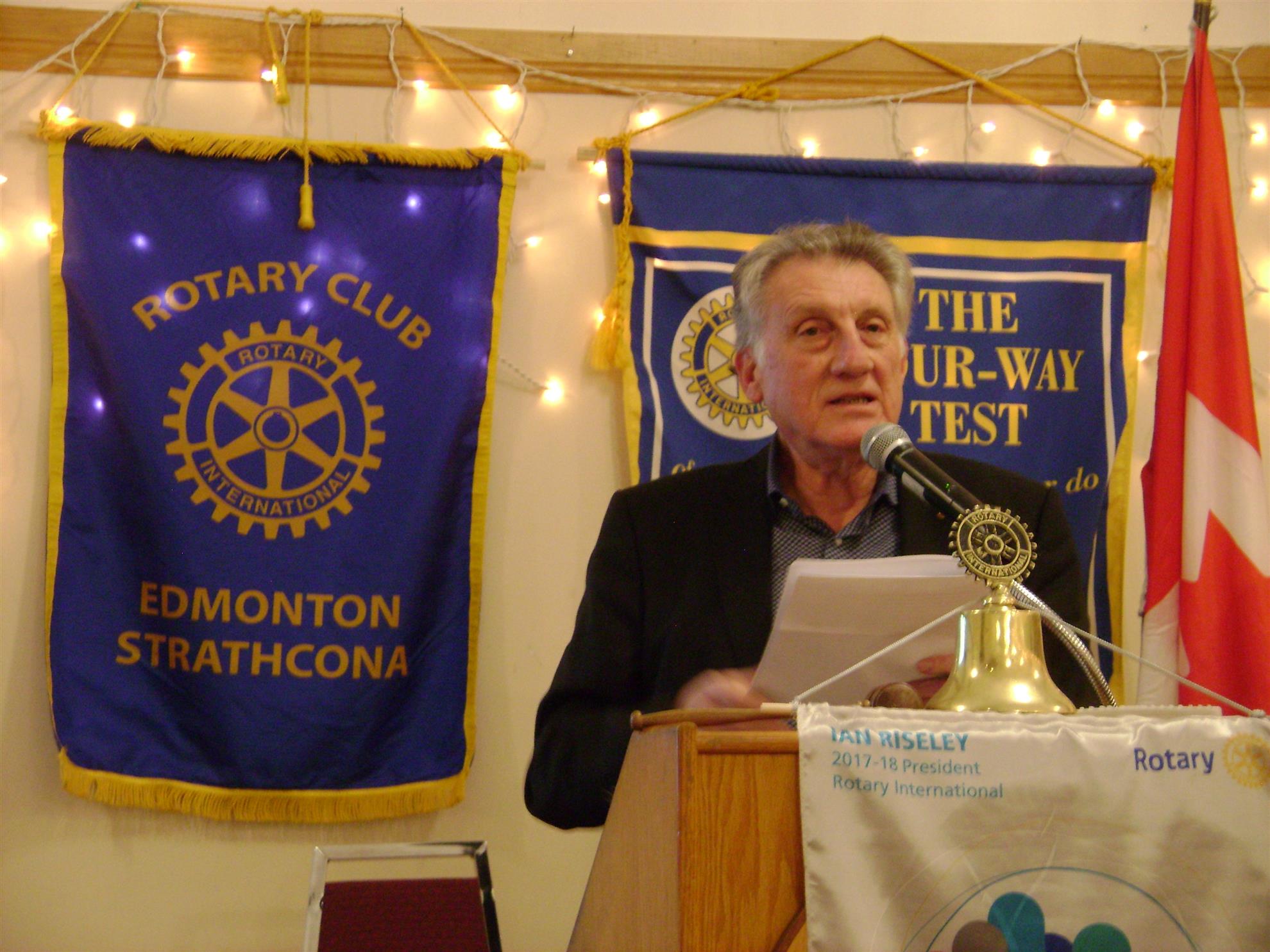
Dimitri Papanicolas