Giles Beeker is a multi-faceted business and real estate development professional. Presently working with Santa Rosa-based developer Hugh Futrell Corporation, Beeker leads acquisition, development, and programming activities in hospitality and mixed-use projects for the firm.
Prior to moving back to California, Beeker led the development and programming team for the largest building in Washington DC. Totaling more than three million square feet, the Ronald Reagan Building and International Trade Center is owned by the U.S. Government, however, the legislation that created the project requires that it serve as a public building with public spaces managed by a private sector company. Beeker worked within a partnership formed by Fidelity Investments and Urban Retail Properties to plan and manage the public space- over one-million square feet- and meet the Congressional mandate that the building serve as an "International Trade Center," a catalyst for the redevelopment of Pennsylvania Avenue, and an asset for residents, tourists and government workers.
Beeker developed business plans to create a large conference and event business line, lease office space to businesses involved in international trade, operate a large public food court with visitor services, develop and produce programs to bring together U.S. Government agencies involved in trade promotion or regulation and US companies trying to increase export activity, and to provide basic property management services to the facility. On acceptance of the business plans by the U.S. Government, Beeker was hired by the partnership and became the project’s senior executive for nearly 14 years.
Earlier in his career, Beeker led a Los Angeles-based consulting team focused on the wine, food, and hospitality space. Assignments included development and management of all hospitality events for Coca-Cola at the 1996 Atlanta Olympic Games, a wine industry modernization and brand development program for the Republic of Macedonia, and financial due diligence supporting the sale of California Pizza Kitchen.
Beeker also managed marketing and sales in the Western US for Kobrand Corporation, a leading wine supplier and importer, and served in corporate and field management roles for Bel Air Hotel Company, Raleigh Enterprises, and Hyatt Hotels and Resorts.
Beeker has held governance and leadership roles in industry, government, and affinity organizations, including as delegate to the World Economic Forum, representative to the President’s Export Council, board director of the World Trade Centers Association, British-American Business Association, American Institute of Wine and Food, and as president of the Sommelier Association of California.
Beeker was granted a bachelor of arts degree at Christ Church College, University of Oxford and Master’s Degree at the London School of Economics and Political Science. Beeker lives in Saint Helena, CA with his wife and two sons.
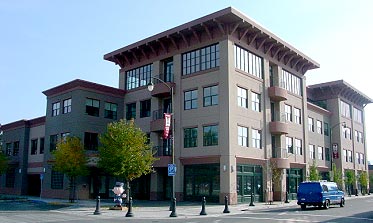
Giles will update us on the status of the Courthouse Square project.
In addition to our weekly meeting at Fountaingrove Inn, Sunrise members gather by special interests such as Bridge and Hiking, Construction and Instruction.
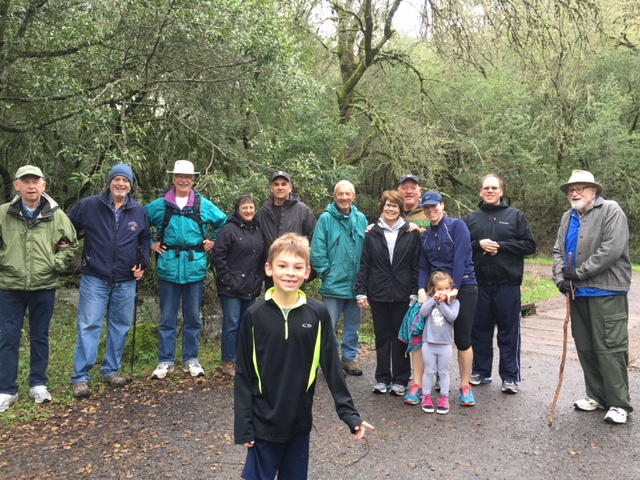
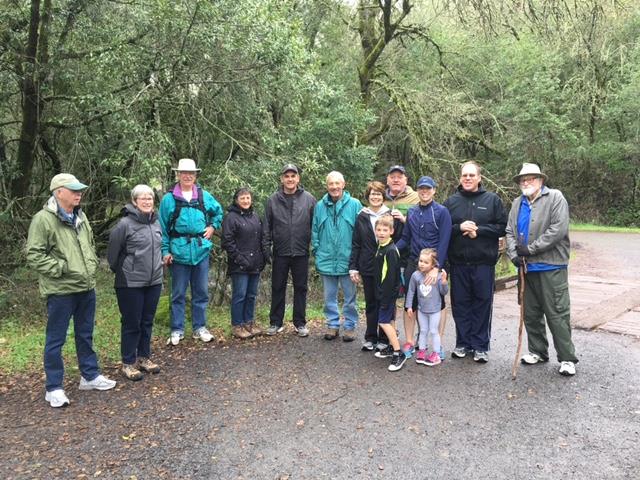
We are a well rounded group, providing opportunities for sharpening our minds and bodies. This past weekend's Spring Lake Park hike attracted members and their extended families. Led by Marty Behr, the Sunrise Hikers trek weekly. Below, this week's wisely dressed crew includes Jim and Susie Kirkbride's granddhildren on the young side and veteran, 90+ Sunriser Del Raby sporting signature beard and pole on far right.
We are also known to generate public enthusiasm and refreshment per our hosting of the Bear Republic beer booth at the City's St. Patrick's Day 5k Run March 12. Draught Master Peter Hoberg is accepting applications for associates. Apply early, competition is keen for the limited places at the counter.
Members are also recognized for their accomplishments and recent travels:
Peter Banks reported on his and spouse Mary's 3 week Caribbean adventure on their Catamaran Serenity. Amidst 35 knot winds and at times 15 foot swells, all aboard returned without mishap.
John Jones announced his company's new record of 428 person's served in a single day during the January mission to the remote Nicaraguan village of Maravillas.
Leroy Carlenzoli and Rich Randolph assembled the Club's Peace Wall at Women's Recovery Services. Immediately two school girls created their personalized messages of Peace and Hope, oriented toward their respective mothers.
Max Childs did some boasting of his twin daughters Bridget & Cassidy. In addition to UC Berkeley admission with scholarship, a nomination for the Press Democrat Citizenship Award has been made.
Del Raby heralded the March 25th Progressive Dinner Announcement-Invitation. Del is fielding questions and still can accept offers to host a course.
Steve Zwick rolled out our Annual Golf Tournament details. Reserve Thursday June 2 for the Oakmont West Fete. More to follow.
Aroundabouts and Signals: Steven Weinberger of W-Trans gave us his Engineer's perspective on the features of traffic management. In particular Steven, also a lecturer at Sonoma State University in their Traffic Management Program, offered a contrast between signal light controlled intersections and roundabout designed. After 1995 the roundabout design began to gain popularity: They require less right of way cost and operating expense than signal controlled. They are more expensive to build. They also have a record of a 35% reduction in traffic accidents, as well as wait time and air pollution from prolonged idling. Planning of these intersections may take 2-10 years. Projects in Sonoma County for roundabouts are proposed near Windsor River Road, Frates and Adobe i Petaluma, Broadway and Highway 12 in Sonoma, and nearby 4 Corners area at Broadway and Leveroni/Napa Roads.
Steven's company is the developer of the concept of Complete Streets: Designing safety into roadways for pedestrians and bicyclists as well as automobiles. Incorporating features to assist sight impaired pedestrians is a main assessment, and drew the attention of Sunriser, Sebastopol resident Nancy Aita: "How do you convince people to press the button to activate street imbedded flashing lights?"
On a regular basis, our resident photo pros Warren Smith and Jack Strange submit pictures of what is going on at the weekly meetings. You can always find the most recent pictures at the websites photo journal called "Meeting Sighting" Please note that all the meeting photos for the entire Rotary year are at this location with the most recent on the last page.
Thanks for all the great pictures Warren and Ross! Link to Meeting Sightings. The most recent are on the last page!
Sabalos, Nicaragua- local partners Rafael and Ninoska with San Juan Rio Relief consult with contractor as the stalwart walls and reinforced foundation take shape. The skies above are smiling on this life saving progress at the Regional Health Center in Sabalos. Sunrise Rotarian John Jones has been spearheading vision and dental projects to this area for nearly a decade, coordinating club members, their families and Sonoma County professionals on high impact weeklong visits.
More updates to follow as this long awaited construction dream awakes!!
Posted by Rich Randolph & Dave Lorenzen on Feb 19, 2017
Club Runner APP-eal
Dave Lorenzen offered a concise intro to access and install the Club Runner Application to your smart phone. When installed, you have a user friendly portal to our versatile member communication and database tool.
The "app" is ClubRunner, and provides you instant access to our directory, officers, stories, and events. Coming soon is attendance.
Posted by Rich Randolph & Noel Glab on Feb 19, 2017
Please Return Your Survey
Noel Glab, survey coordinator on the club community project assessment committee, sends a gentle reminder to reply to your email generated link to this group's survey.Contact Noel if you did not receive or have a question about this helpful tool.
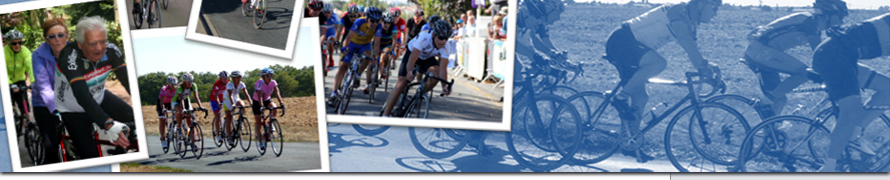
From The Rotarian Magazine: Culture: Life in the bike lane
Like a lot of us, I spent much of my childhood riding bikes, but fell out of the habit for a while. Forty years. Then my wife and I moved to New York, where cyclists risk their necks in a daily Thunderdome of cabs, police cars, firetrucks, double-decker buses, messengers on motorbikes, and delivery trucks backing around corners at 20 miles an hour. Not for me! At least not until my 50th birthday, when my metabolic furnace flamed out. Calories started going directly from beer bottle to beer belly. It was time to start exercising. Either that or give up Samuel Adams, and I couldn’t do that to Sam.
I started on a stationary bike in a gym. Working up a sweat while watching TV, I could see how many calories I was burning: about 200 in a half-hour at a smooth pace, enough to cancel out one beer. I felt stronger and more alert afterward, but there was something unsatisfying about being an aging, balding guy working hard to get nowhere. Call it a midbike crisis – I longed to get outdoors again.
On my 55th birthday, my wife bought me an all-black cruiser with fat tires and wide handlebars. That bike is as indestructible as I feel when I’m on it. Riding around Manhattan, I stuck to bike paths along the Hudson River at first, feeling the wind blowing through where my hair used to be. Little by little I branched out into the city.
I was a late-life convert to a fast-growing trend. “Walking and jogging are awesome, but you cover so much more ground on a bike. There’s no better way to explore a new city or the town where you live,” says Steve Taylor, a spokesman (get it?) for the League of American Bicyclists, a nonprofit group with more than 100,000 members. He calls biking a healthy, environmentally friendly alternative to sitting in a car, “not just for young people or fitness buffs, but for businesspeople who might not have been on a bike since they were kids. It has never been easier for grown-ups to ride, and it’s getting easier every year.”
Each year brings thousands of miles of new bike lanes all over the world. In the United States, programs modeled on those in cities like Paris and Amsterdam are making bike-sharing the Zipcar of human-powered transport. New York’s Citi Bike, the nation’s largest, boasts 100,000 members. Others include Boston’s Hubway and Chicago’s Divvy.
Like most cyclists my age, I’m not out for thrills, chills, or medals. Whenever I’m tempted to race a rider who’s zipping up behind me, I remember the day I spent with Lance Armstrong when he was Tour de France champion. When I asked how he could possibly dominate world-class cyclists who were doping if he wasn’t doping, he gave me an icy look and said, “Hard work. Any other questions?”
I had one. “Any advice for a cyclist my age?”
He looked me over and said, “Don’t fall off.”
I have tried to live by Lance’s advice. Unfortunately, it is practically impossible to ride across the Brooklyn Bridge without running into a tourist. They’re always stepping into the bike lane without warning, smiling for selfies. Later, rubbing Neosporin on my scabs, I console myself by thinking of people all over the globe enjoying photos of their trip to New York, with me as a blur in the background, skidding off my bike.
By now I’ve traversed more than 10,000 miles of the five boroughs, from Tribeca to West Harlem and back, under the Brooklyn, Manhattan, and Williamsburg bridges to the United Nations building, across the 59th Street Bridge to Queens and from there to Red Hook, Brooklyn, where the Statue of Liberty looks you right in the eye – enough mileage to feel I belong here as much as any mogul in a limousine. I can tell you more about New York’s nooks and crannies than Donald Trump, who choppers to a New Jersey airport from a Manhattan helipad that I pass a couple of times a week.
One day I detoured to Grant’s Tomb, a granite colonnade in Riverside Park in Harlem. Guess who’s buried there? Fifty blocks from there, the 40-foot-tall Little Red Lighthouse stands guard over a stretch of the Hudson River that English warships and American colonists once fought over. I took a wrong turn near there and found myself pedaling madly between speeding cars and semitrailers on a ramp to the George Washington Bridge. That was my second-worst wrong turn. The worst was the day I hung a left instead of a right and found myself in the middle of Macy’s Thanksgiving parade. I didn’t know if I should plow through the marching band ahead of me, or stop and sing.
Seven miles south of Macy’s, in a desolate part of Brooklyn, you can pedal across a Superfund site where toxic sludge flows into New York Harbor. Every now and then you’ll see a fisherman pull a striped bass out of the Gowanus Canal. Can’t say I would like to join him for dinner, but it’s good to see signs of life. And that, in the end, might be the biggest difference between biking and other modes of moving. On foot, you can’t cover much ground. In a car, you might as well be in a submarine. On a bike, you get to see and hear and smell the world. You can put down your kickstand anywhere you want.
I often ride a 12-mile circuit from Brooklyn to Queens and back, with a detour over a drawbridge to Roosevelt Island, a thin slab of turf and pavement in the middle of the East River. I set out with supplies in my pockets – nuts, a bagel, a bag of cat snacks – because I’ll be meeting some friends along the way. There’s a colony of feral cats on Roosevelt Island, a dozen notch-eared strays that shelter in a hut that a friendly carpenter built for them. They come out for tuna-flavored treats when I stop by. Sparrows, pigeons, gulls, and Canada geese tussle over bits of bagel. From there it’s four miles to a park where some of the squirrels know me. Riding up to a spot where they nest in an oak tree, I’ll make a clicking noise. The squirrels hear human voices all the time, not to mention car horns, sirens, leaf blowers, and a hundred other city sounds, but only one human clicker. They don’t know English and I don’t know rodent, but they understand the signal: It’s the peanut guy! They pile out of a hole in the oak, one after another, looking for lunch. And in a world of inequality, politics, violence, and other terrors, it’s a relief to spend a minute with creatures that are absolutely delighted simply to get a peanut.
Now my family and I are moving to a college town in Massachusetts. I hear they’ve got more than 1,000 miles of bike trails up there. The squirrels of Massachusetts will have to learn the signal.
Like to bike? Join Rotary’s International Fellowship Cycling to Serve. Find out more at cycling2serve.org.
Kevin Cook’s next book, Electric October, will be published in the fall.

.png)
.JPG)
.png)
.jpg)





.jpg)
.JPG)
.jpg)