David and Ginny Freeman from the Sonoma Valley Authors Festival
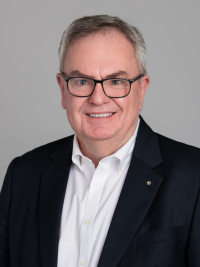
David Freeman
David was in the financial services business for 30 years in Houston, New York and San Francisco, where he held senior management positions. Moving to San Francisco in 1997, he joined Ashfield Capital Partners LLC and was a shareholder in the firm. Prior to this, he was with Bessemer Trust in New York and San Francisco.
While living in New York City, he was a Board Member of Cities in Schools (now Communities in Schools), a program developed as a safety net so underserved youth could get the assistance they needed to help them stay in school.
During his 17 years in San Francisco, he was a Board Member of Episcopal Charities, Merola (part of San Francisco Opera) and President of the Northern California Chapter of the American Liver Foundation and on the Vestry of St. Mary the Virgin Episcopal Church.
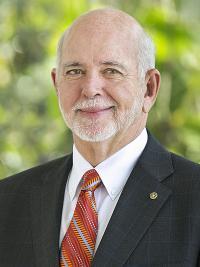
Ginny Gustafson Freeman
Ginny has spent her life trying to engage both the left and right sides of her brain! She was recruited from Purdue University, where she earned her B.S. degree in Management, by Arthur Andersen & Co. to work for their consulting group in their Chicago HQ.
She relocated to San Francisco to work for Bank of America in tech support then joined IBM, later Lexmark, where she achieved recognition in sales, staff and management roles. At one time, she concurrently owned a retail store on Union Square. After 22 years in the corporate world, Ginny became a self-employed Executive Assistant and for 12 years provided her technical and creative skills to high-net-worth clients, family offices, and foundations.
In her third career, Ginny started PixElation LLC after coursework at San Francisco’s Academy of Art University. Her most significant project was supervising the duplication of a set of family photos that spanned a period of fifty years and included over 15,000 individual images that were electronically captured, printed, and bound as well as digitally organized and stored.
As a member of a private women’s club, she became chair of the program committee, where she helped organize several dozen speakers, authors, and field trips for the membership and was energized by the shared learning experiences. When David retired in 2015, they decided to move to the wine country and partner together in creating the Sonoma Valley Authors Festival in honor of their mothers, who were lifelong readers and learners.
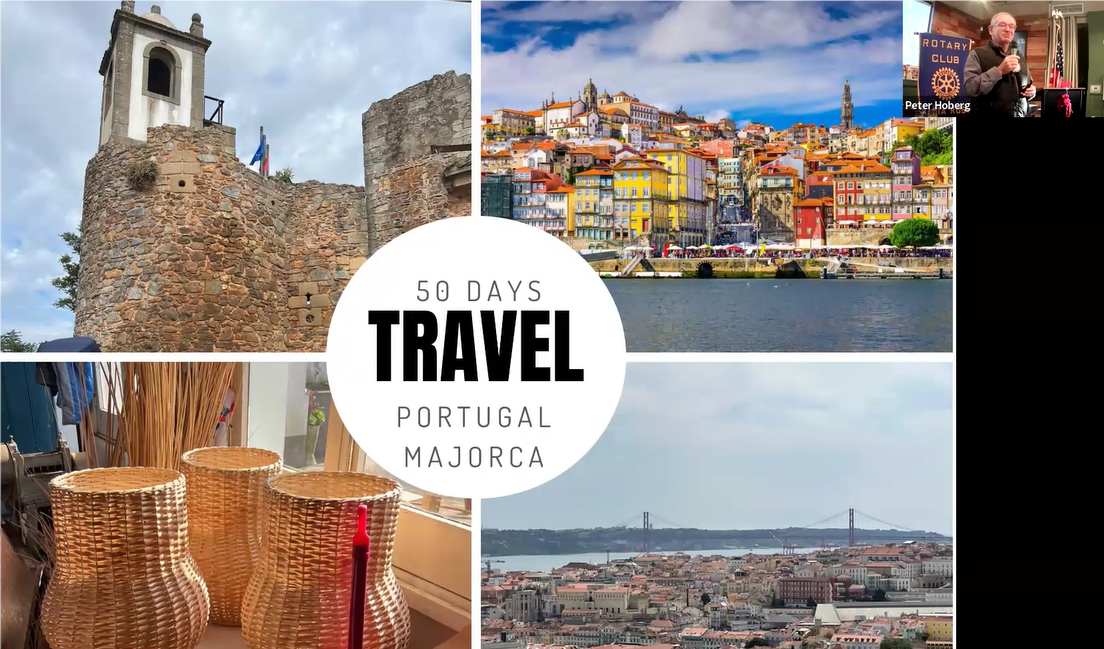
John Jones' 50-day Vacation to Portugal and Spain!
Our speaker for Thursday, February 8, 2024, was our own Sunrise Rotarian, John Jones. A brief bio for those of you who don’t know John well: he grew up in Sonoma County, graduated from Sonoma State University, and joined Linkenheimer LLP, an accounting firm, in May 1977, immediately after graduating from SSU. John is a past president of the California Group of Accounting firms, Chairman of the Board of Elders at St. Mark Lutheran Church, board member of San Juan Rio Relief. He has been a member of Sunrise since 1986 and is currently Sunrise’s International Service Chair. John spearheaded of Sunrise’s successful long-term effort to build, equip, and staff a surgery center in Sabalos, Nicaragua. John is also the non-titular head of Sunrise’s expert eye examination staff and has personally examined over 20,000 villagers for cataracts, pterygiums, and vision prescription needs.
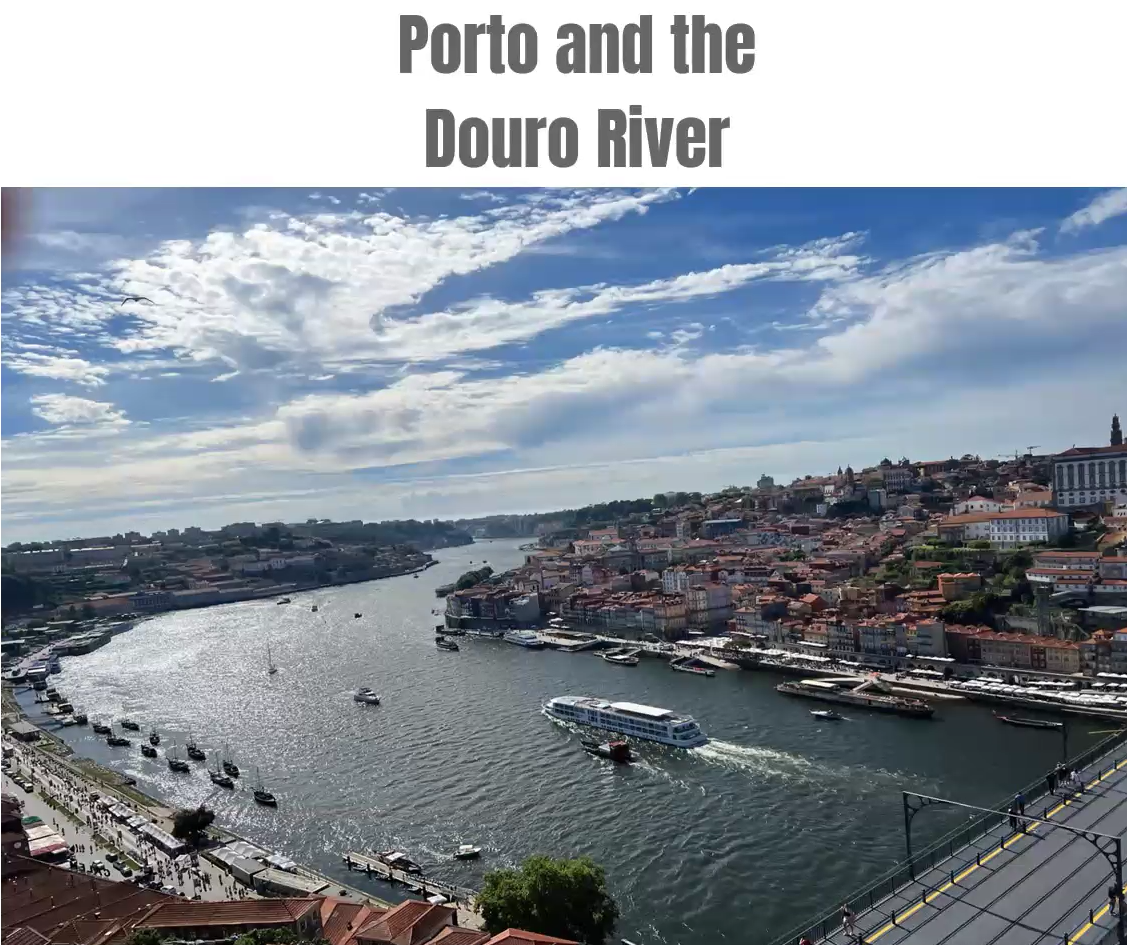
John presented his 50-day trip to Spain and Portugal in the summer of 2023. This extended trip was in part a pre-retirement exercise; John wanted to know what it would be like to be out of the office for 5-6 weeks (he liked it!). John traveled with his wife, Ardys, and with other friends and relatives for parts of the trip. They flew into Oporto in Portugal, flew to the Azores, back to Lisbon, and then on to Majorca. In Portugal, John and Ardys took a riverboard tour of the Duero, one of the most significant rivers in the Iberian Peninsula. The trip took John and Ardys through the beautiful wine region of Portugal, home of the famous “port” wine and others.
The Azore Islands are part of Portugal but located in the middle of the Atlantic Ocean about 2 ½ flight time west from Oporto. The Azores consist of 14 volcanic islands. The Islands were the setting for the novel Moby Dick, and you can still see whale observation stations on some of the islands. Back in the day, when a whale was sighted the community got into their small whaling boats and set out after the whale!
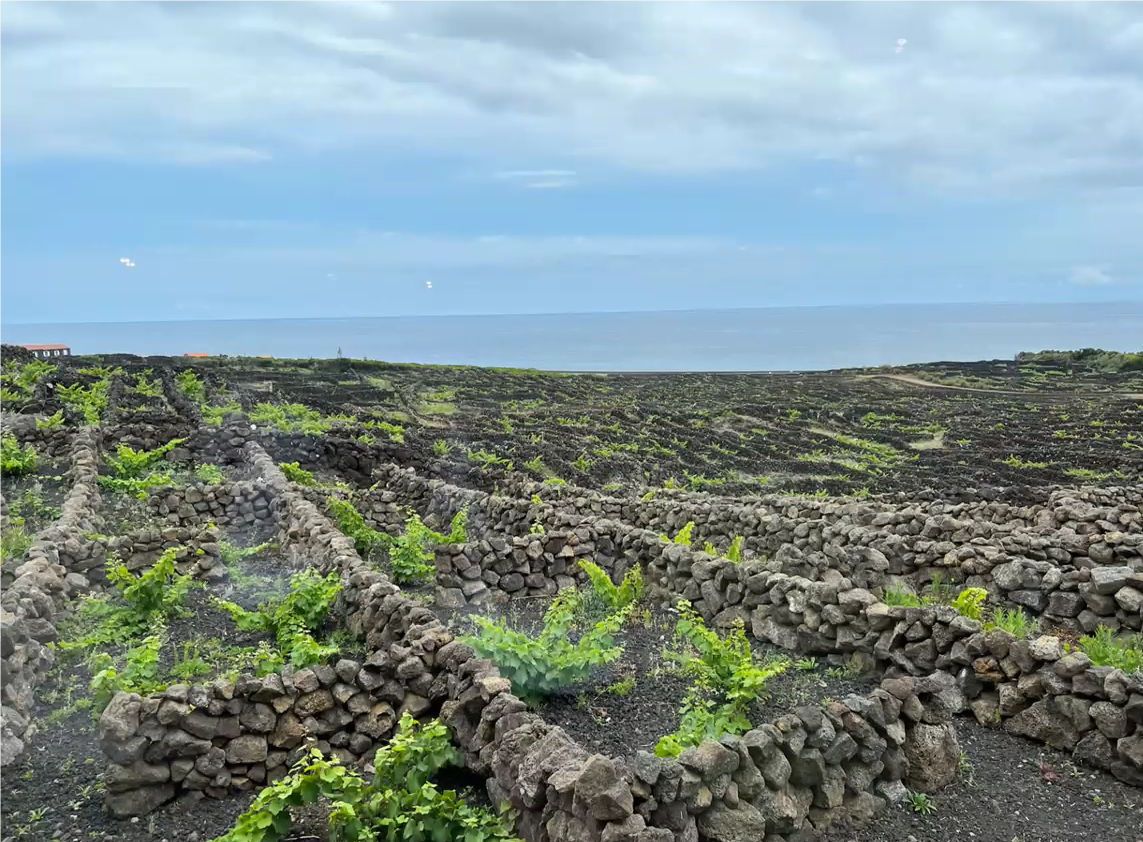
John also noted that wine grapes are grown in the Azores, but it is so windy they build small rock walls around the vines to protect them from the wind! There are no indigenous mammals in the Azores. Thus, protein in the Azores is almost entirely based on seafood.
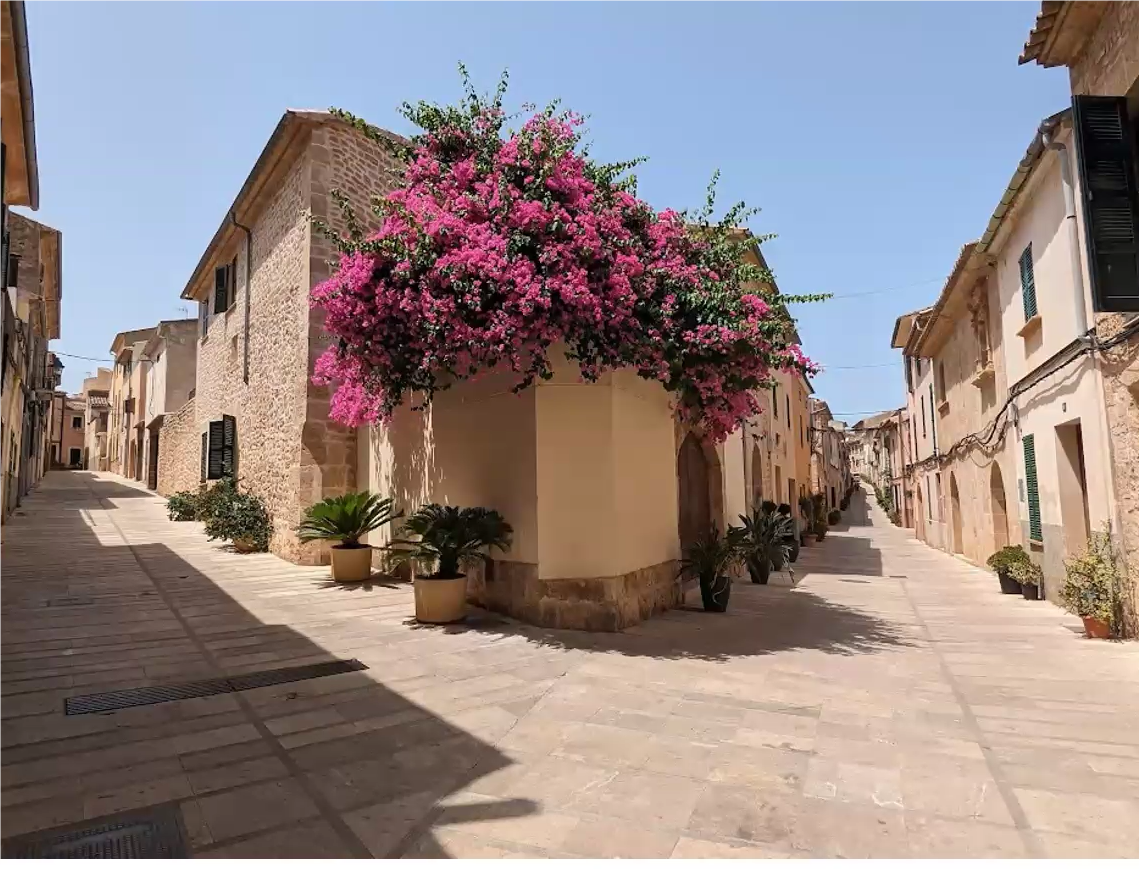
The next stop of the journey was Lisbon, which reminds John of Barcelona without the glitz. Lisbon has great food, nice people, and good prices! From Lisbon, John and Ardys flew to Majorca, which is situated in the Mediterranean about 180 miles south of the Barcelona, Spain. Majorca is a major European tourist destination, and has beautiful beaches, lovely cities, and great food and wine. Majorca is one of John’s favorite places in the world! John’s extended family, including children and grandchildren, met him in Mallorca for a fun-filled vacation.
Thank you John for transporting us to Spain and Portugal for a few lovely minutes! What an amazing trip!
Click HERE to view a limited time recording of John's presentation.
On a regular basis, our resident photo pro Warren Smith, submits pictures of what is going on at the weekly meetings. You can always find the most recent pictures at the websites photo journal called "Meeting Sighting" Please note that all the meeting photos for the entire Rotary year are at this location with the most recent on the last page.
Thanks for all the great pictures Warren!Link to Meeting Sightings. The most recent are on the last page!
President Debra announced the day as "Fat Thursday" -- the day before Lenten denials take effect -- when all are encouraged to feast on doughnuts. But alas, doughnuts were not served at the breakfast meeting. However, the devout could. substitute mini turnovers and sweet bread slices for doughnuts until lunch, when the delightful circular pastries could be obtained.
I am enthused and encouraged by your embrace of mental health initiatives throughout the Rotary world. More than 1,000 of you have responded so far to an ongoing survey by the Rotary Action Group on Mental Health Initiatives, offering your feedback on what Rotary can do to improve the personal well-being of members.
The top suggestions are illuminating. Rotary members are asking for more fellowship, camaraderie, conversation, cohesiveness, and connection. They also want more recognition, validation, and integration. They are seeking more service opportunities, and they want more wellness activities, including mental health speakers, awareness efforts, and education.
Our members not only appreciate the greater focus on mental health, but they also believe that making more of the Rotary experience will materially improve their lives. I find it interesting that members are not asking anything dramatically new of their club — rather they want more of what we do best. For example, connection can be improved during meetings simply by assigning seating once each month to encourage people to speak with someone new.
Here are some great ways that we can help achieve these results and make Rotary more appealing to those considering membership. First, we need to acknowledge the importance of increasing belonging in our clubs and to encourage Rotary members to make the most of every opportunity for new and stronger connections. Public health experts worldwide are concerned about increasing levels of loneliness — the U.S. surgeon general has even declared it an epidemic. Mental health experts agree that finding groups and clubs around common hobbies and interests is a strong way to create greater connectedness. This is what Rotary is all about. We need to make sure all of our members are fully engaged and that our communities are better aware of this inherent strength.
Second, if your club has found new ways to build connection, please share your stories with us at mindhealth@rotary.org so we can make them more broadly known within the Rotary world. Your good ideas might inspire others. Post your service project stories on Rotary Showcase.
And finally, I encourage you to share feedback from surveys like this with your club and bring forward your own ideas to improve your club experience and meet your peers’ expectations. The journey we have begun is about more than mental health. It is about taking advantage of the full strength of our wonderful organization and helping all members feel that they are part of a community that cares deeply about their personal well-being.
Everything you do to strengthen connections in Rotary, with each other and the people we serve, also helps improve mental health. And everything we do to improve mental health helps strengthen those connections. Let’s continue this virtuous cycle.
Following the news is challenging these days. Stories of war and violence are deeply discouraging. It breaks my heart when I hear about innocent bystanders, particularly women and children, who are caught in the crossfire of conflict.
Is there anything we can do about it? We certainly can’t turn away from the problem. I think in these times, we need to shift our focus from what we can’t change to what we can do. We can also support what we know works.
February is Rotary’s Peacebuilding and Conflict Prevention Month. It is one of our areas of focus because peace is central to everything we do in Rotary. Even though most of us aren’t diplomats at the negotiating table or peacebuilders working on active conflicts, in Rotary’s singular way, what we do works to promote peace and prevent conflict somewhere, every day.
Every Rotary member should remember this during the month of February: When you support any of the areas of focus of The Rotary Foundation, you are contributing to peace. Foundation grants that address fundamental issues — such as a global grant focused on enhancing basic literacy in a community — will cultivate a better understanding of the world and lead to greater economic stability, laying the groundwork for peace.
You can say the same for all the areas of focus, from the environment to economic development. They help stabilize communities, lift families out of poverty, and foster the pursuit of education.
Peace is and always has been interwoven into the fabric of Rotary beyond our projects, too. In 1999, when we established the Rotary Peace Centers through a visionary initiative of our Foundation, we reaffirmed this commitment. This month, we are once again renewing that vision, with Bahçeşehir University in Istanbul, our host partner for the newest Rotary Peace Center, as it takes its first steps to prepare for the initial cohort of students arriving in early 2025.
All along the way, as Rotary has evolved into a global force for good, it has championed peace and understanding in countless ways, and our Foundation remains the great driving force behind that vision. It will be part of Rotary’s eternal legacy.
And by supporting our work, you will be able to say that you are a part of that legacy. You can directly support it by visiting rotary.org/donate and selecting peacebuilding and conflict prevention as the area of focus.
So, yes, there is a lot you can do to support peace and prevent conflict. The next step is up to you.
There are Rotary clubs in more than 200 countries, including some of the world’s most remote locations. Indeed, it’s accurate to say Rotary has spread to virtually every corner of the globe. Here, meet six far-flung clubs and learn what they do.
St. John’s, Newfoundland and Labrador, Canada
In Nuuk, Greenland, the aurora borealis fill the sky.
Mark Malik Nordlund Madsen/Lisa Germany/Guide to Greenland
St. John’s has five Rotary and Rotaract clubs. Founded in 1921, the 60-member Rotary Club of St. John’s is the oldest in this Canadian province. “Rotary is wonderfully represented in our small city,” says Ron Burke, the club’s president. The provincial capital of Newfoundland and Labrador, St. John’s has just under 110,000 inhabitants. The city’s Rotary clubs do not see themselves as competitors, but pool their forces to make a difference. Together, they created the Rotary Sunshine Park, a recreational area with a water pier, a leisure center, and a chalet that can be rented for overnight stays.
Networking with other clubs is especially important in an area where cities are separated by long distances. In June, District 7815 held a conference in Moncton, New Brunswick, attended by Rotarians from four provinces. “It is expected that our district will continue these annual conferences to promote cooperation, networking, and the exchange of best practices and initiatives,” Burke says.
Recently the St. John’s clubs bought a house for a local organization that aids homeless veterans. “We paid for new furniture, created a community room that will bear Rotary’s name, and provided rent subsidies for residents. The club agrees that this should be a long-term project,” Burke says. That should not be a problem for a club that has existed for 103 years.
Fairbanks, Alaska
The Rotary Club of Fairbanks, Alaska, USA is now 84 years old. The 95-member club’s lunch meetings are always well attended. club member “Usually, it’s business relationships that lead to new memberships,” says club member Jonal Lani Machos. “It’s also not unusual that in a small town like Fairbanks, new members are already known beforehand.”
The Rotary members are looking forward to the completion of a multi-year project in May. The club invested US$500,000 to build a large playground. The club maintains a close partnership with the Rotary Club of San Ignacio, Cayo, Belize. There have been mutual visits in recent years, always combined with projects. For example, the club supported the construction of sanitary facilities at several schools in and around San Ignacio.
Helgoland, Germany
Members of the Rotary Club of Helgoland, Schleswig-Holstein, Germany must travel at least two and a half hours by ship to visit another club. The nearest one is located about 60 kilometers from the island, which lies on the North Sea coast. A total of 1,300 people live there. In such a small community, “the bond among the members is strong,” says club member Bärbel Wichmann.
The 25-member club has just celebrated its 30th anniversary. After several fundraising projects at various island festivals, the club recently gave the local school two suitcases of learning materials for “End Plastic Soup,” an initiative of Rotary clubs across Europe. Another project, “Food on Legs,” delivers food to seniors by handcart. The club also worked closely with the Rotary Club of Otterndorf-Land Hadeln, Lower Saxony, Germany, to send aid to Ukraine. “We find this cooperation very enriching,” Wichmann says.
Tarawa, Kiribati
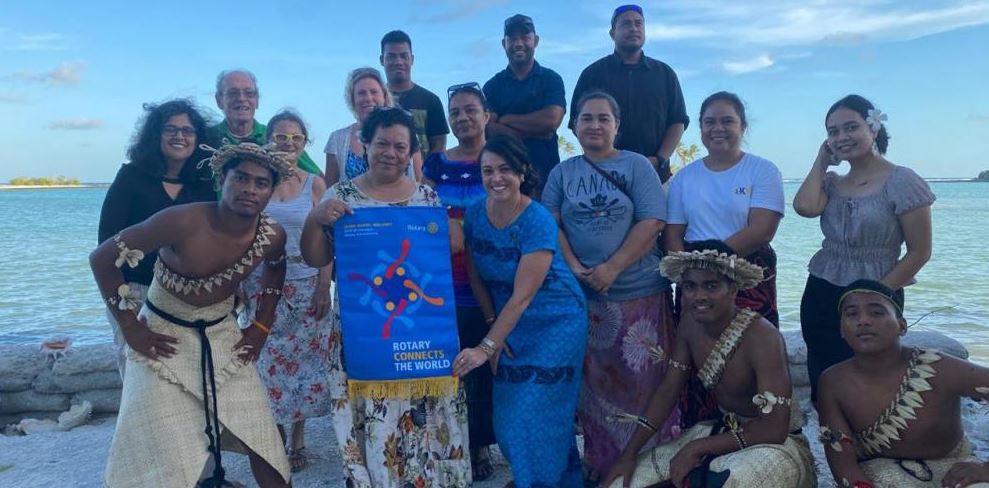
Members of the Rotary club of Tarawa, Kiribati
Rotary Club of Tarawa, Kiribati
District 9920 includes half of Auckland, New Zealand, as well as the American territory of American Samoa and the Pacific nations of the Cook Islands, Fiji, French Polynesia, Samoa, Tonga, and Kiribati. There are 53 Rotary clubs in the district, a third of which are located in the Pacific countries. The Rotary Club of Tarawa, Kiribati, founded in 2019 on the country’s main atoll, has 10 members. It is 2,230 kilometers from the next nearest Rotary club on the Fiji Islands, and has carried out projects worth nearly US$2 million, including immunizing children on 21 inhabited islands of the Gilbert Islands group as part of “Give Every Child a Future,” an initiative of Rotary Zone 8.
Saint Pierre and Miquelon, France
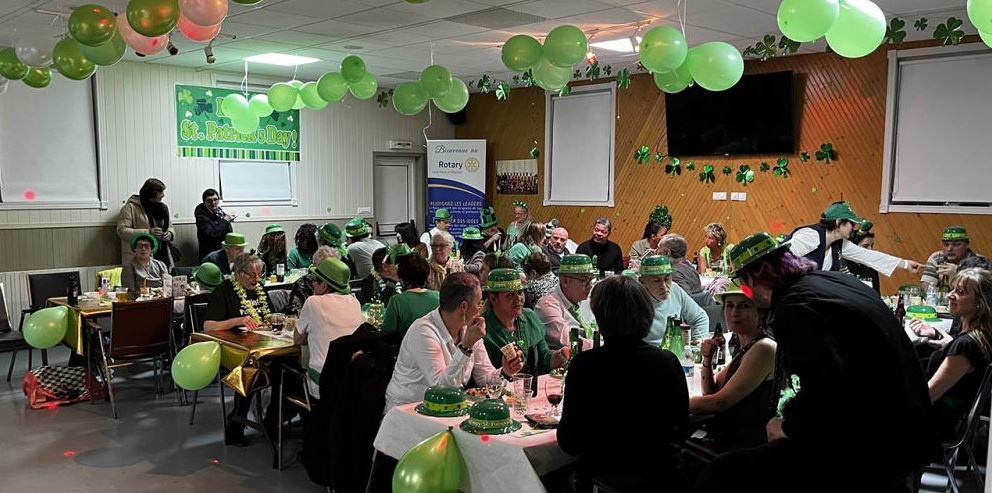
Members of the Rotary Club of Saint-Pierre and Miquelon, France, celebrate St. Patrick’s Day.
Rotary Club of Saint-Pierre et Miquelon, France
The 21-member Rotary Club of Saint Pierre and Miquelon was chartered in 1989 on a small archipelago of 6,000 inhabitants, 25 kilometers south of Newfoundland that is part of France. inhabitants
It is the only French club in Canadian District 7815, which includes the four Atlantic Canadian provinces of: Newfoundland and Labrador, Nova Scotia, New Brunswick, and Prince Edward Island. Due to the isolated location, club members tend to work together with local service clubs and other associations.
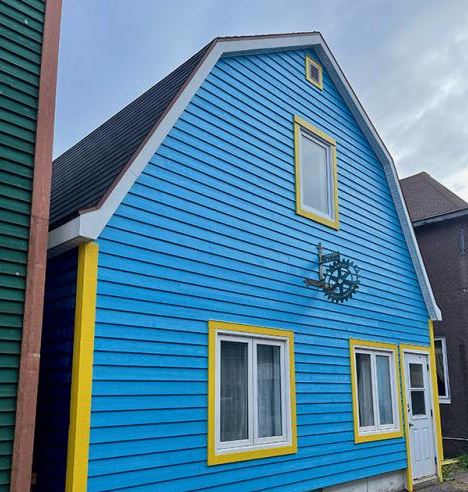
In Saint-Pierre and Miquelon, the Rotary club owns a brightly painted clubhouse – in blue and gold, of course.
Rotary Club of Saint-Pierre and Miquelon, France
In the past year, members have organized 15 projects and events, including a bingo night in partnership with the local radio station that raised money for End Polio Now. They also helped set up a free library in the town square.
Saint Pierre and Miquelon will host its first district conference in 2024. The incoming governor, Roger Sévigny, is a member of the local club.
Shetland, United Kingdom
In 1972, the Rotary Club of Shetland, Shetland Islands, Scotland, took root on this archipelago which lies between Orkney and Norway where the North Sea meets the rugged North Atlantic. The club is located in Lerwick, the main town and port of the archipelago. “Since the nearest club is 129 kilometers away, there are no activities with other clubs,” club member Susan Stout says.
Since residents of the island travel infrequently, service is what connects the 17 members. . A recent dinner raised money to support local charities.
The club capitalizes on space in the public square, where they promote Rotary to the island’s 7,000 people. “We have a stand at a large local agricultural fair to advertise our club,” Stout says.


.png)






.png)