Thursday, November 8th at 11:30 (in your seats then please). If you have not purchased your tickets yet please bring a check made payable to the club for $30. Next step is to invite and bring a veteran.
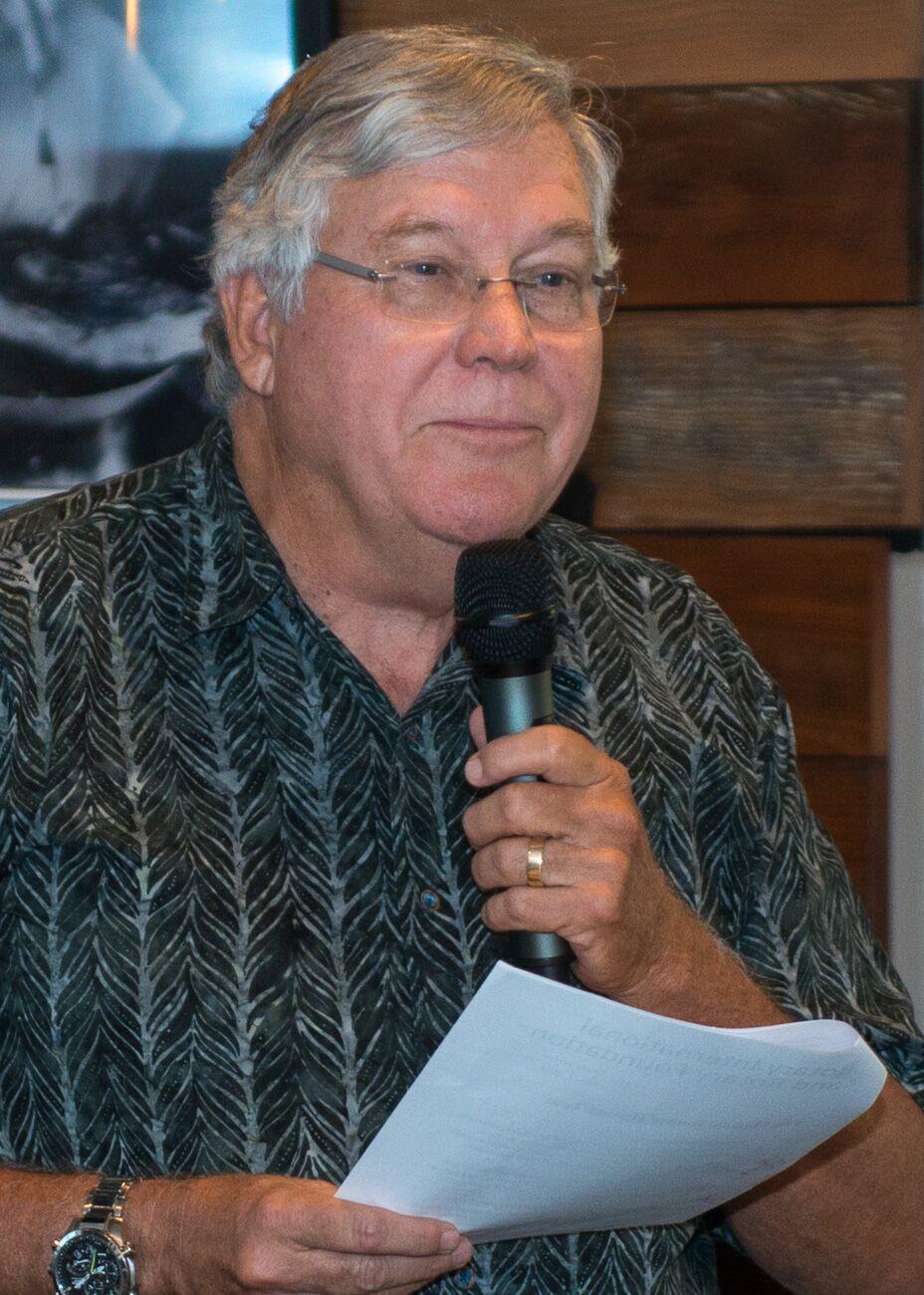
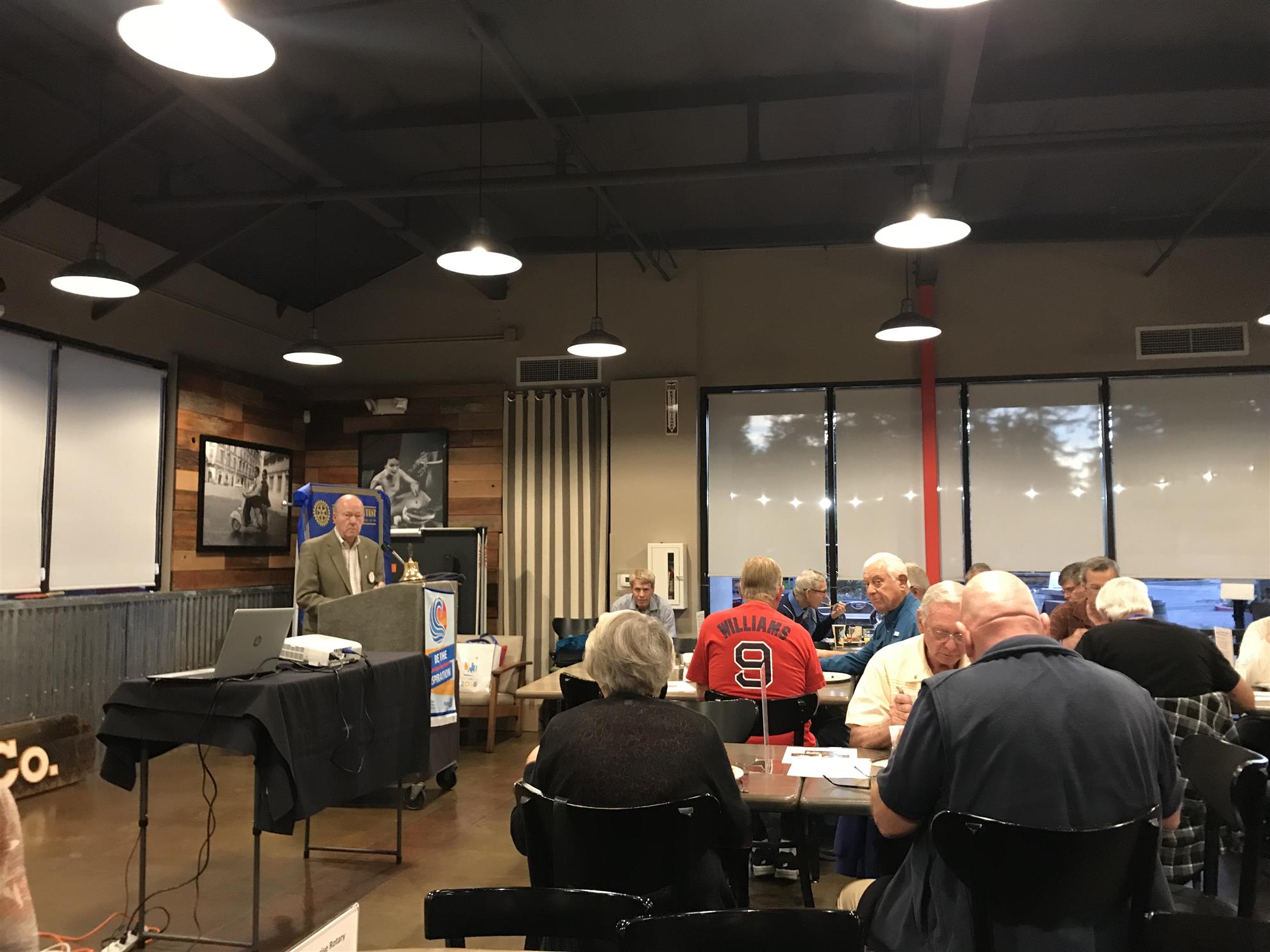
Randy Seelye, our Foundation Chair, gave us a “Magical Rotary Mystery Tour” through Rotary’s long involvement in promoting worldwide peace, including some information about the history of Rotary’s efforts towards that goal.
Rotary International has long worked for international peace. Our own club’s international projects, including SRKSEP, Sabalos, and our other eyeglass projects, demonstrate our dedication to developing peace through international involvement. Rotary International itself was instrumental in helping start the United Nations. Back in 1942, Rotary was one of the prime instigators of UNESCO, a precursor of the United Nations. Rotary and UNESCO continue sharing a common goal; the furtherance of peace through education, science and culture. We have been partners with UNESCO since the end of World War II in the development of international scholarships awarded by Rotary and managed by UNESCO.
Our Peace Scholar program has resulted in 100 peace scholarships, with 6 peace centers worldwide. The goal is to develop scholars with critical conflict resolution skills. At one time a Peace Center was located in Berkeley. In fact, our member, Del Raby, was involved in the program when it had an office in Berkeley.
Two years ago the Rotary Foundation was named the best charity in the world. The Foundation has six specific goals: promoting peace, providing clean water, saving mothers and children, supporting education, growing local communities, and fighting disease. The Foundation is largely driven by fundraising by local Rotary clubs. Our own club has donated a total of $423,103 since our inception. 91% of donations to the Foundation are spent directly on its programs.
The Foundation’s main funding vehicle is the Annual Fund. Annual Fund donations go to the Foundation. Three years later 50% of our club’s donations come back to our District and are typically given back to the clubs and used again by the clubs in the form of donations and service projects. Our club has benefited from this ‘refund’ by recently funding musical instruments and a goat barn for Elsie Allen.
Our contribution goal this year is $13,000. We are almost ½ of the way to meeting this goal. Randy acknowledged the contributions made by Peter Hoberg (our designated Polio Rider), in generating these contributions through sponsorships for his riding. Randy also outlined the various categories of Foundation donations, including benefactors, bequest society, major donors ($10,000) and Paul Harris Society members ($1,000 annually).
Thank you, Randy, for this Magical Journey. Your work as Foundation Chair, and your long involvement in Foundation projects is much appreciated!
On a regular basis, our resident photo pro Warren Smith submit pictures of what is going on at the weekly meetings. You can always find the most recent pictures at the websites photo journal called "Meeting Sighting" Please note that all the meeting photos for the entire Rotary year are at this location with the most recent on the last page.
Thanks for all the great pictures Warren!Link to Meeting Sightings. The most recent are on the last page!
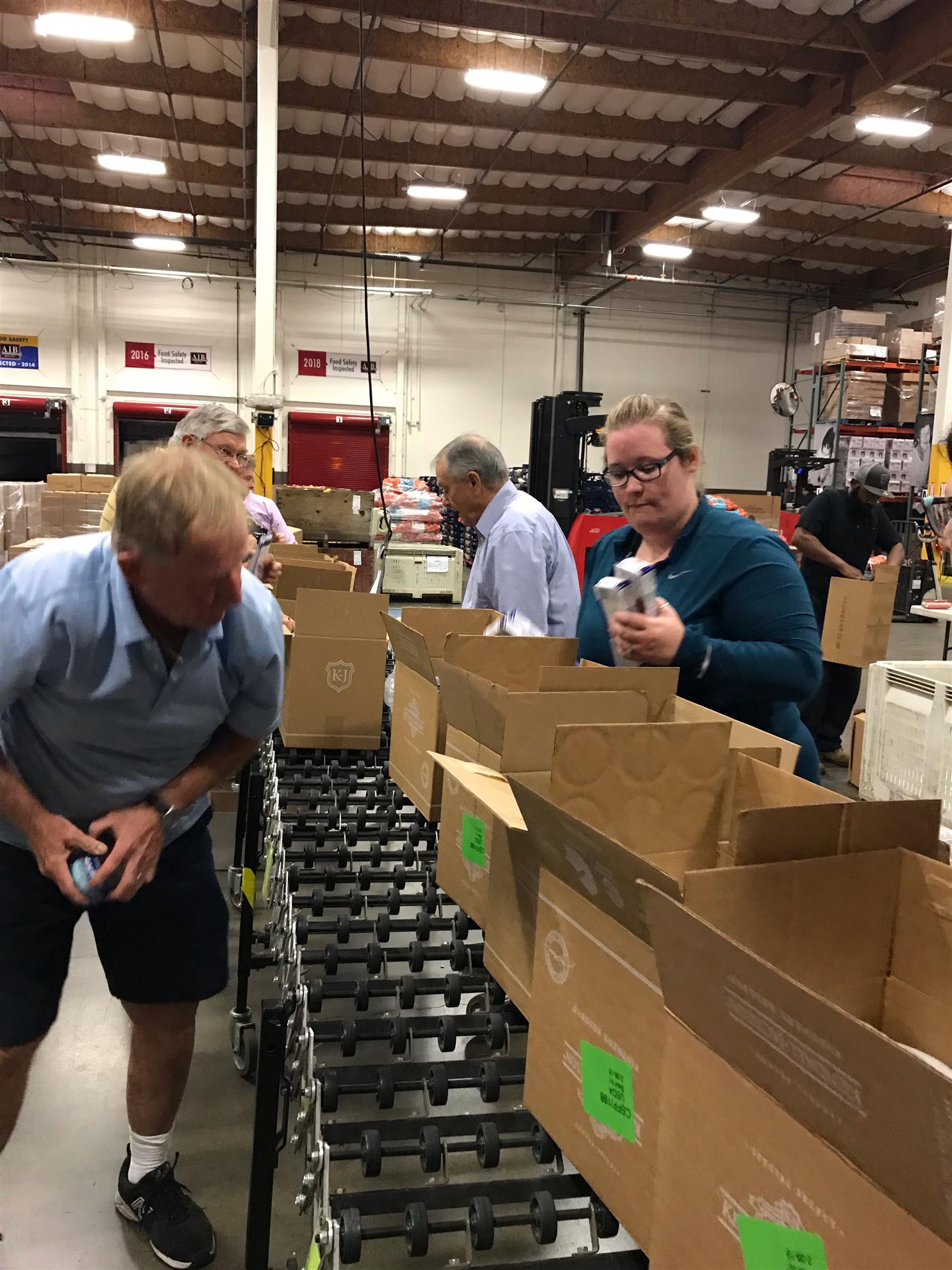
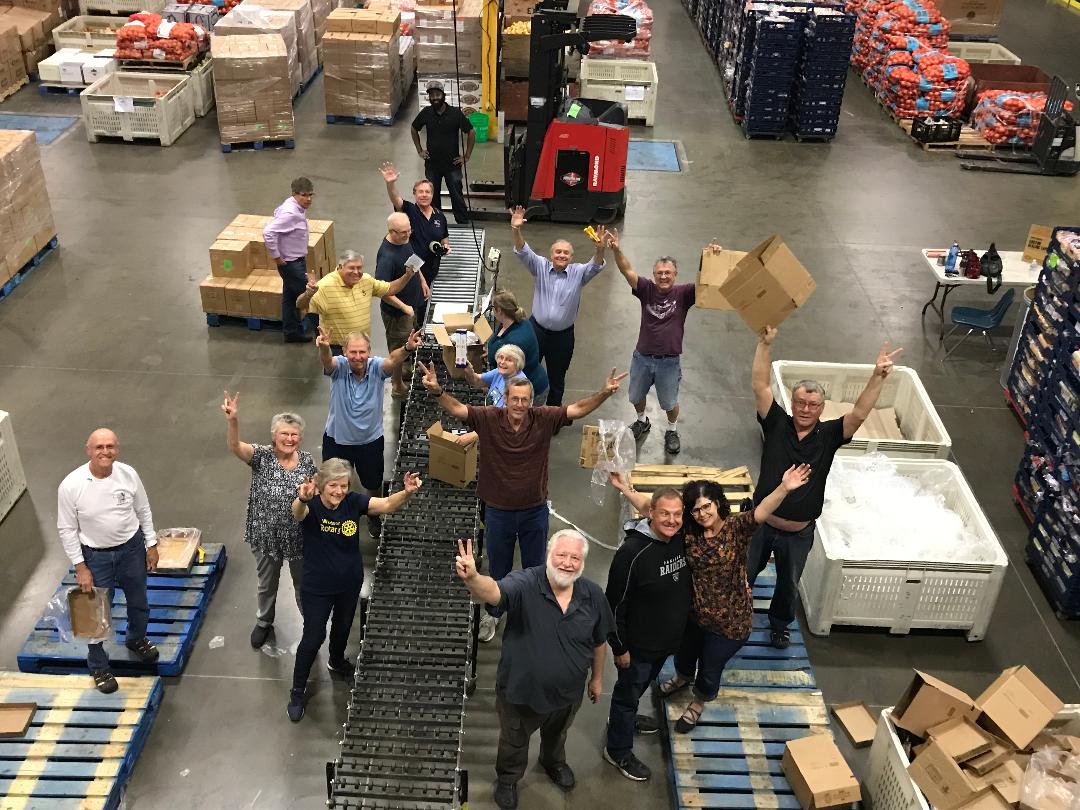
For all of us who ever watched Lucille Ball and Vivian Vance in their chocolate àssembly line routine, this was our chance to be in front of the camera! Thanks to Jennifer Adams Service Director, Sunrise teamed up with Windsor Rotary last Thursday and boxed hundreds of 22.75 pound cartons of nutritious foodstuffs including recipes for distribution to seniors in need.
Ask any members listed on the sign in sheet and they will tell you just how fulfilling their hour plus serving was! And, there weren't any dishes or clean up!
This schedule was so well received it is likely to become a repeat in the months to come Seconds please!!
One early June, more than 30 years ago, I had a business trip scheduled to Las Vegas. I had been a Rotarian for about six years, and I thought of myself as an active member: I attended every meeting, I’d served as club secretary, I knew everyone in my club. But for me, Rotary was very much a community organization. It connected me to Nassau and perhaps even to the Bahamas — but no farther.
I had never given much thought to Rotary beyond the Bahamas, and it had never crossed my mind to travel to a Rotary convention. But that spring, I realized that my trip to Las Vegas would coincide with the Rotary International Convention and thought, why not? I sent in my registration and paid my fees, never suspecting that the experience would change my life.
When I walked through the doors of that convention, I was stunned. It was one thing to know that I was part of a global organization with over a million members around the world. It was something else altogether to stand there in the middle of it. I went to every general session, looked in at every booth at the House of Friendship, and learned about projects that I hadn’t even known you could do in Rotary. That convention didn’t just open my eyes. It opened my mind. It inspired me to completely change the way I saw Rotary, what Rotary could do for me, and what I could do through Rotary. That inspiration has stayed with me ever since — and is renewed every year, at every Rotary convention.
In June 2019, Rotarians from all over the world will converge in Hamburg to Capture the Moment at the 110th Rotary International Convention. Many, like me, will have been coming to conventions for years; many others will be coming for the first time. Whether they’re looking to connect with old friends, to find inspiration for a new Rotary year, or simply to see what Rotary is all about, each of them will find their own moment in Hamburg.
Hamburg is a port city that connects Germany to the world and that has been an economic and cultural hub for centuries. It’s a wonderful place to visit — to stroll the shores of the city’s lake, take a boat trip on the Elbe River, dine out, hear great music, and explore fascinating museums. It’s also the ideal place to kick off a European vacation.
If you’re a regular convention goer, you absolutely won’t want to miss out on the friendship and inspiration you’ll find in Hamburg. And if you’ve never been to a convention, please consider this my personal invitation. Register at riconvention.org by 15 December for the best rate — and let this convention Be the Inspiration for your Rotary journey.
Every year we celebrate November as Rotary Foundation Month. How fortunate we are to have a world-class Foundation that allows us to do so much good in the world. We should all take pride in the fact that something good happens every second of every day because of Rotarians and our Rotary Foundation.
Remember how excited we were at the 2017 Rotary International Convention in Atlanta, where we celebrated the Foundation's first 100 years? The fundraising goal for that year was $300 million, and, as you recall, we raised $304 million to exceed that goal. It was a landmark year for the Foundation.
In the 2017-18 Rotary year, as the Foundation entered its second century of service, we had an even more ambitious fundraising goal of $360 million. At the convention in Toronto in June, outgoing Trustee Chair Paul A. Netzel told attendees that we once again had a landmark year for our Foundation, setting a one-year fundraising record of $373 million.
This year our fundraising goal totals $380 million. Our goal for polio is $50 million, which will be turned into $150 million through the Bill & Melinda Gates Foundation matching grant. Add to that a $137 million goal for the Annual Fund, $61.5 million for the Endowment Fund, and $31.5 million for global grant cash and other outright gifts, and our many programs will be fully funded and Rotarians will be completely equipped and empowered to continue making real change.
Now, it's up to you and me. We have the chance to forge a path of ever-increasing relevance and influence — to choose the direction and tempo of the Foundation's second century.
I'm challenging you to increase your involvement in our Foundation — by doing, by giving, and by inspiring. Together we can make tomorrow even brighter than today. We can make every month Rotary Foundation Month. So, Be the Inspiration, build your Rotary legacy, and let's make this yet another landmark year in our history.
1. How did your club first get involved with the community of St. Helene?
Rotary District 5370, which includes the Edmonton, Alberta, area, had done playground projects in Belize. About six years ago, they wanted to build two in Honduras, in communities where you’d least expect it. We worked with them as the host club to get interested communities to apply, including one about a 45-minute boat ride from here called St. Helene. Like many villages in the developing world, it had no water, poor sanitation, no electricity, not much of an economy, health issues, and a school with no books and no materials to educate the children. But the people there wanted a playground and had a piece of land to donate.
The Canadian Rotarians spent about two weeks on this island building the playground. They promised they’d come back and do more. Our Rotary partners in Canada asked us as the local Rotarians to do a community assessment to learn about the priorities of the people in the village.
2. Can you describe how you carried it out?
We started with a community meeting, which was well-attended. But it was primarily the village council that did the talking. The others — moms and dads, the elders — sat in the back and nodded. Then we did focus groups that were much smaller, eight or 10 people, which did not involve the community leaders. That was very interesting, because some of the things the people were telling us were right in line with what the village council was telling us, but we heard other things, too. They were very open about the struggles the community is facing and the lack of opportunity for themselves and their children.
The other exercise that was really interesting was called community mapping. You let members of the community draw a map of their village. Some things are important to people in different ways. The school is important to people with children; the clinic is important to just about everyone. It’s another way to get them talking about what they have and what they don’t have, and what they need.
The process cost very little — our total expenses were under $600 — and it was worth every penny.
3. What did you think the community needed before you conducted the assessment? What did you discover?
This probably applies in many developing contexts — when you go into a poor community, the people there will take whatever help you want to bring. They’re not going to say no to a project. But that doesn’t mean that my idea of their greatest need is the same as theirs.
I went in with the preconceived notion that we’d do a water project. But we learned so much through the community assessment. Our Canadian partners said, “We want to do all of this.” Now we’re taking a holistic approach to address the needs of the community through a series of global grants, starting with a $156,000 grant to provide St. Helene with a clean and sustainable water system and a $176,000 grant to establish a public school that will extend local education through high school (it currently ends after sixth grade). That wouldn’t have happened without the community assessment — we would have just gone in and done a water project, and that would have been the end of it.
4. What advice do you have for other clubs?
Follow the community assessment guide on Rotary.org. I was involved in real estate development in Wisconsin for 17 years before I moved to Honduras, and a community assessment wasn’t anything I was familiar with. I was nervous about it. But the guide walks you through different methods. It’s something that we as Rotarians can do ourselves, and we can learn a lot doing it.
• Illustration by Viktor Miller Gausa. Read more stories from The Rotarian.
Rotary Club of Santa Rosa Sunrise - Founded June 30, 1986

.png)
.jpg)

.JPG)
.png)



.jpg?_=636770623211009415)
.jpg)
.jpg)


.jpg)