The United States officially began its withdrawal from the World Health Organization (WHO) earlier this year through a presidential executive order. Under the mandatory one-year notice period, the U.S. exit from the WHO and the cessation of funding would take effect around January 22, 2026.
At the same time, many governments are retreating from the globalism that defined the post–Cold War era and are reducing financial support for UN agencies, which now face deep funding shortfalls.
As the United Nations confronts an existential crisis, community groups that played an important role in the UN’s founding and have long enjoyed close partnerships with the institution, must once again step up to help the world body navigate its current challenges.
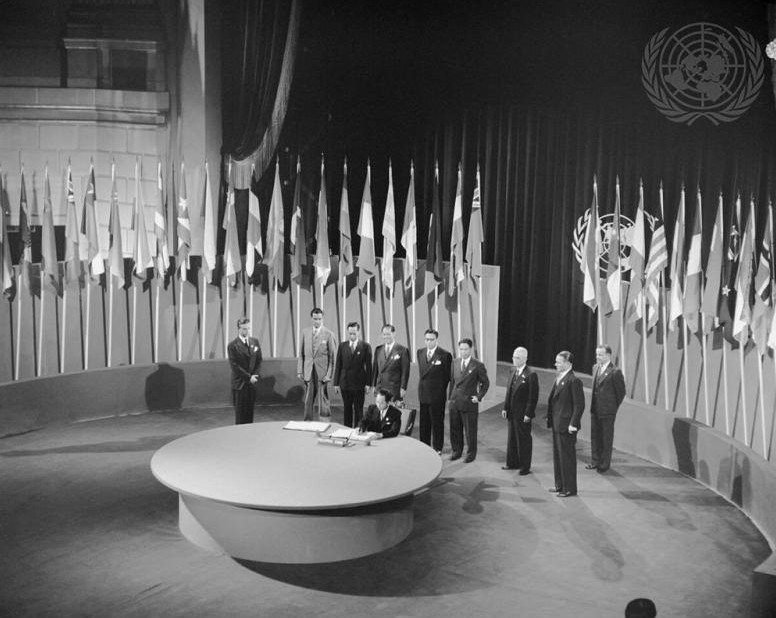
Brigadier General Carlos P. Romulo, a Rotary member, resident commissioner of the Philippines to the United States, and chair of the Delegation to the Philippines Commonwealth, signs the UN Charter at a ceremony held at the Veteran's War Memorial Building in San Francisco, California, USA, on 26 June 1945.
Photo courtesy of UN Photo/Yould
The term “United Nations” first appeared in the 1942 Declaration by United Nations, a document signed by 26 Allied nations during World War II as an attempt to prevent future global conflicts. Two years later, delegations from the United States, Great Britain, the Soviet Union, and China met in Washington, D.C., to develop a proposal for the structure of this global peace-making body.
In the period leading up to the 1945 UN Charter Conference, many Americans embraced “America First” isolationism and were skeptical of global governance. In response, Rotary and many large international civic organizations were tasked by the U.S. government with a critical mission: using their global reach to broaden public support for an intergovernmental organization dedicated to fostering cooperation, maintaining peace, and addressing global challenges. Through conferences and membership publications, Rotary promoted this visionary concept of a world body that promised to “save succeeding generations from the scourge of war.”
Their efforts paid off. When delegates from 50 nations gathered in San Francisco in 1945 to negotiate and finalize what became the UN Charter, the U.S. State Department invited Rotary and 41 other nongovernmental organizations to serve as consultants and technical advisers during the negotiations.
These NGOs were not mere observers. They brought persuasive advocacy and specialized expertise that helped shape the treaty. Their future role was ultimately enshrined in Article 71 of the UN Charter, which authorizes the Economic and Social Council to establish formal channels for consultation with NGOs. This provision ensured that civil society would have an institutional voice within the UN system.
Although the UN initially functioned primarily as a forum for sovereign states, the global landscape has changed dramatically over the past eight decades. Civic organizations have expanded rapidly at the local and national levels—particularly in developing countries—and today they represent a powerful “third force” in international affairs.
In recent years, I have attended numerous major UN conferences. Nearly all of them, whether focused on women, food security, or climate change, have been accompanied by robust NGO forums designed to broaden participation and help shape global agendas. As former UN Secretary-General Boutros Boutros-Ghali once observed, “NGOs are an essential part of the legitimacy without which no international activity can be meaningful.”
Civic organizations amplify citizen concerns, monitor compliance with international agreements, and help implement them. They bridge the gap between global policy and everyday life through public campaigns, community programs, and initiatives such as Model UN.
Perhaps most importantly, they bring scale. Rotary operates in more than 200 countries and geographic areas, mobilizing millions of volunteers. Rotary became a founding partner of the Global Polio Eradication Initiative in 1988, alongside the WHO, UNICEF, and others. As a result of this collaboration, global polio cases have fallen by 99.9 percent.
Many civic organizations also align their work with the UN Sustainable Development Goals, advancing progress on inequality, climate change, hunger, public health, and education. They promote peace by addressing root causes of conflict, such as poverty, lack of opportunity, and injustice, through joint development projects with UN agencies and people-to-people exchanges, including youth programs and international scholarships. Their efforts also include mediating dialogue as neutral parties and delivering humanitarian aid.,
At this critical moment for the UN and its agencies, civic organizations must continue to do what they do best: educate the public, mobilize grassroots networks to support the UN’s work, use storytelling to shape public opinion, and advocate with governments and legislatures to sustain financial commitments.
We will also continue partnering with the UN by leveraging our on-the-ground networks to provide access, sharing specialized expertise in areas such as health, food, and shelter, and using our agility and community trust to deliver aid during disasters and conflicts. Just as importantly, NGOs can help raise funds to fill the gaps left by governments. Between 2024 and 2025, Rotary was among the largest contributors to the World Health Organization.
In a world marked by conflict and political polarization, the United Nations remains a beacon of hope for millions. The WHO embodies that hope through science and global cooperation against health threats. Our longstanding partnership with the UN demonstrates how much stronger the world can be when citizens and governments work together.
John Hewko is a lawyer, public policy scholar, and serves as CEO of Rotary International.
— December 2025



.png)