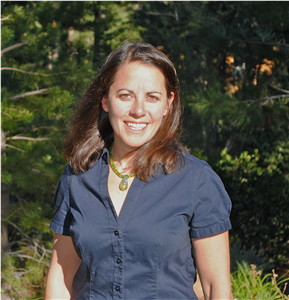
As Tahoe Fund CEO, Amy leads efforts to secure private funding and support from individuals, foundations and corporations for environmental improvement projects that improve Lake Tahoe. Amy has raised more than $20 million from private donors helping to secure more than $80 million of public funding. The Tahoe Fund’s portfolio includes projects that restore lake clarity, enhance sustainable recreation, promote healthier forests, improve transportation, and inspire greater stewardship of the region. In addition to helping ensure completion of more than 130 projects, she worked with 30+ partners to create the region’s first collaborative stewardship campaign, Take Care, to change the culture of caretaking in the Tahoe Region. Prior to joining the Tahoe Fund, Amy was director of marketing and communications for the North American arm of renewable energy giant ACCIONA. In this role she was a member of the management committee and responsible for corporate branding, internal communications and product marketing. She led the company’s communications and stakeholder engagement activities for more than 1,00MW of wind and solar developments, and worked with industry groups to lobby federal and state leaders for policies to expand renewable energy throughout the US and Canada. Amy began her career at Saatchi & Saatchi and Ogilvy & Mather in NYC. She has garnered attention for various brands in a variety of media outlets, including ABC’s “20/20”, NPR, and the New York Times. Her experience includes work with IBM, Johnson & Johnson, General Mills, and the National Crime Prevention Council. Amy was appointed to the Nevada Outdoor Recreation Advisory Council by Governors Sisolak and Lombardo and serves as the Vice-Chair. She is a federal appointee to the Lake Tahoe Federal Advisory Committee, received the "Spirit of the Lake" Award from the TRPA, a member of the International Women's Forum, and was named a Reno Gazette Journal “Twenty under 40” honoree. She volunteers with SOS Outreach as a mentor and serves on the Lake Tahoe School Board of Trustees. She graduated from Brown University where she was an All-American sailor. You can often find her out exploring the trails or enjoying the Lake.
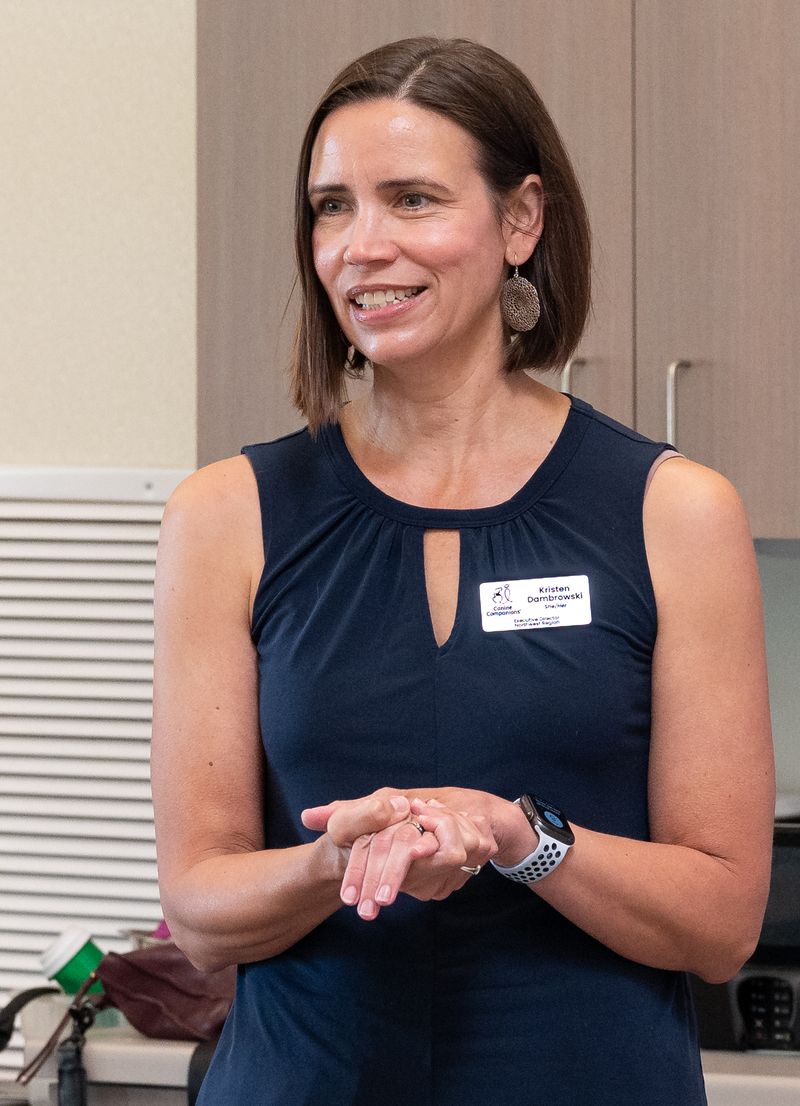
A Tour of Canine Companions Hosted by Kristen Dambrowski
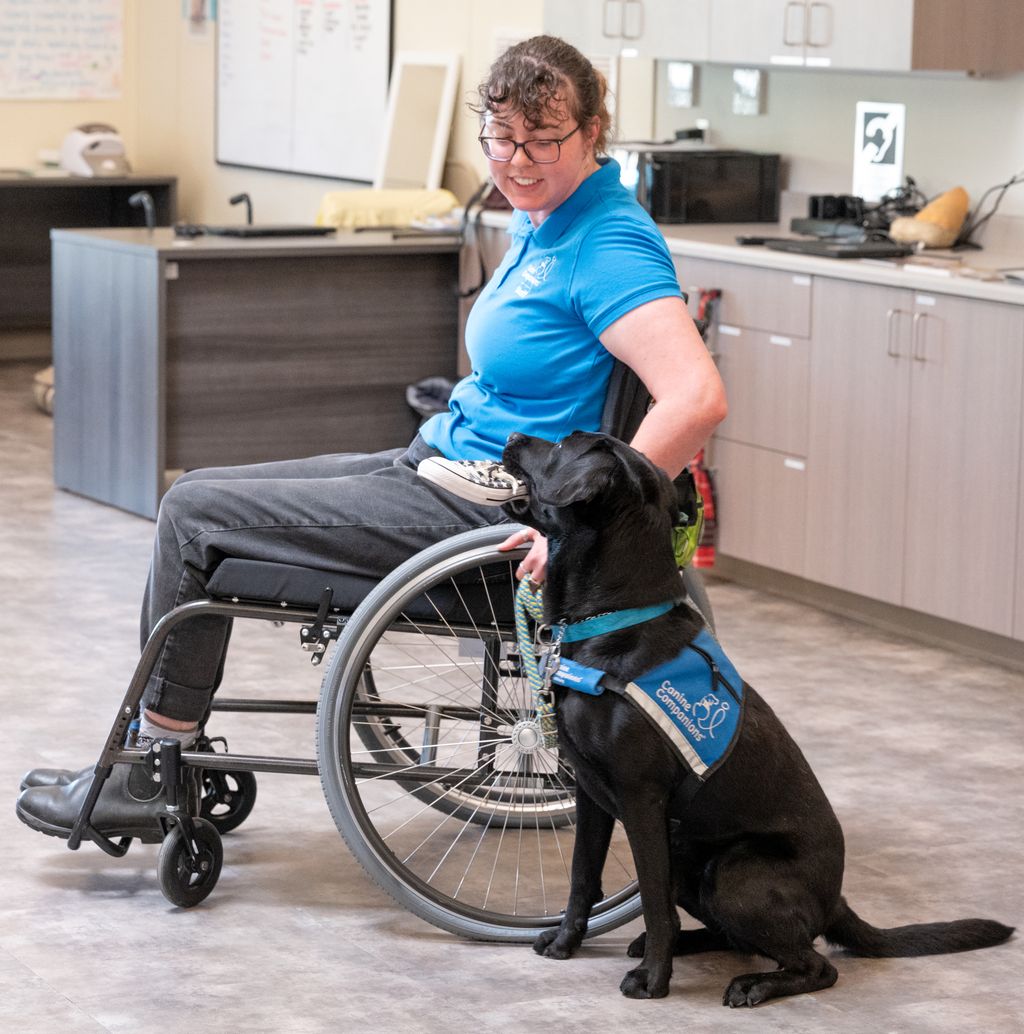
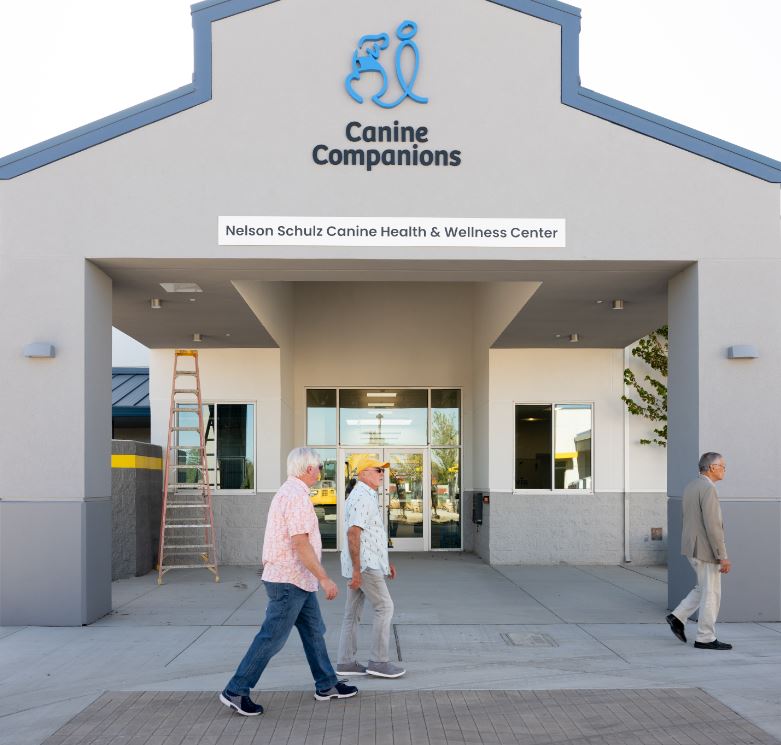
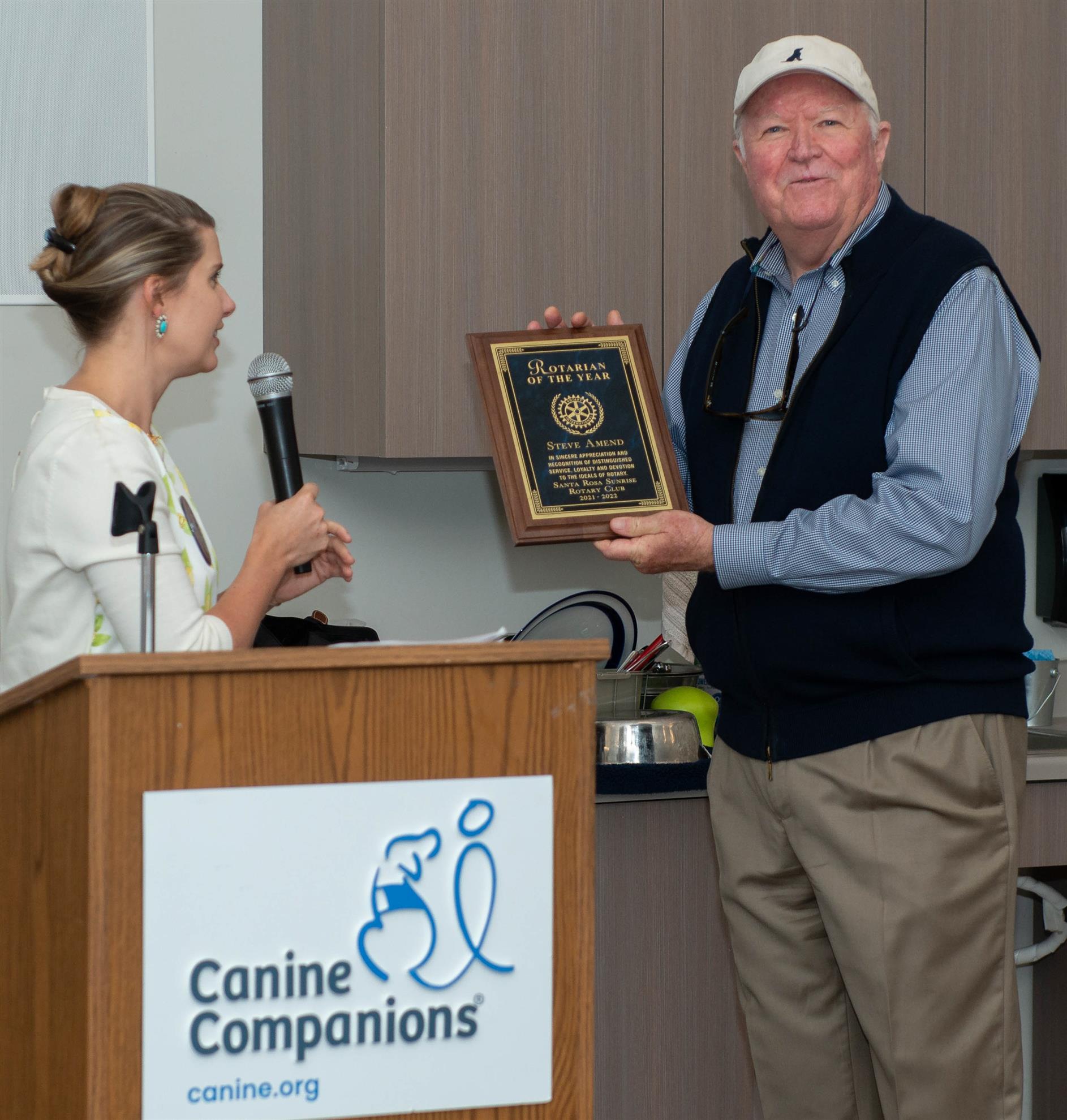
Our meeting for June 6, 2024 was a field trip to Canine Companions on Dutton Avenue. Kristen Dambrowski, Northwest Regional Executive Director, was our tour guide! Kristen has a master’s degree in Nonprofit Administration University from the University of San Francisco. She joined Canine Companions in July 2022. Her past experience includes 21 years with the YMCA of San Francisco. We also received a live demonstration of what Canine Companions dogs can do from Lauren, a trainer, and the remarkable Moby, a canine trainee! The trip also allowed Santa Rosa Sunrise Rotary to deliver a donation to Canine Companions in person.
Canine Companions was founded in Santa Rosa almost 50 years ago. Its founder recognized that dogs can support people with disabilities in a variety of ways. It is now a national organization with 6 campuses. It provides service dogs to adults, children, and veterans with disabilities, and facility dogs to professionals working in healthcare, criminal justice and educational settings. It has placed over 5,000 dogs since 1975 and currently has 4,300 volunteers. All of its dogs are scientifically bred and trained for their jobs. The dogs are labs and golden retrievers. The training life cycle starts with birth at a Canine Companions facility. From 8 weeks to 18 months the dogs are raised by volunteers in the volunteers’ homes and taught basic manners. The dogs then “graduate” to professional training at a Canine Companions facility for 4-6 months, where they typically learn 45 tasks/commands. After another 3 months the dogs are assigned to their new clients. There is no charge to the clients for these dogs!
Well trained companion dogs can assist their owners in variety of ways. They can assist people with PTSD by waking them or pulling bed covers away during nightmares, creating space for them in crowds, waking them up, and providing them with deep pressure. Hearing dogs can save lives by alerting people to sounds. Lauren and Moby demonstrated a variety of techniques used to retrieve fallen items, including the 3 nodes of delivering items to people in wheelchairs; stepping up to hand them to their clients, “visiting” people by laying their chins on the wheelchair’s arm, and bringing their front paws up to the person’s lap. Lauren also noted a variety of additional skills taught in professional training, including tugging doors and drawers open, pushing them closed, turning lights on and off, and nudging people to interrupt their behavior. Moby is an extremely motivated dog!
We also toured the new, state-of-the-art veterinary clinic at the facility in the final stages of construction. Once completed, Canine Companions will have the capacity to provide health care services onsite to all of its dogs! Kristen also told us about the prison program at Coffee Creek in Oregon, San Quentin, and other incarceration facilities. Puppies are raised by prisoners until they begin their professional training. The program has a positive impact on puppies and prisoners alike!
Thank you, Kristen, Lauren, and Moby for the great and highly informative tour. This is such an amazing program! Keep up the great work!
On a regular basis, our resident photo pro Warren Smith, submits pictures of what is going on at the weekly meetings. You can always find the most recent pictures at the websites photo journal called "Meeting Sighting" Please note that all the meeting photos for the entire Rotary year are at this location with the most recent on the last page.
Thanks for all the great pictures Warren!Link to Meeting Sightings. The most recent are on the last page!
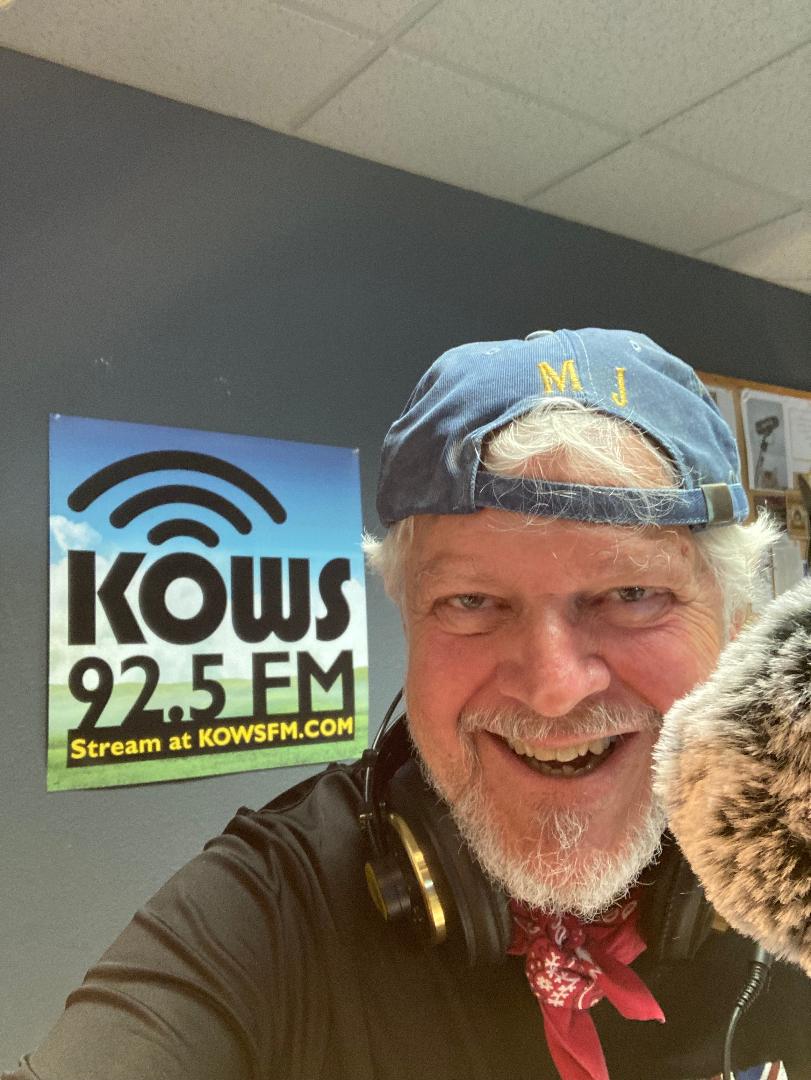
M.J. Girard is currently an on air personality on KOWSfm.com His “Roots of Rock” is broadcast every Sunday morning at 7 AM
Ah...summer approaches, and the livings easy, or so says the song! So much to contemplate, should I pull weeds, or just watch them grow? Maybe I can put on my favorite tunes, pop in my ear buds and accomplish two things at once!
Let's reflect upon our past summers, from our earliest recollections of listening to the radio, on a transistor, to the family car as we drove to a destination and tuned into whatever station we could find.
What songs do you remember most, Elvis, the Beach Boys, Tom Petty, the Stones, the Fab Four, think back... wouldn't it be nice to have them available to bring back those fond memories while enjoying our beautiful county, the heart of the North Coast, where peace, harmony, tranquility and quiet are shared with our community.
Support the local entertainment scene, encourage the artists to excel in their craft, and of course, send your song request directly to me, and I will do my very best to send them your way. During this summer the "Roots of Rock" will be featuring the "Songs of Summer"... tunes that will bring back those smiles of yesteryear!
It’s customary for a Rotary president in the final month in office to recap the past year on this page, and I am proud of all we have achieved together. But I want to focus on our future, and that begins with polio.
We have reached an astonishing 3 billion children with the polio vaccine, and we have averted an estimated 20 million cases of paralysis. But it’s not enough. We must continue supporting the End Polio Now campaign to reach zero cases and keep our promise to the world’s children.
Polio is not our only global commitment. In fact, Rotary has been working toward global peace even longer. Spreading Positive Peace through service projects and Rotary Peace Centers around the world is more important than ever.
We must also continue to build peace from within, and that begins with supporting mental health and wellness among our fellow Rotary members and the communities we serve. Rotary has an opportunity to help build a global mental health system that currently does not exist, and I urge all members to consider joining the Rotary Action Group on Mental Health Initiatives to keep up the momentum we began this year.
It’s been the honor of a lifetime to serve as your president. You have given Heather and me memories we will cherish forever. I look forward to our continued friendship and our collective commitment to Create Hope in the World.
You can find all prior "RI President's Messages" at this LINK
Every June, we in Rotary look back at our accomplishments and plan for what’s next. For me, this month is the end of seven years in Rotary leadership that began as president-elect of RI.
It’s remarkable how far we have come during that time, and how much we’ve done through The Rotary Foundation. We wouldn’t be where we are without your support and without you dreaming big.
A few months back, I saw these big dreams when I visited a hospital in India where doctors perform 4,200 pediatric heart surgeries a year thanks to a global grant. I will never forget the hospital in Taiwan where ambulances funded by another Foundation grant have doubled the survival rate for heart patients. And these examples barely scratch the surface; your Foundation awarded 1,098 global grants during the 2022-23 Rotary year. Think about the scale of that work — the magnitude of our impact.
Our Programs of Scale initiatives around the world are more proof of how big dreams are becoming reality. We have grant recipients working to end malaria in Zambia, reduce the mortality rate of mothers and infants in Nigeria, and eliminate cervical cancer in Egypt. Soon, our fourth program of scale will get started, dedicated to sustainable farming in India.
Through your support, our dream of spreading peace is growing, with the Otto and Fran Walter Rotary Peace Center set to welcome its first students at Bahçeşehir University in Istanbul next year. And if we hadn’t envisioned a better world and supported PolioPlus, would it have been possible that Nigeria would be declared polio-free, as it was in 2020?
This is why your support of the Foundation is so critical. We set an ambitious fundraising goal of $500 million this year. We are well on our way to reaching the goal, and with the support of everyone reading this we’ll make it. I’m especially counting on Rotary members who have not yet contributed. Whatever you give, know that your gift will make a difference, whether it’s for polio eradication, literacy initiatives, peace education, or any other area in which Rotary excels.
These seven years have been a fantastic run for me. I have met so many passionate leaders in Rotary, Rotaract, Interact, and other members of our Rotary family. You have all inspired me with your drive and the big dreams you dare to dream.
All I can do is say thank you. I can’t wait to see how far those Rotary dreams will take us in the years ahead.
You can find all prior "Messages from the Foundation Trustee Chair" at this LINK
A lot of babies are born at the Alokpatsa Community-Based Health Planning and Services compound, a health center in eastern Ghana. And for years, a lot of those babies were born in the dark.
“We didn’t have any power. What we had were lamps and candles,” says Nelson Addy, a former facility team leader at the center in the Oti region. “When the woman delivering had a tear and we wanted to suture, we found it very difficult. We had to strain our eyes with our phone [flashlights] to do the suturing.”
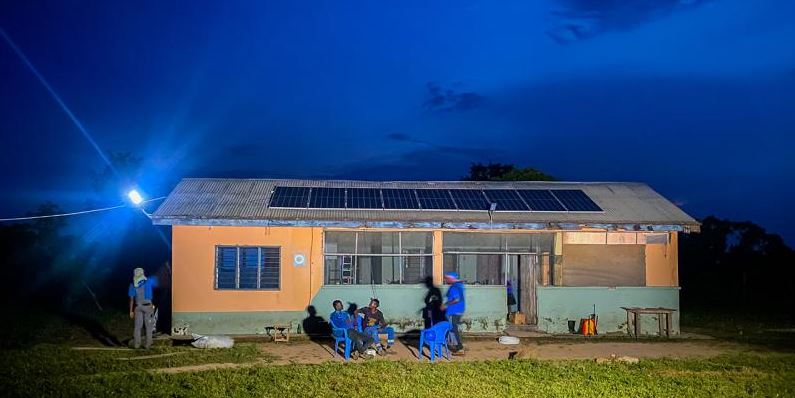
That changed when the Rotary Club of Accra-Spintex, of the Greater Accra region of Ghana, installed a new solar power system at the center. The project included a complete rewiring and, crucially, plenty of lights.
In 2021, the Rotary Club of Accra-Spintex installed a new solar power system at the Alokpatsa Community-Based Health Planning and Services compound in eastern Ghana. For years, many babies had been born there by the light of candles and cellphone flashlights because of unreliable power.
Courtesy of Nortse Amarteifio
“In the surgical ward, we made sure there would be no need for them to use [phone] lights,” says Nortse Amarteifio, the president of the Accra-Spintex club, whose solar company donated labor and some materials for the $21,000 installation. “We also put in solar streetlights all around the compound and on the street in front of the hospital.”
One of the first mothers to give birth after the installation was so delighted with the upgrades, Addy says, she used “Solar” as the name for one of her children. “It felt like it was all planned by nature for the child to see the first light installed in Alokpatsa,” he says.
Solar solutions
Solar energy previously had powered the Alokpatsa health center, but that system was no longer working. Clinic staff members were excited for the return of a solar system. The Alokpatsa installation is one of numerous Rotary projects using solar power to improve access to health care around the world. In the past dozen years, Rotary clubs have installed solar power systems in health centers in Nepal, Haiti, Pakistan, Mexico, Armenia, India, and many African countries — and there’s much more to do. An estimated 1 billion people in lower-income countries are served by health facilities that lack reliable electricity or have no electricity at all, according to a 2023 report by the World Health Organization. In sub-Saharan Africa, only half of hospitals have reliable electricity. Extreme weather, often connected to climate change, is exacerbating the problem, increasing energy costs and damaging power grids.
“Off-grid health facilities need to have access to clean, reliable energy solutions,” says Luciana Mermet, who works for the United Nations Development Programme as the manager of the Global Fund Partnership and Health Systems Team, HIV and Health Group. “And we’re not talking only about solutions in rural areas. Urban areas can also have unreliable power grids. If you don’t have affordable and sustained energy access, you will have situations where you’re delivering [babies] in candlelight or where you’re unable to refrigerate the health commodities you need to provide care.”
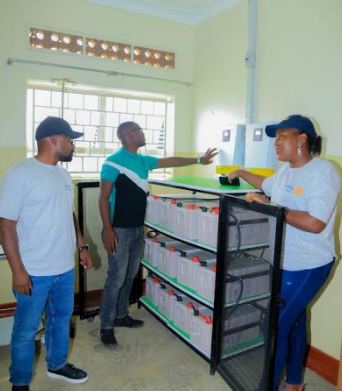
Rotary members in Uganda, including (from left) Joseph Ssuuna, Joseph Ssengooba, and Charlotte Atukunda, led a solar project at a rural health center.
Courtesy of Annie Ninyesiga
Women giving birth in rural areas are among the most affected by such inadequacies, according to the WHO report. It was this problem that galvanized Annie Ninyesiga, president of the Rotary Club of Bwebajja, Uganda, to get a solar system installed at a rural health center in her country. Her club secured a Rotary Foundation global grant in partnership with the Rotary Club of Aarau, Switzerland, to pay for the $76,000 maternal and child health project, which also provided medical equipment, an ambulance, and training for health workers, village health team members, and traditional birth attendants.
“This center serves a very big population in hard-to-reach areas,” Ninyesiga says. “We thought it was important that the people have access to, at least, the basic maternal and child health support.” She adds that solar is superior to the area’s hydroelectric power grid. “The hydroelectric power is not reliable. It’s on and off,” she says. “Sometimes it can’t even charge a mobile phone. Sometimes it provides light but can’t run any equipment.”
Not only do solar panels keep lights shining and equipment functioning, they reduce electrical bills and cut down on the need for generators fueled by expensive — and climate-unfriendly — gasoline. Health facilities then have more funds for patient care. By installing a solar power system at Hospital Bienfaisance in Pignon, Haiti, a Rotary project significantly lowered the hospital’s $4,000 monthly gasoline costs.
Even in areas where there are few or no health centers, solar power can bring health care to people in a very literal way. A few solar panels can enable a doctor to convert a van or trailer into a mobile clinic to serve remote areas.
Revolutionizing vaccine storage
Solar power is also revolutionizing vaccine storage. Many vaccines must be stored at temperatures of 36 to 46 degrees Fahrenheit (2 to 8 degrees Celsius). The oral polio vaccine can be stored at this temperature for six months. In areas with limited or no electricity, or frequent power outages, vaccine refrigerators are often powered by kerosene. They can work only if there’s fuel available, so there may be periods when no vaccines can be stored. Also, this type of refrigerator often provides uneven cooling, spoiling the vaccines inside.
“Sometimes the fridge might not be functioning perfectly — the control is erratic,” says Souleymane Kone, team lead for WHO’s Essential Programme on Immunization. “During the night the temperature might drop down to -1 Celsius [30 Fahrenheit] sometimes, and in the daytime it will go up, exposing the vaccine to excessive heat.”
In 2015 Gavi, the Vaccine Alliance, one of Rotary’s partners in the Global Polio Eradication Initiative, found that up to 90 percent of health facilities in some countries were equipped with old, obsolete, or broken refrigerators. Since then, Gavi, UNICEF (another GPEI partner), and other NGOs have focused on transitioning to solar direct drive refrigerators. First introduced in 2010, these refrigerators are powered directly by the sun without using batteries. The solar energy freezes water or another freezable substance to make an “ice bank” inside the unit that maintains the right temperature after the sun goes down. Costing around $4,000, a fridge can keep vaccines cold for three days or more without the sun shining.
“It is critical for us, especially when looking at increasing the coverage of routine immunizations, that we have a sufficient cold chain storage capacity at all different levels, including the remote areas, including places where there are frequent power fluctuations,” says Anahitta Shirzad, a health specialist with UNICEF’s Immunization Supply Chain program.
“The solar direct drive refrigerators come in very, very handy,” Shirzad says. “They have supported [our goal of] reaching the unreached. We’re looking at the last mile.”
Solar direct drive technology works best with motors such as those used in fans or pumps, while many installations that power whole buildings use solar batteries to store excess energy. At Alokpatsa, the Rotary club solar installation makes it possible to operate a water pump, a sterilizer, and a refrigerator that stores vaccines for two other facilities in the area. It also powers a humbler, but still welcome, piece of equipment: an iron.
“When the lights came, I was able to iron my uniform,” Addy says. “Everyone in the community would now see me as a professional. I felt so happy. I don’t even know how to express this happiness.”
This story originally appeared in the June 2024 issue of Rotary magazine.
The Environmental Sustainability Rotary Action Group can assist Rotary clubs with solar energy solutions and ways to get involved.


.png)






.png)