Bicoleur Vinyards - "How I Went From Tech to Owning a Vineyard"
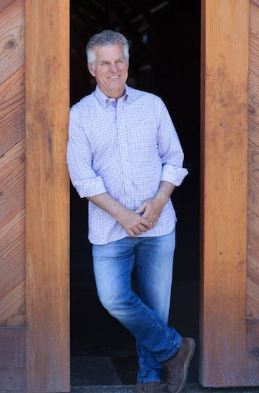
Native born in Santa Rosa, Mark Hanson was raised in Lucas Valley (San Rafael) where he went to Terra Linda High and then to Santa Clara University where he majored in Marketing. He went on to earn his MBA from Golden Gate University. His working career includes Sales and Executive Management for 25 years in Silicon Valley growing four start-up software companies to be acquired by big name companies such as IBM, Adobe Systems, Sybase and Borland Software. His last operating job in the Software Industry, Executive Vice President - Corporate Development at Siebel Systems, he led 20+ acquisitions at Siebel Systems. (Acquired by Oracle). In a departure from the software industry, Mark became an Operating Partner for SF based private equity firm, Genstar Capitol for the last 16 years.
Mark acquired a vineyard property on Starr Road in Windsor 7 years ago. It's a Family Run business with his wife (Elizabeth- married 35 years) and daughter (Sarah). They launched Bricoleur Vineyards wine business in 2017. They have been hosting outdoor wine & food tastings - Thursday - Monday, 10am - 5pm since Memorial Day 2020. Their Public Tasting Room grand opening scheduled for May 2020 (didn't happen due to COVID).
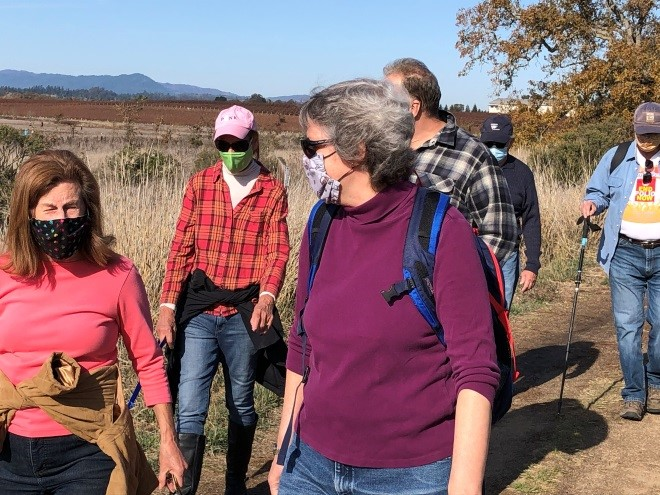
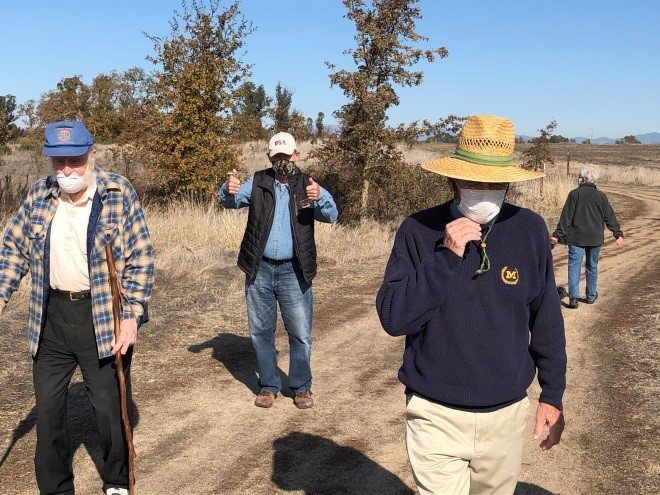
Last Saturday a dozen Sunrisers enjoyed one of the most beautiful crisp mornings in recent weeks on a walk/hike through the Laguna de Santa Rosa. The path was mostly flat and followed the perimeter of what is a vast waterway in the wet season (remember those?). The group, including Stacy Drucker-Andress and friend Steve, Lori Rodriguez, Del Raby, Marty Behr, Peter and Mary Banks, Paul O’Rear, Steve Zwick, Liz Colbert and Roy and Barbara Johnston, enjoyed a two and a half mile out-and-back stroll before enjoying a picnic lunch at the trailhead. Wildlife was abundant, mostly birds, with circling hawks and a pair of ravens perched in a trailside tree spotted. Many locals were also enjoying the beauty of Sonoma County along with various breed of hound in tow. All Sunrisers are encouraged to try and make the last hike of 2020 on December 12 at 10:00 am on a moderately strenuous hike from the top of Oakmont into Annadel State Park- see Marty Behr for details.
From a recovering bank credit guy who had an “aha” moment on newly appreciating sales people when he was pushed into starting his own business in 2011, I had a few thoughts this week on how to approach people to buy our Sunrise Super Raffle tickets:
· You only get one chance with most prospective buyers; make sure you give it your best “ask” out of the box.
· Put yourself in the other person’s shoes- what message about the Raffle would appeal to this person I’m talking to? The work we do in the community, maybe including a cause that they also are passionate about? Our long-standing international projects and the SRKSEP program? Are they travelers?- Ask how they’d like to travel on a luxurious and intimate riverboat down the Rhine River for 10 days. Do they have business connections?- ask if they’re looking for fun, rewardomg and memorable client holiday gifts. Could they use an extra $10,000 (duh)?
· Ask yourself how you would best respond to an “approach”-
- A personal telephone conversation (10 pts.)
- A personalized email with a request (6 pts.)
- A group email with a stock message (1/2 pt.)
· Use the tools in the Sunrise Rotary Raffle tool chest, including our great new promotional Youtube film, our stock description of the Raffle and Sunrise Rotary, either as the basis of a telephone script or an email
· Speak from the heart and be yourself- it always works.
In the face of a pandemic, the important work of fighting polio must continue
Rotary and its partners have mobilized disease-fighting infrastructure to respond to COVID-19 —while remaining dedicated to eradicating polio
by Hank Sartin
The COVID-19 pandemic has created health challenges that go beyond the disease itself. In May 2020, the World Health Organization reported that, worldwide, 80 million children under age one were not receiving routine vaccinations for a variety of diseases. Pausing vaccinations — which involve close contact between vaccinators, infants, and their families — was necessary in the face of the pandemic. But as UNICEF Executive Director Henrietta Fore warns, “We cannot exchange one deadly outbreak for another.”
Amid these challenges, Rotary’s contributions toward polio eradication are more important than ever. In January 2020, the Bill & Melinda Gates Foundation and Rotary renewed their long-standing partnership, committing to raise an additional $450 million for polio eradication over the next three years. Rotary is committed to raising $50 million each year, with every dollar to be matched with two additional dollars from the Gates Foundation. “While response to the COVID-19 pandemic is an urgent global health priority, we cannot let our progress against polio backslide,” says Michael K. McGovern, chair of Rotary’s International PolioPlus Committee and a member of the Global Polio Eradication Initiative (GPEI) Polio Oversight Board. “Our recent success in the African region shows that a polio-free world is achievable, but renewed focus and support for ongoing efforts in the two remaining endemic countries must be prioritized in order to deliver on our promise of a polio-free world.”
In March, the GPEI helped mount a worldwide response to the COVID-19 pandemic, tapping the infrastructure created for polio vaccination and surveillance. All the while, it dedicated funds and other resources to resuming polio vaccination efforts as soon as it was safe to do so, and to adjusting the vaccination and surveillance infrastructure as needed.
Polio experience underpins pandemic response
When COVID-19 emerged, the GPEI brought decades of experience to the response. While critical functions of the polio eradication effort continued, polio workers became involved in contact tracing, testing, and educating communities about hand washing and other ways to reduce transmission of and exposure to COVID-19. In many cases, they carried out both polio eradication and COVID-19 response activities simultaneously.
The polio eradication infrastructure has proved invaluable in the pandemic: GPEI hotlines, emergency operations centers, computers, and vehicles were all enlisted to support the COVID-19 response. In Nigeria, World Health Organization field offices, which are used to coordinate polio eradication efforts, have doubled as hubs for WHO teams focused on COVID-19. In Pakistan, hundreds of polio surveillance officers have been trained in COVID-19 surveillance. In Afghanistan, volunteers who educate communities about polio have been trained to teach people about COVID-19, including hand washing and other preventive measures.
PolioPlus grants continue to fund critical work
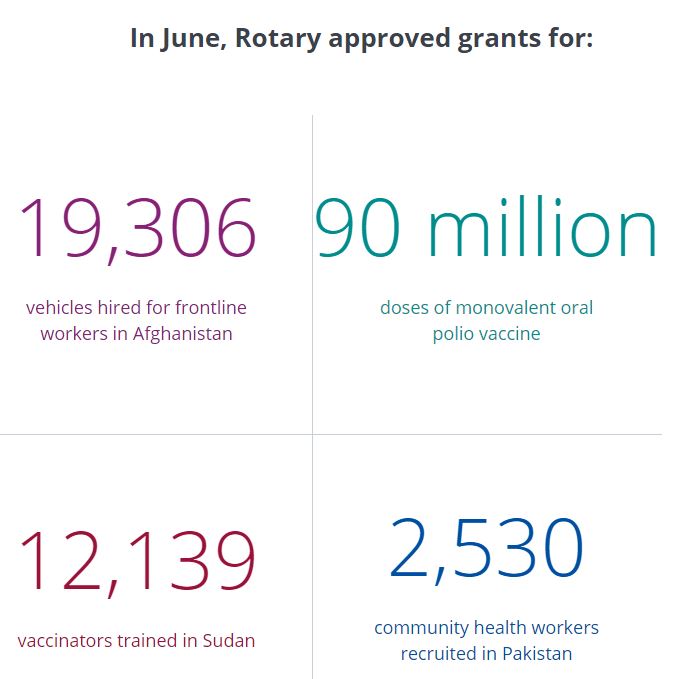
Polio immunization activities began resuming in July, with precautions taken to protect frontline workers and communities. With funding from Rotary members, Rotary issued more than $50 million in PolioPlus grants in June to support polio eradication work in Afghanistan and Pakistan (the last two countries where wild polio remains endemic) and across Africa. In Afghanistan, communications and community outreach work (called “social mobilization”) is crucial; this has included distributing 3 million bars of soap to promote hygiene, protect against polio and COVID-19, and improve local reception of vaccination efforts. In Pakistan, the social mobilization effort has a special focus on outreach to local religious leaders, who can promote vaccinations in mosque announcements and sermons.
In June, WHO committed to funding a Subnational Immunization Day in the Democratic Republic of Congo in the first quarter of 2021. A $3 million grant from Rotary will help fund vaccinations for an anticipated 8.4 million children in that country.
The WHO Regional Office for Africa continues polio surveillance in 47 countries across the continent. A $4 million PolioPlus grant will fund lab and surveillance activities such as collecting and transporting stool samples and conducting training. It will also support procedural changes made necessary by COVID-19.
As Rotary marked World Polio Day on 24 October 2020, members knew that even in the face of a pandemic, the important work of fighting polio must continue. Now more than ever, the support of all Rotary members is needed to help win the fight for a polio-free world.
• This story originally appeared in the October 2020 issue of Rotary magazine.
Rotary Club of Santa Rosa Sunrise - Founded June 30, 1986


.png)

.jpg)