Thank goodness 2020 is over. There’s a vaccine on the way- I know two people who have received their first shot already- but we can’t afford to ease up. No one told the virus that vaccines are being sent out. There is more COVID-19 virus in the community now than at any point in the last year- why start playing Russian Roulette now? Stay inside! Wear a mask! Don’t go where others congregate!
Invite a friend or someone interested in the environment to this Thursday’s meeting, it will probably be the best speaker we have this Rotary year. And given that we will have eight Rotary clubs represented, we will have a lot of fun as well. After all, Rotarians are just the kind of people you want to hang out with, aren’t they? Here is the Zoom link: Click here.
I hope your ticket sales are going well! This fundraiser is a test-drive of what we may decide to continue with in the future as it has the potential to return some of the highest levels of funding for donations with less cost and volunteer hours than past endeavors. I don’t have anything against our fabulous extravaganza auctions (and supported several way more than I intended through sudden giddy enthusiasm brought on by a glass or two), but in an auction we invest quite a bit up front (room, food and drink, entertainment) not knowing how much people will bid. With a raffle, it’s the opposite- there is little upfront cost and we know exactly how much Sunrise Rotary we will receive, since it’s 100% within our control. To quote the mortgage guy, “It’s the biggest no-brainer in the history of mankind.”
A blonde found herself sitting next to a lawyer on an airplane. The lawyer kept bugging the blonde wanting her to play a game of intelligence. Finally, the lawyer offered her 10 to 1 odds, and said every time the blonde could not answer one of his questions, she owed him $5, but every time he could not answer hers, he’d give her $50. The lawyer figured he could not lose, and the blonde reluctantly accepted.
The lawyer first asked, “What is the distance between the Earth and the nearest star?”
Without saying a word, the blonde handed him $5. Then the blonde asked, “What goes up a hill on 3 legs and comes back down the hill with 4 legs?”
Well, the lawyer looked puzzled. He took several hours, looking up everything he could on his laptop and even placing numerous air-to-ground phone calls trying to find the answer. Finally, angry and frustrated, he gave up and paid the blonde $50.
The blonde put the $50 into her purse without comment, and finally the lawyer said, “So what is the answer to your question?”
Without saying a word, the blonde handed him $5 and settled back into her seat.
After successfully establishing a presence in Great Britain and Ireland, Rotary expanded its reach to mainland Europe with the chartering of a club in Madrid, Spain, on New Year’s Day 1921.
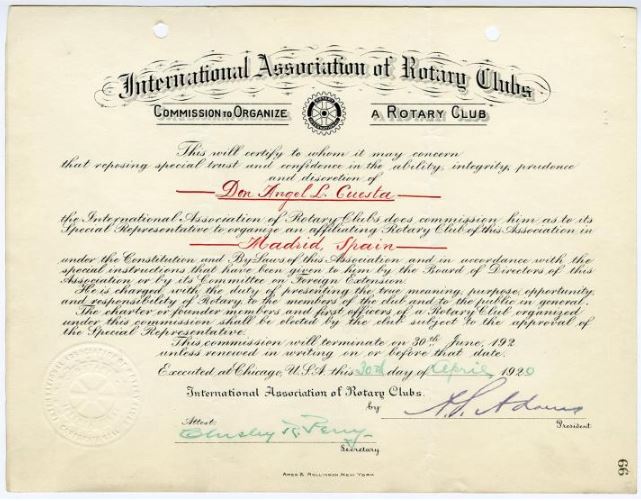
To get the club started, the secretariat had contacted Rotarians in Havana, Cuba, for a recommendation of someone who might be well suited to organize it in Spain. The Havana members suggested Angel Cuesta, a cigar magnate originally from Spain who had also helped organize clubs in Cuba. Now living in Tampa, Florida, USA, he was assigned as special representative in 1920. Cuesta traveled to Spain, and working with Ely Palmer, the American consul in the Spanish capital, led an organizational meeting in October 1920.
Certificate authorizing Rotarian Angel Cuesta of Tampa, Florida, USA, to organize a Rotary club in Madrid, Spain.
With so many highly qualified potential members in Madrid, the organizing group wanted to grow the clubs quickly and asked the secretariat to exempt them from the slow-growth policy that previous countries and regions employed. But the secretariat felt strongly that to reach the region’s full potential, a more moderate approach to growth was best.
Beyond Madrid
Cuesta believed that once the Madrid club was well-established and the Rotary concept of service became better known in Spain, it would be easy to organize in Barcelona. The club there received its charter in April 1922. The Zaragoza club followed in December 1925, then the San Sebastián club in February 1926.
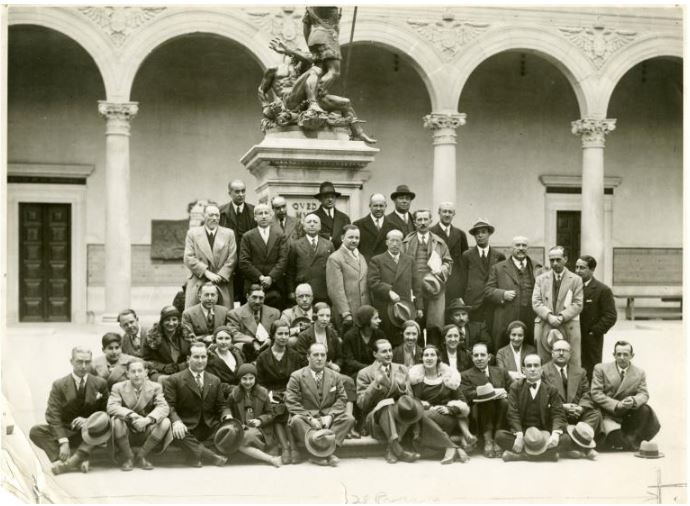
Organizational meeting of the Rotary Club of Toledo, Spain, attended by members of clubs in Madrid, Alicante, Aranjuez, and Zaragosa, in 1932.
The appetite for Rotary in Spain continued to grow. The Rotary clubs of Spain held their first conference in Barcelona in 1928. In the late 1920s, the Barcelona club promoted international understanding by hosting its first youth exchange, an activity that was emerging throughout the Rotary world at the time and continues today. The Barcelona members hosted the sons of London Rotarians for a weeklong stay in Spain’s Catalonia region, where they witnessed the industry, cultural activities, and home life of typical Spanish families.
In 1929-30, the Rotary International Board of Directors included its first Spanish member. Another Spaniard sat on the board in 1935-36.
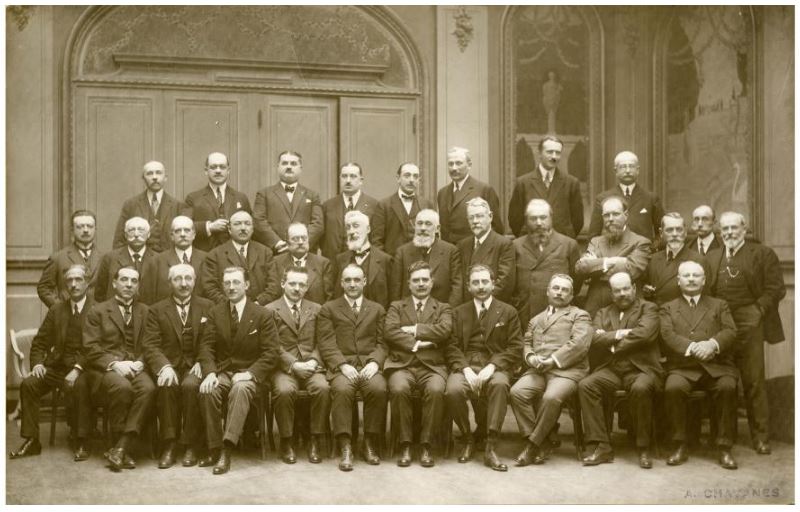
An early meeting of the Rotary Club of Lyon, France, which received its charter in October 1923. Club founder Etienne Fougère is in the center of the first row, with his arms folded. The meeting was attended by members of the Rotary Clubs of Barcelona, Spain, and Paris, France.
The outbreak of the Spanish Civil War in 1936 and Francisco Franco’s rise to power quickly halted Rotary’s expansion in the country. The Franco regime persecuted perceived “enemies of the state,” and anti-Rotary rhetoric was pervasive. In 1936, Rotary was banned. Because clubs were unable to function, the 28 clubs in the country had their membership in Rotary formally terminated in 1940.
Rotary reemerges in Spain
With the death of Franco in 1975 and a return to democracy in the late 1970s, Rotary clubs began to re-emerge throughout Spain, starting in Madrid.
In 1976, a group in Madrid dedicated themselves to restarting Rotary and began meeting unofficially as a Rotary club. At the time, it was necessary to work with the Spanish government before affiliating with Rotary International. In May of that year, RI President Ernesto Imbassahy de Mello and Vice President Bernardo Guzmán traveled to Spain. Together with Jaime Enseñat, president of the newly formed Madrid club, and other Spanish Rotarians, they had the honor of being received by King Juan Carlos de Borbón.
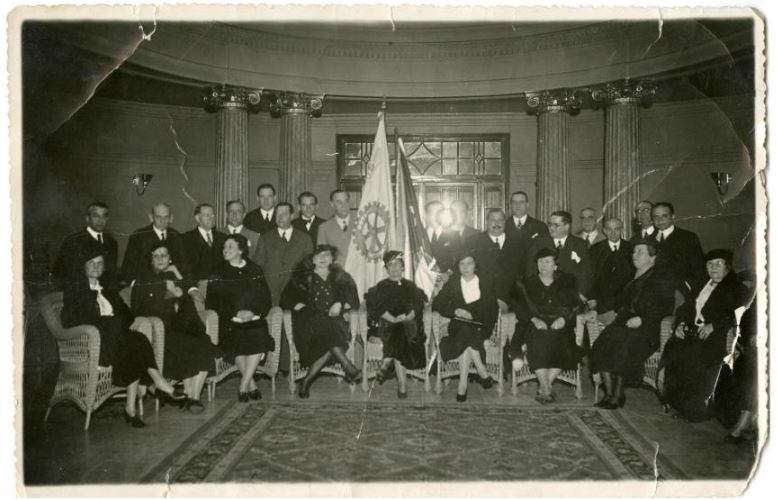
Members of the Rotary Club of Bilbao, Spain, and their spouses in 1932.
The next year, Guzmán served as Rotary’s special representative to organize the Madrid club. It was officially chartered on 6 June 1977, but in consideration of why it had closed, was later granted the retroactive charter date of 1921. Rotary celebrated its return with a charter signing and presentation at the 1977 Rotary International Convention.
Across the continent
While Rotary was growing in prewar Spain, members also worked with Rotary International’s leaders to start clubs elsewhere in Europe.
In April 1920, Rotarian E.J. Felt of Tacoma, Washington, USA, went to Paris, France, to lay the foundation for a strong club there. He identified potential members locally and in consultation with J.E. Lloyd Barnes, a member of the Rotary Club of Liverpool, England, and president of the British Association of Rotary Clubs (now RIBI). After Felt’s death, Rotary designated John Bain Taylor of London to assist business leaders in Paris to complete the organization of the club. The Rotary Club of Paris received its charter on 1 April 1921.
Other early European firsts include these Rotary clubs, listed with their RI charter dates:
København, Denmark — 3 August 1922
Oostende, Belgium — 29 August 1923
Milano, Italy — 19 December 1923
Zürich, Switzerland — 23 May 1924
Praha, Czech Republic — 19 October 1925
Wien, Austria — 19 October 1925
Lisboa, Portugal — 23 January 1926
Hamburg, Germany — 8 October 1927
World War II forced many clubs in Europe to close. As with the Spanish clubs, these clubs made a proud return after the war.
January is finally here. As we look forward to 2021, our thinking doesn’t have to stop at the end of these 365 days. Are you thinking ahead about what you will be doing in 2022, 2023, and beyond?
We cannot foresee the future, but we can steer ourselves where we want to go. I think it is important that every Rotary club hold a strategic meeting at least once a year. Past RI Director Greg Yank, who has a lot of experience working with clubs on their plans, shares his viewpoint.
A famous aphorism states, “By failing to prepare, you are preparing to fail.” Planning is essential to achieving success in all areas of life, including Rotary, and we’re getting better at it every year.
Strategic planning for Rotary clubs works. I have helped many clubs find that pathway by working with them to build what I call a blueprint, a multiyear plan that answers the fundamental question: “What is our vision for our club?” The best plans I have seen are those that are focused, when a club concentrates its resources on the best opportunities it has. Your Rotary club cannot be all things to its members and to the community it serves; it has limited human, financial, and time resources. A successful plan factors in assets and limitations to chart the desired pathway for your members.
Begin building a multiyear strategic plan by brainstorming with your club, asking, “What are our initiatives and priorities for the next two to three years?” Document your answers using action-oriented language that is specific, concrete, and measurable about the goals you want to achieve.
Next, narrow down your initiatives to a core set of three to five priorities. Your club will then develop specific objectives for each initiative, outlining who will be involved, key milestones of achievement, how progress will be tracked, and a timeline for completion. Keep your plan short and simple.
Then go out and do it. Review the progress you make toward accomplishing the initiatives, and revise as needed at least once a year. Rotary has a solid template to assist clubs in their planning, which you can find at my.rotary.org/en/document/strategic-planning-guide.
We want to enrich and enliven our clubs with new discussions and ideas. But how do we attract the diverse professionals, from different backgrounds, ages, and experiences, who are all driven by as strong a sense of integrity as we are?
Through strategic planning, we explore this question to define the very nature of our club and the value it offers to its members and to the community. Each club is different, and each club’s value will be unique. During the planning process, clubs may also find that some of the activities they used to do are no longer relevant or attractive.
Once your club makes a strategic plan, it’s time to take action and carry out the necessary changes. When we do that — as we engage members in vibrant and active clubs that not only have fun but also serve their communities with projects that have real and lasting impact — our clubs grow stronger. And when we discover what makes our own clubs unique and build upon those core values in all our efforts, Rotary Opens Opportunities to enrich the lives of everyone.
Having grown up amid lush green forests in the mountainous landscape of Sri Lanka, I always recall the words of the great poet Rabindranath Tagore: “Trees are the earth’s endless effort to speak to the listening heaven.”
How sad that so often we humans insist on interrupting this conversation.
Just like every other living thing, we are a part of nature. But we are also the only species that bears the responsibility of protecting the environment for future generations. The coronavirus pandemic has shed light as nothing has before on the relationship between environmental degradation and threats to public health.
A few years ago, the government-owned electricity company in my country planned to build a second coal power plant, in eastern Sri Lanka. It would suck 93 million liters of water per hour from a bay where fragile ecosystems meet the deep sea, the site of one of the largest spawning grounds for sperm whales in the world. After processing, those 93 million liters per hour would be dumped into the ocean, now loaded with toxic chemicals that put that marine life at great risk.
Learning from the lessons of the damage caused by the first plant, a coalition formed, made up of many public advocates, including Rotarians. They ran a campaign that alerted the media, the public, and the local community to the potential dangers, in addition to taking legal action. The government eventually abandoned its coal plant idea after the resulting public outcry.
We can truly move mountains when we come together.
When some of us moved to add the environment as Rotary’s newest cause, we did so because of the urgency of the problem. In 1990-91, RI President Paulo V.C. Costa set forth a vision, and today we will take this work to the next level. We live in a time of great stress on our environment, of rapidly rising sea levels, massive storms, disappearing rainforests and wildlife, and destructive forest fires. Climate change touches us all, rich and poor.
We will face the challenge strategically, as with the other areas of focus. In fact, the six other areas of focus depend on this one. For what good is it to fight disease if our polluted environment causes us to become sick again?
The Rotary Foundation will be central to this work. More than $18 million has gone toward environment-related global grants in the past five years. Building upon this work to protect the environment, we will give yet another Rotary gift to future generations. And you can be a part of it today.
Rotary Club of Santa Rosa Sunrise - Founded June 30, 1986


.png)

.jpg)