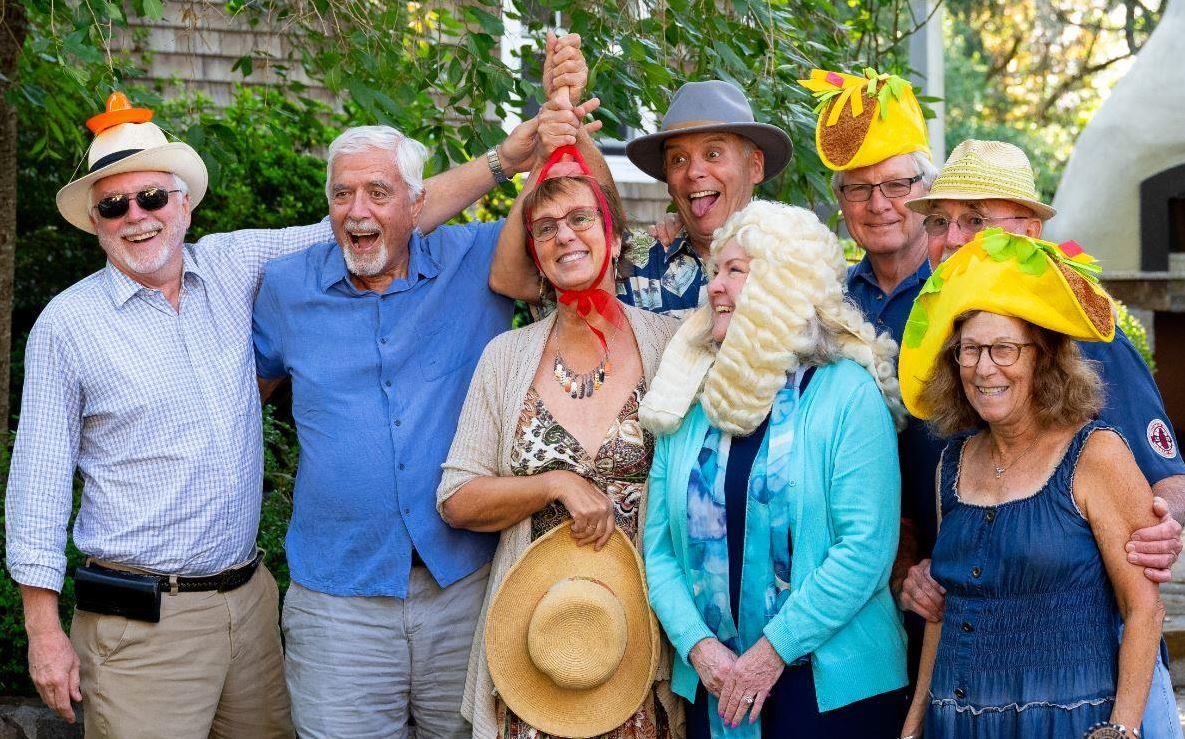
On a regular basis, our resident photo pro Warren Smith, submits pictures of what is going on at the weekly meetings. You can always find the most recent pictures at the websites photo journal called "Meeting Sighting" Please note that all the meeting photos for the entire Rotary year are at this location with the most recent on the last page.
Thanks for all the great pictures Warren!Link to Meeting Sightings. The most recent are on the last page!
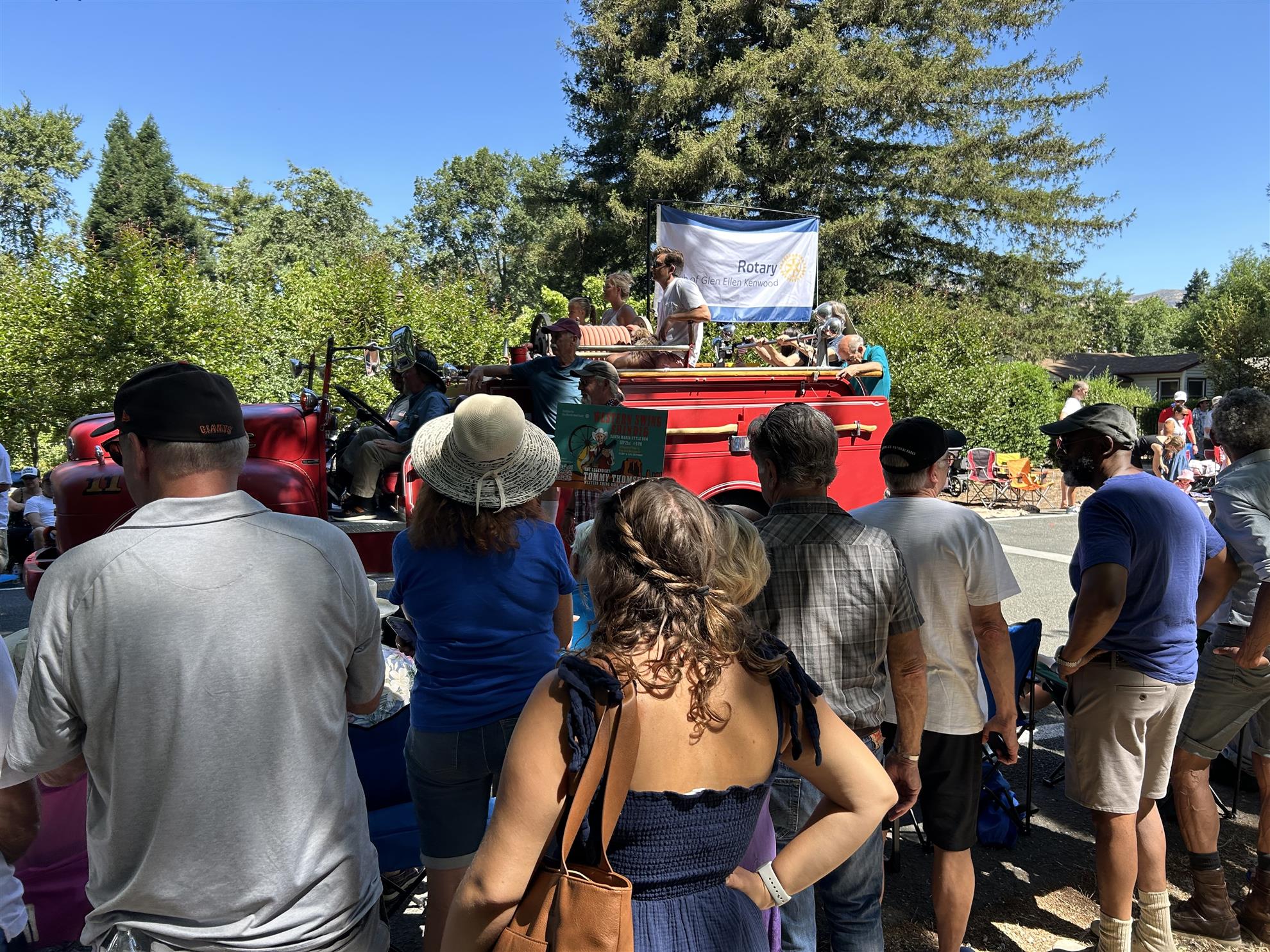
July 4th was celebrated in Kenwood's continuing ~ over 50 years~ community Independence Day parade. Here the Glen Ellen-Kenwood Rotary Club rides a 1949 classic fire truck, one of several vehicles honoring first responders.
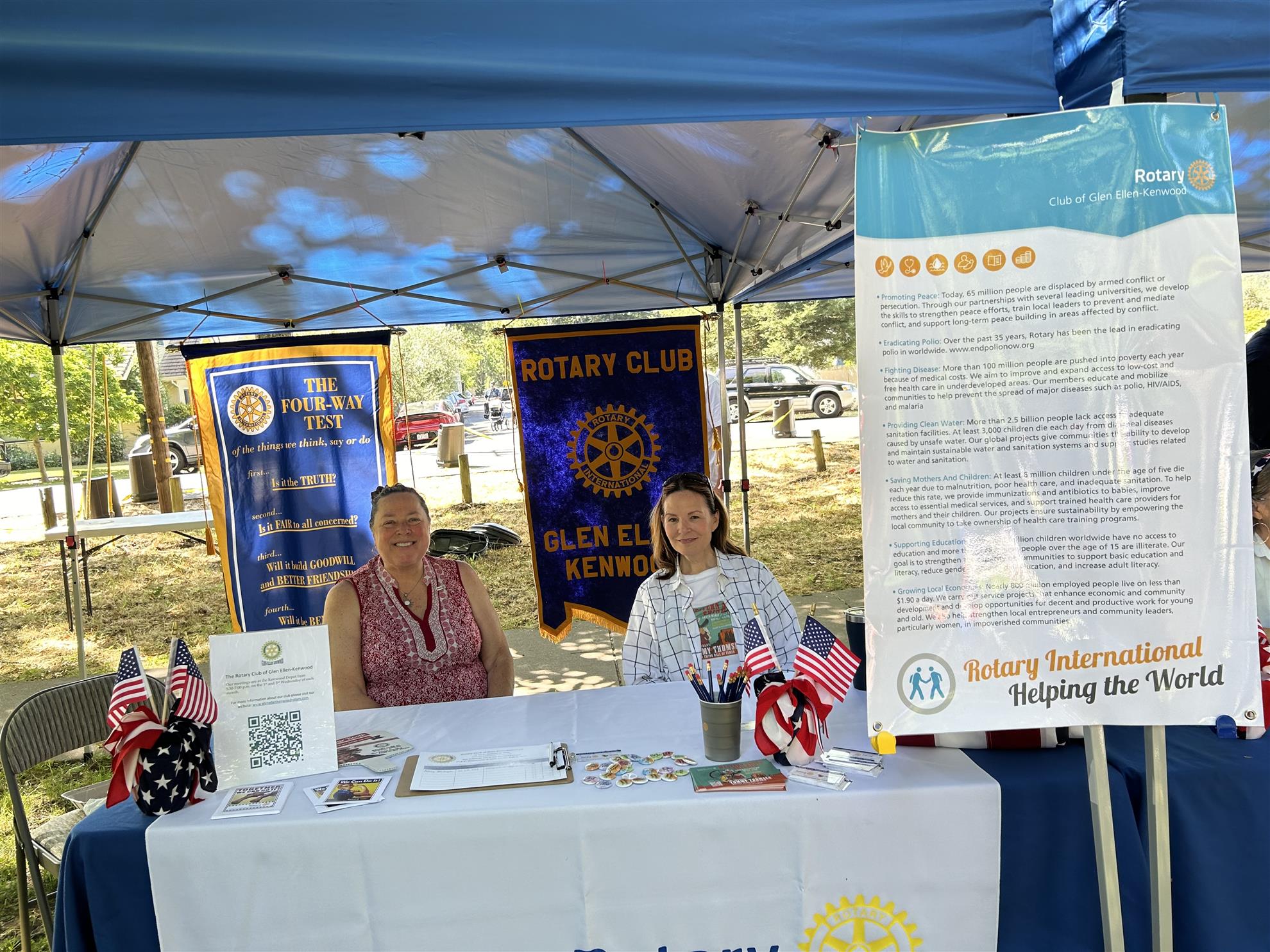
Chrissy on the left and Denise represented the Glen Ellen-Kenwood Club's activities and invited participation and membership.
They expressed interest in the upcoming regional Peace Conference in January 2-25.
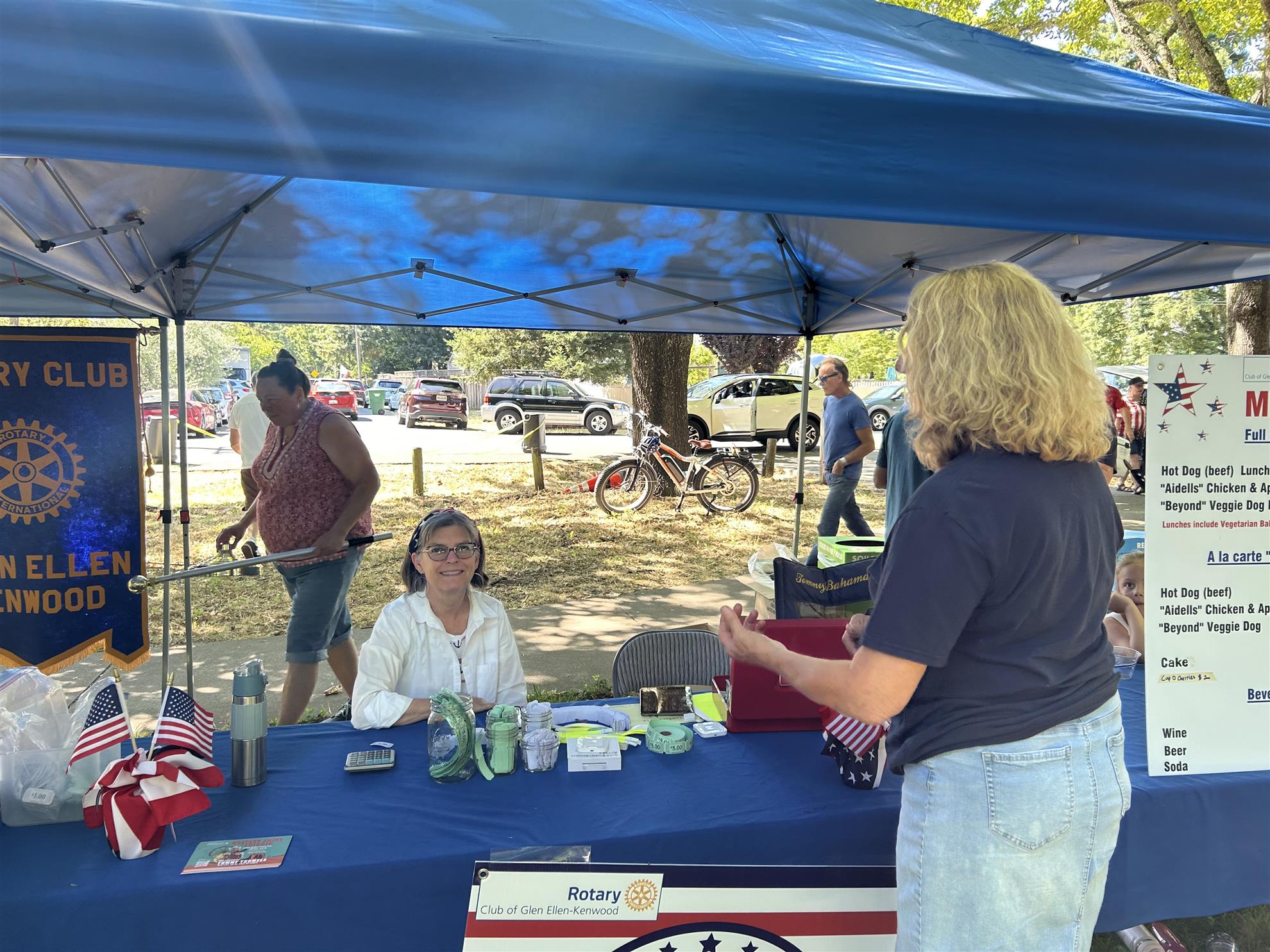
Also present and promoting their Club's Shindig September 21 was Ann Peters, a Charter Member and lifelong Kenwood and Sonoma Valley advocate.
Meeting Rotarians across town or across the globe is a privilege and ongoing opportunity to network in behalf of building goodwill and better friendships.
Santa Rosa Sunrise at the Prune Packers game. Go Pack!!!
Do you check out our Facebook page? The editor found this little gem on Saturday. I wonder Which of these prunes will tell us the rest of the story during our Thursday meeting? Be present to find out.
Four men are in the hospital waiting room because their wives are having babies. A nurse approaches the first guy and says, “Congratulations! You're the father of twins.” “That's odd,” answers the man. “I work for the Minnesota Twins!” A nurse then yells the second man, “Congratulations! You're the father of triplets!” “That's weird,” answers the second man. “I work for the 3M company!” A nurse goes up to the third man saying, “Congratulations! You're the father of quadruplets." “That's strange,” he answers. “I work for the Four Seasons hotel!” The last man begins groaning and banging his head against the wall. “What's wrong?” the others ask. “I work for 7 Up!”
Rotary is at its best when we foster a sense of inclusion and belonging in our clubs. In fact, I would go so far as to say that belonging is The Magic of Rotary itself.
With a focus on inclusivity and belonging, it is easier to be united in a common purpose. When we are committed to one another and focused on our goals, we are most effective.
Rotary’s Action Plan can help. The Action Plan comes with tools you can use to collect feedback, assess your club’s strengths and weaknesses, and address challenges.
The world is changing, and our clubs can’t afford to stand still. But the changes we make need to be consistent and strategic — building on one another toward a greater vision. The Action Plan can help you work toward that vision and create effective change within your club. Following the Action Plan and addressing suggestions from the community will go a long way to fostering the sense of belonging we want all Rotary members to feel in their clubs.
That’s why expanding our commitment to diversity, equity, and inclusion is so important. Committing ourselves to each other’s well-being is the first step to expanding our reach, allowing us to spread Positive Peace in these troubled times.
Peacebuilding is one of our top priorities, and one of the most effective ways we can build peace is with our Rotary Peace Fellowships, through which peace and development professionals learn how to prevent and end conflict.
We offer the fellowships through our Rotary Peace Centers at leading universities around the globe, where more than 1,800 Rotary Peace Fellows have graduated. And thanks to a $15.5 million gift from the Otto and Fran Walter Foundation, we can continue supporting peacebuilders in more regions with the next peace center at Bahçeşehir University in Istanbul.
Opening another peace center is a monumental achievement, and it is my great honor to invite you to celebrate at next year’s Rotary Presidential Peace Conference at the Istanbul center. The three-day conference 20-22 February will highlight the many ways our family of Rotary advances peacebuilding. Registration for the conference is officially open. I hope to see you there.
The 2025 Rotary Presidential Peace Conference has great potential for our peacebuilding efforts — but only if we have your support.
The truth is, we’re not going to bring peace to the world, end polio, or grow membership by waving a wand and saying some funny words. It’s up to you. You create the magic with every project completed, every dollar donated, and every new member inducted.
I love my Rotary family and I know you do too. That’s why I know that together, we can make every club and district simply irresistible. This year, let us change the world by embracing The Magic of Rotary.
You can find all prior "RI President's Messages" at this LINK
This month, we begin a new journey together to celebrate The Magic of Rotary. So buckle up for an exciting trip.
If Rotary is a beautiful car that you are proud to drive, The Rotary Foundation is the engine that propels it to your chosen destination. And it’s the strengths of Rotary — especially you and our other incredible 1.4 million members — that make The Rotary Foundation powerful.
Like many new members, I knew little about The Rotary Foundation when I joined Rotary. However, everything changed in 1985 when, as incoming president of my club, I attended my first Rotary International Convention with my wife, Gay, in Kansas City, Missouri. We will never forget the thunderous support the audience showed for Dr. Albert Sabin, creator of the oral polio vaccine, who called upon Rotary to vaccinate the world’s children. It marked the dawn of PolioPlus, a pivotal moment in Rotary’s commitment to children worldwide, and I was there!
You, as a member of Rotary, are also a part of The Rotary Foundation. You are part of a worldwide movement that implements global grants to build sustainable systems for clean water and sanitation where there are none. You help train peacebuilders in a world plagued by unrest. And through supporting the Foundation, you help people rebuild their lives after natural disasters.
This is the magic of The Rotary Foundation. But let’s remember that magic doesn’t happen on its own, which is why I am counting on your support and engagement this year.
To accomplish more good throughout the world, the Foundation trustees have set an ambitious fundraising goal of $500 million for 2024-25. Achieving this goal will require the support of everyone reading this message. It will also help us reach our goal of building the Endowment Fund to $2.025 billion by 2025.
To help us keep financial support of the Foundation at the forefront throughout this year, I have developed Mark’s Magical Markers — a set of specific targets to help us achieve our overall goals. The first Magical Marker focuses on personal commitment, particularly to the Annual Fund, which supports the grants, scholarships, and vocational training teams that make the magic happen. Please contribute what you can to the Annual Fund no later than 31 August.
This year, let’s fuel the engine that takes us around the globe to do good. Let’s unleash The Magic of Rotary through the Foundation. And let’s make this year an unforgettable one — for us and for the people whose lives we will touch.
You can find all prior "Messages from the Foundation Trustee Chair" at this LINK
A lot of babies are born at the Alokpatsa Community-Based Health Planning and Services compound, a health center in eastern Ghana. And for years, a lot of those babies were born in the dark.
“We didn’t have any power. What we had were lamps and candles,” says Nelson Addy, a former facility team leader at the center in the Oti region. “When the woman delivering had a tear and we wanted to suture, we found it very difficult. We had to strain our eyes with our phone [flashlights] to do the suturing.”
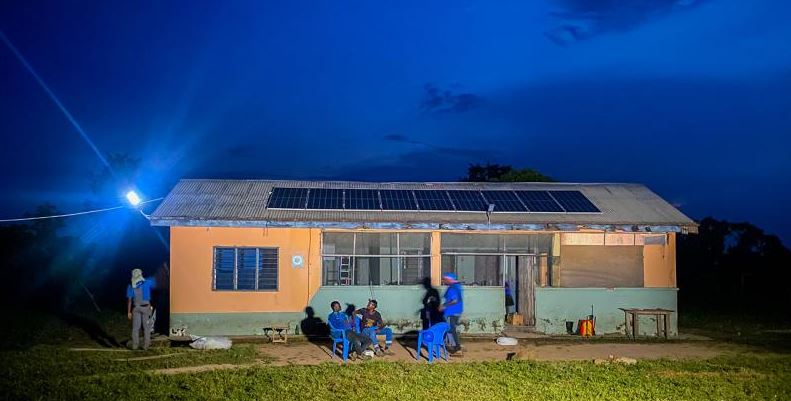
That changed when the Rotary Club of Accra-Spintex, of the Greater Accra region of Ghana, installed a new solar power system at the center. The project included a complete rewiring and, crucially, plenty of lights.
In 2021, the Rotary Club of Accra-Spintex installed a new solar power system at the Alokpatsa Community-Based Health Planning and Services compound in eastern Ghana. For years, many babies had been born there by the light of candles and cellphone flashlights because of unreliable power.
Courtesy of Nortse Amarteifio
“In the surgical ward, we made sure there would be no need for them to use [phone] lights,” says Nortse Amarteifio, the president of the Accra-Spintex club, whose solar company donated labor and some materials for the $21,000 installation. “We also put in solar streetlights all around the compound and on the street in front of the hospital.”
One of the first mothers to give birth after the installation was so delighted with the upgrades, Addy says, she used “Solar” as the name for one of her children. “It felt like it was all planned by nature for the child to see the first light installed in Alokpatsa,” he says.
Solar solutions
Solar energy previously had powered the Alokpatsa health center, but that system was no longer working. Clinic staff members were excited for the return of a solar system. The Alokpatsa installation is one of numerous Rotary projects using solar power to improve access to health care around the world. In the past dozen years, Rotary clubs have installed solar power systems in health centers in Nepal, Haiti, Pakistan, Mexico, Armenia, India, and many African countries — and there’s much more to do. An estimated 1 billion people in lower-income countries are served by health facilities that lack reliable electricity or have no electricity at all, according to a 2023 report by the World Health Organization. In sub-Saharan Africa, only half of hospitals have reliable electricity. Extreme weather, often connected to climate change, is exacerbating the problem, increasing energy costs and damaging power grids.
“Off-grid health facilities need to have access to clean, reliable energy solutions,” says Luciana Mermet, who works for the United Nations Development Programme as the manager of the Global Fund Partnership and Health Systems Team, HIV and Health Group. “And we’re not talking only about solutions in rural areas. Urban areas can also have unreliable power grids. If you don’t have affordable and sustained energy access, you will have situations where you’re delivering [babies] in candlelight or where you’re unable to refrigerate the health commodities you need to provide care.”
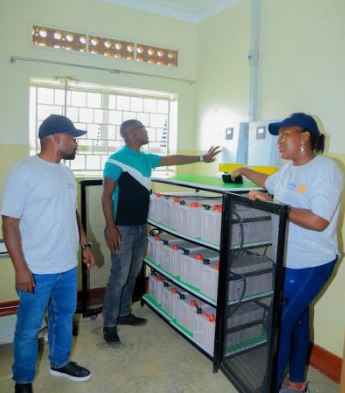
Rotary members in Uganda, including (from left) Joseph Ssuuna, Joseph Ssengooba, and Charlotte Atukunda, led a solar project at a rural health center.
Courtesy of Annie Ninyesiga
Women giving birth in rural areas are among the most affected by such inadequacies, according to the WHO report. It was this problem that galvanized Annie Ninyesiga, president of the Rotary Club of Bwebajja, Uganda, to get a solar system installed at a rural health center in her country. Her club secured a Rotary Foundation global grant in partnership with the Rotary Club of Aarau, Switzerland, to pay for the $76,000 maternal and child health project, which also provided medical equipment, an ambulance, and training for health workers, village health team members, and traditional birth attendants.
“This center serves a very big population in hard-to-reach areas,” Ninyesiga says. “We thought it was important that the people have access to, at least, the basic maternal and child health support.” She adds that solar is superior to the area’s hydroelectric power grid. “The hydroelectric power is not reliable. It’s on and off,” she says. “Sometimes it can’t even charge a mobile phone. Sometimes it provides light but can’t run any equipment.”
Not only do solar panels keep lights shining and equipment functioning, they reduce electrical bills and cut down on the need for generators fueled by expensive — and climate-unfriendly — gasoline. Health facilities then have more funds for patient care. By installing a solar power system at Hospital Bienfaisance in Pignon, Haiti, a Rotary project significantly lowered the hospital’s $4,000 monthly gasoline costs.
Even in areas where there are few or no health centers, solar power can bring health care to people in a very literal way. A few solar panels can enable a doctor to convert a van or trailer into a mobile clinic to serve remote areas.
Revolutionizing vaccine storage
Solar power is also revolutionizing vaccine storage. Many vaccines must be stored at temperatures of 36 to 46 degrees Fahrenheit (2 to 8 degrees Celsius). The oral polio vaccine can be stored at this temperature for six months. In areas with limited or no electricity, or frequent power outages, vaccine refrigerators are often powered by kerosene. They can work only if there’s fuel available, so there may be periods when no vaccines can be stored. Also, this type of refrigerator often provides uneven cooling, spoiling the vaccines inside.
By the numbers
675 million
People worldwide without electricity
22,000
Square miles of solar panels — about the size of Lake Michigan — that would be needed to power the entire U.S.
33%
Share of solar electricity worldwide generated in China
“Sometimes the fridge might not be functioning perfectly — the control is erratic,” says Souleymane Kone, team lead for WHO’s Essential Programme on Immunization. “During the night the temperature might drop down to -1 Celsius [30 Fahrenheit] sometimes, and in the daytime it will go up, exposing the vaccine to excessive heat.”
In 2015 Gavi, the Vaccine Alliance, one of Rotary’s partners in the Global Polio Eradication Initiative, found that up to 90 percent of health facilities in some countries were equipped with old, obsolete, or broken refrigerators. Since then, Gavi, UNICEF (another GPEI partner), and other NGOs have focused on transitioning to solar direct drive refrigerators. First introduced in 2010, these refrigerators are powered directly by the sun without using batteries. The solar energy freezes water or another freezable substance to make an “ice bank” inside the unit that maintains the right temperature after the sun goes down. Costing around $4,000, a fridge can keep vaccines cold for three days or more without the sun shining.
“It is critical for us, especially when looking at increasing the coverage of routine immunizations, that we have a sufficient cold chain storage capacity at all different levels, including the remote areas, including places where there are frequent power fluctuations,” says Anahitta Shirzad, a health specialist with UNICEF’s Immunization Supply Chain program.
“The solar direct drive refrigerators come in very, very handy,” Shirzad says. “They have supported [our goal of] reaching the unreached. We’re looking at the last mile.”
Solar direct drive technology works best with motors such as those used in fans or pumps, while many installations that power whole buildings use solar batteries to store excess energy. At Alokpatsa, the Rotary club solar installation makes it possible to operate a water pump, a sterilizer, and a refrigerator that stores vaccines for two other facilities in the area. It also powers a humbler, but still welcome, piece of equipment: an iron.
“When the lights came, I was able to iron my uniform,” Addy says. “Everyone in the community would now see me as a professional. I felt so happy. I don’t even know how to express this happiness.”
This story originally appeared in the June 2024 issue of Rotary magazine.
The Environmental Sustainability Rotary Action Group can assist Rotary clubs with solar energy solutions and ways to get involved.


.png)





.png)