LOBOSONG is an auditioned group of singers that meets every morning at 7:00am before the normal school daybegins. Students are given the opportunity to excel musically and creatively - developing as a team in a professional performance environment. They collaborate every year with the dance department, theater department, and the jazz band to develop a themed cabaret show called Lobo Lounge.
Kyle Thompson is now in his twenty-first year as the music director at EAHS, overseeing all of the ensembles at Elsie Allen including LOBOSONG, Drum Line, Jazz Band, and Guitar Class and Piano Class. In 2010, Mr. T was given the honor of being the Elsie Allen High School Educator of the Year, was awarded the Chamber of Commerce Excellence in Education Award in 2009 and 2013, and received the Music Director of the Year for 2015 from the Northern California Band and Choir Director's Association.
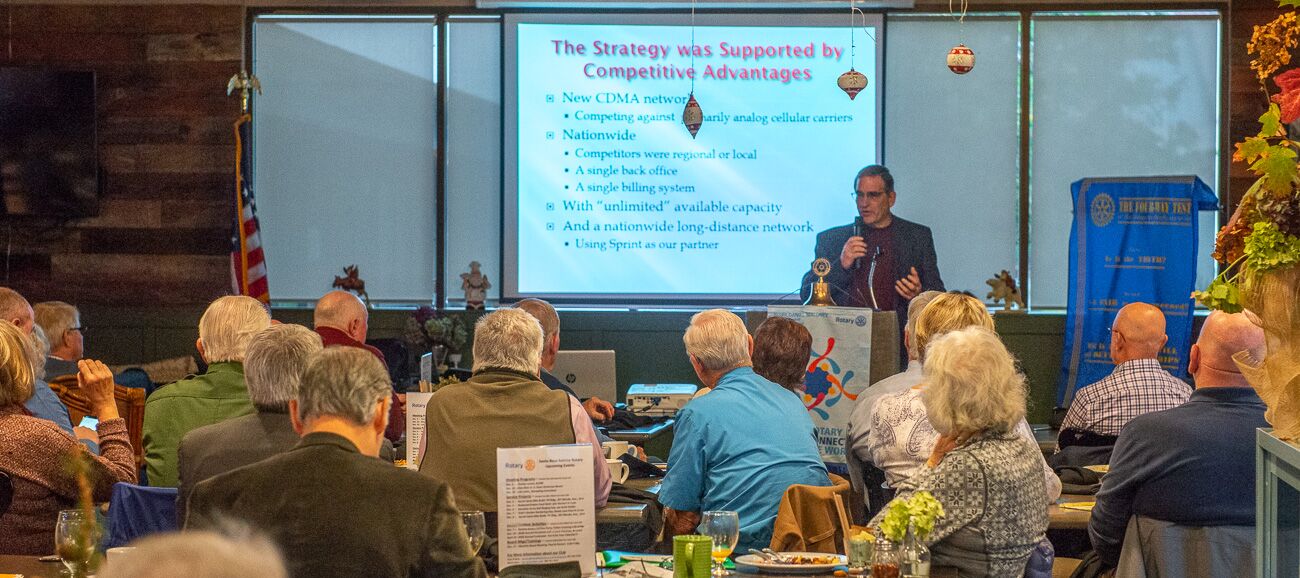
Lessons from the Rise and Fall of a $10 Billion Dollar Company, by Chuck Levine
Charles Levine was our guest speaker for December 5th. Chuck is a former president of Sprint PCS. Chuck’s topic was “Lessons from the Rise and Fall of a $10 Billion Company.” We haven’t had too many speakers who could speak from personal experience about managing a multi-billion dollar enterprise and Chuck did not disappoint! Chuck discussed some of the reasons the company grew from non-existent to over $10 billion dollars in revenue in 4 ½ years. Sprint PCS’ key advantage was a laser-like focus on learning and responding to why customers make decisions, that is, ascertaining and delivering a competitive advantage to customers. Sprint PCS was the leading voice in the rapidly growing wireless network market while he was the President. The fall, however, was steep. After he left, the company lost customers for 12 straight quarters! The company made a series of bad decisions driven by factors such as the perceived need to merge with other companies. One example is the merger with Nextel. In Chuck’s opinion, Nextel had nothing to offer Sprint PCS in terms of delivering competitive advantage to customers. Nextel’s culture was nothing like Sprint’s, which created internal dissension and disarray. This was one of the worst deals in history! Chuck is also critical of Sprint’s repeated efforts to rely on its older, long-distance business operating methods and executives. Sprint PCS is still trying to catch up to the companies that imitated Sprint’s business when Sprint stumbled.
Chuck is now on the Boards of Directors of a variety of companies, including non-profits. Chuck’s story is amazing and informative. Some of the lessons are ‘stick with what you do best’ and ‘size doesn’t always matter.’ Most importantly, develop a single focus within your company; a focus geared towards providing the customer with an economic advantage. And, don’t waste time in meetings discussing employee attire; the ‘panty hose’ v. no panty hose issue! Thanks, Chuck – well done and come back!
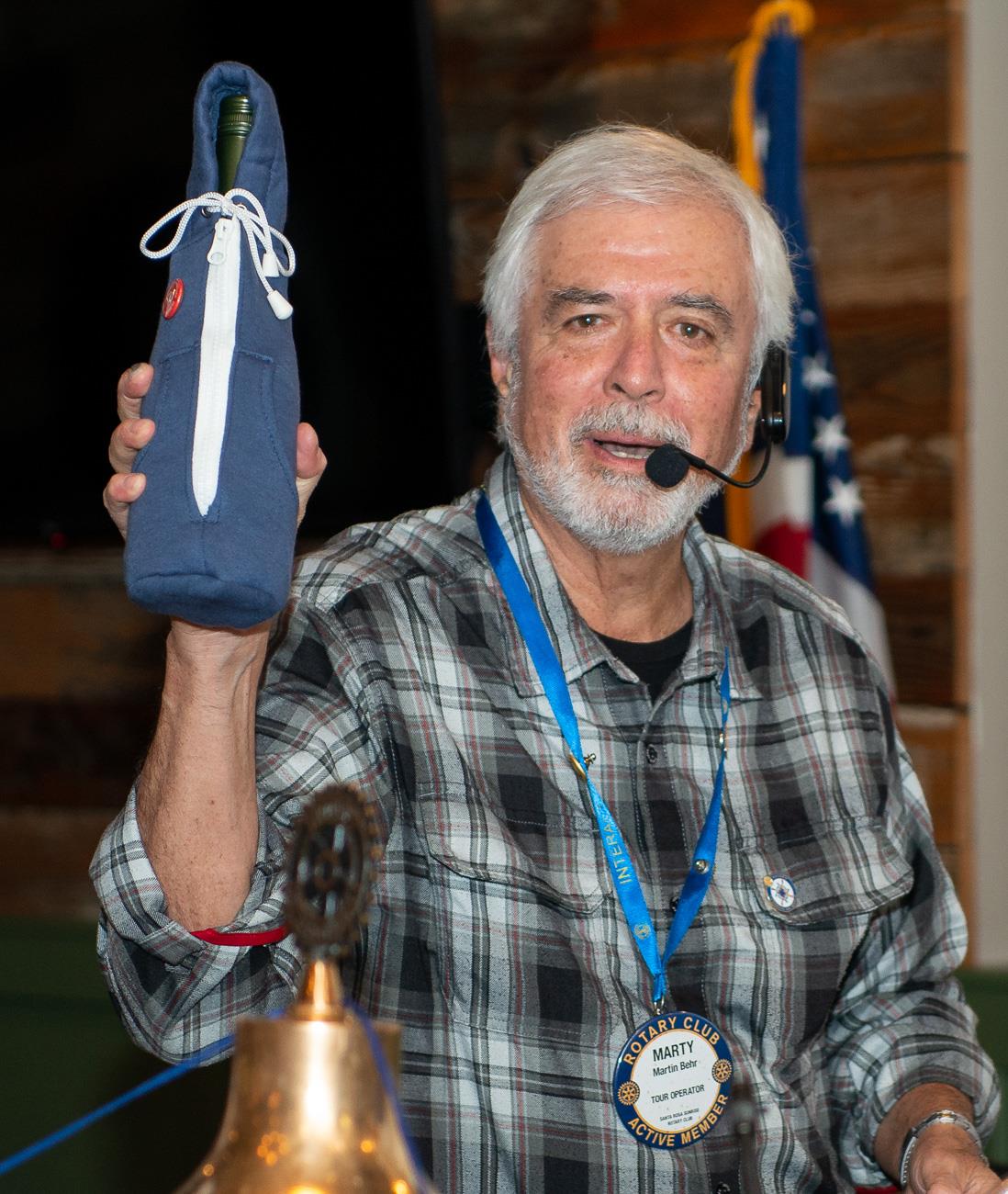
On a regular basis, our resident photo pro Warren Smith, submits pictures of what is going on at the weekly meetings. You can always find the most recent pictures at the websites photo journal called "Meeting Sighting" Please note that all the meeting photos for the entire Rotary year are at this location with the most recent on the last page.
Thanks for all the great pictures Warren!Link to Meeting Sightings. The most recent are on the last page!
‘Tis the season to be jolly…Once again the holidays have hit us, one and all… Decorations galore, we shop every store, for bargains…and so much more!
Christmas music is all around us, on the television, our radios and every store. There was a time when Christmas carols were prohibited!
That’s right, Christmas was abolished during the Cromwell era in the Commonwealth of England. Parliament prohibited the practice of caroling as a Pagan rite, thereby sinful. Cromwell’s reign also prohibited any and all celebrations of the Christmas holiday. In 1644, the Westminster Assembly of Divines declared Sunday as the only holy day, thereby abolishing Christmas altogether. Parliament went so far as to state that celebrating Christmas was an offense, punishably by imprisonment. It wasn’t until Cromwell was desposed and Charles II came to the throne, restoring the Stuarts as rulers that the English population could celebrate Christmas, and the singing of carols, without fear of retribution or prosecution.
The Victorian Era was a wealth of new carols, “Silent Night”, “O Little Town Of Bethlehem” “O Holy Night”. The nineteenth century saw the first songs mentioning gift bearers, Saint Nicholas, with songs such as “Up on the Housetop” and “Jolly old Saint Nicholas”. This period also saw many hymns associated with the Christmas holiday translated with lyrics and music added. Collections of these carols were very influential in advancing the Victorian revival of Christmas with the first singing of carols in the Truro Cathedral in Cornwall, England in 1880.
Today, since the Second World War, Christmas music may be strictly instrumental, and in the case of carols and songs, that range from the nativity of Jesus Christ to gift giving and merriment, performed in Churches, shopping malls, private homes and on street corners. “White Christmas” a staple of the holiday season, “Santa Claus is Coming to Town” “Have Yourself A Merry Little Christmas” among the most popular.
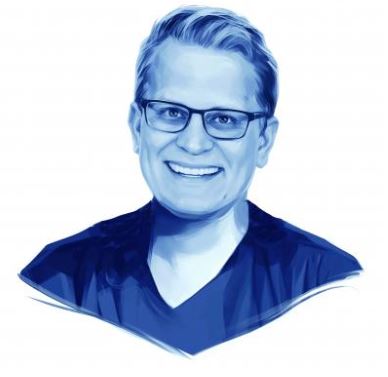
Rotary has really shaped me. I was a Rotary Youth Exchange student, and I was a Rotaractor for 13 years. And I’ve been listening to metal music since I was 10. I love it — it’s my passion, it’s my personality. But I didn’t see any connection between Rotary and metal music.
When I was in Rotaract, I realized that other Rotaractors liked the same type of music, but I never talked about it. I didn’t want to get into a discussion with people about why I like this music. Then in 2013, I read an article in the German-language Rotary Magazin about five Rotarians who attended Wacken Open Air, which is one of the largest metal festivals in the world. So I started a closed Facebook group for Rotarians and Rotaractors to exchange our love of metal music. Then last year I organized a family of Rotary meetup at Wacken Open Air. I was surprised that 23 people showed up. I never thought that this passion of mine could connect with what Rotary does.
2. What do you need to get a fellowship approved?
You need to have 25 interested members from at least five countries. They don’t need to be Rotarians; they just need to be part of the Rotary family. So we have Rotarians, Rotaractors, Rotary Youth Exchange students, and alumni. At the moment, we have 164 members from 23 countries.
Then you need to write bylaws and come up with the purpose of the fellowship. We wanted to do something good, and we wanted to connect the Rotary world and the metal world somehow. So we decided to support The Rotary Foundation and the Wacken Foundation, which helps young people who want to develop their musical skills in a rock and metal environment. Finally, you need to apply to Rotary International for official recognition.
3. How did you spread the word?
Social media — I have a huge network of people through being involved in Rotary. I sent messages through Facebook to the regional magazines. And we got our own booth at the Rotary International Convention in Hamburg. The reactions there were overwhelming. We got something like 60 or 70 new members in that week. A Youth Exchange student in an AC/DC T-shirt came up and said, “That’s so cool. I would never have thought within Rotary I would find this music that I love.”
Then we organized a booth at this year’s Wacken Open Air, where we raised funds for End Polio Now. We talked to people whose image of Rotary was not totally accurate. Now we have metalheads who have never been involved in Rotary but think that what our fellowship is doing is great. They said, “Can we become a member?” So we are changing our bylaws to allow them to join as “friends” of the fellowship. We can start to connect to them so they can get more of an idea of what Rotary is doing around the world.
4. Why should people think about joining a fellowship?
If you know that someone is involved in the family of Rotary, you already have a common interest. But everyone also has different interests and passions — things that you enjoy doing in your free time. Fellowships are a wonderful way to find people who share those other interests with you. If you have not just one common interest but two or three, it’s very easy to talk to people all around the world. You can exchange ideas and come up with new ones, and that’s what I think is great.
— JOHN CUNNINGHAM
• Learn more about Rotary Fellowships and see a list of current fellowships at rotary.org/fellowships.
• Illustration by Viktor Miller Gausa
• This story originally appeared in the December 2019 issue of The Rotarian magazine.
Rotary Club of Santa Rosa Sunrise - Founded June 30, 1986

.png)
.jpg)






.jpg)

.jpg)
.jpg)