Collette Michaud, the Founder and CEO of the Children's Museum of Sonoma County, has a remarkable background. With a degree in commercial art and over 15 years of experience in the children's game software industry, she embarked on a mission in 2005. Starting from humble beginnings out of the back of her minivan, she established the Children's Museum of Sonoma County. Collette's lifelong passion lies in creating engaging, imaginative, and interactive learning environments, whether virtual or physical. Her dedication to providing artful experiences that foster learning and creativity is at the core of her work at the Children's Museum.
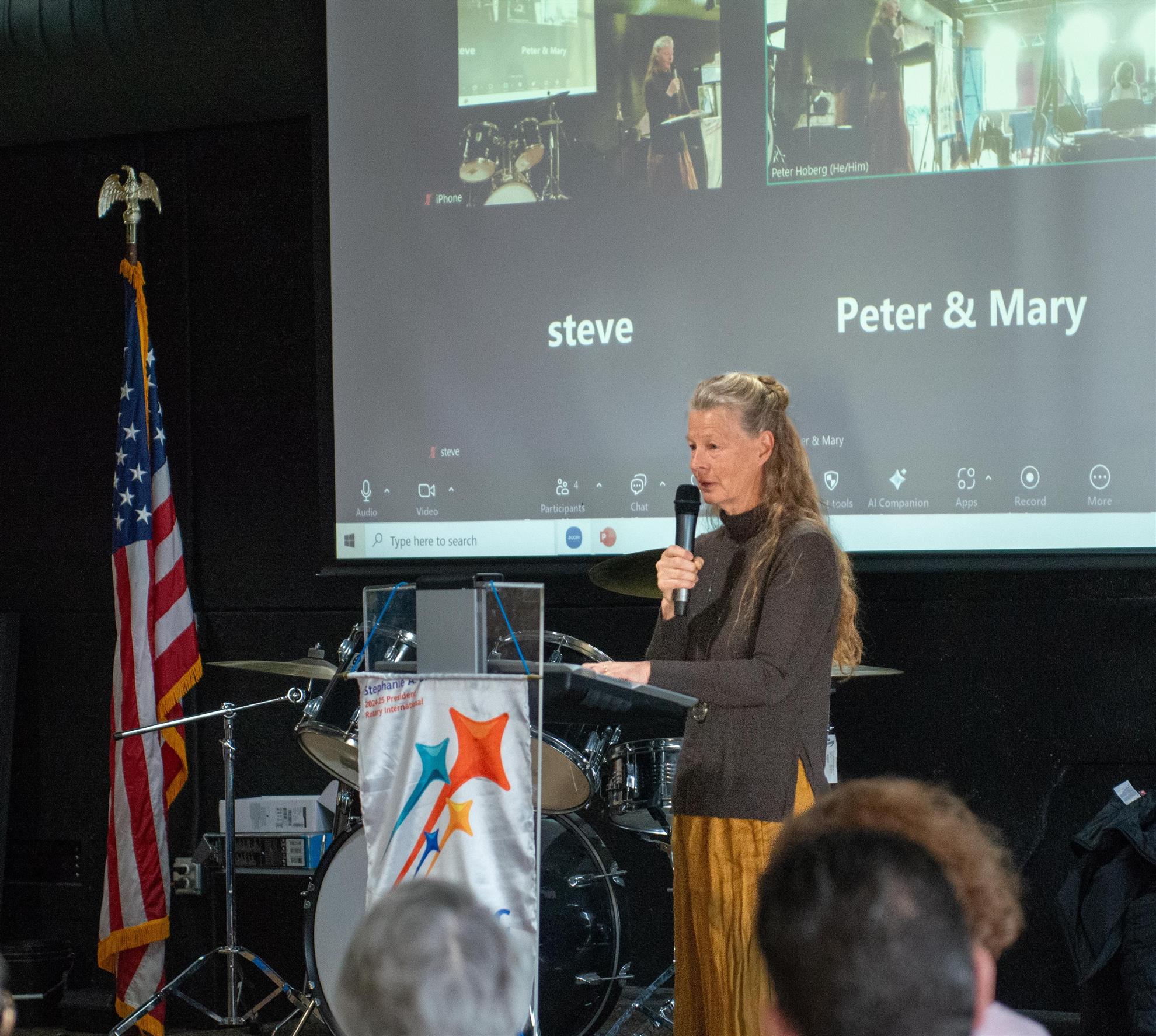
Our speaker for February 27, 2025, was Caroline Wong of Sonoma Flow Farm. Caroline is a teacher, artist, and builder on her Flow Farm property on Sonoma Mountain, near Crane Creek Regional Park. She grew up in France, was trained in computer science and engineering, earned an advanced teaching degree in physics and chemistry, and taught those subjects in France and later in San Francisco for 28 years. She and her husband, Nick, moved to Sonoma County in 2018. She and Nick built and now operate Flow Farm, including an art workshop and home improvement business on the property. Caroline moved to San Francisco from France in 2000 with her 4 children and taught at a Waldorf school. She discovered a love of stained glass, learned how to create in it, and ultimately began teaching it at the Waldorf school. In San Francisco she rented a 2-bedroom apartment with her 4 children and of necessity taught herself how to improve the apartment and make the best use of the space, in the process learning home remodeling and construction skills. She built bunk beds, wooden toys, built a loft, remodeled her bathroom and kitchen, and added storage. She also started actively remodeling other apartments. She used her remodeling and construction skills in rebuilding at Flow Farm. She, along with family and friends, built 3 sheds to live in while the main building was being constructed, and also built the main building and house. Her business at Flow Farm now includes an art school where she gives lessons in working with stained glass, mosaics, sand blasting media, and clay and recycled metals. She also operates a business assisting customers with home improvement projects, including deck remodeling, building sheds, and bathroom remodeling, among other DIY projects. Caroline is dedicated to finding new ways to make things work. Her governing principal revolves around building – to create new spaces, develop relationships, and teach and share art. To Caroline, each project is a chance to bring people together. Caroline, thank you so much for sharing your story and your art with us!
On a regular basis, our resident photo pro Warren Smith, submits pictures of what is going on at the weekly meetings. You can always find the most recent pictures at the websites photo journal called "Meeting Sighting" Please note that all the meeting photos for the entire Rotary year are at this location with the most recent on the last page.
Thanks for all the great pictures Warren!Link to Meeting Sightings. The most recent are on the last page!
When you donate time to FISH it truly helps get food into the hands of hungry people in Sonoma County. FISH can't do this alone and relies heavily on the support of local community volunteers.
Sunrise Community Service Director Paul O'Rear has leveraged efforts by engaging members in food collection and distribution logistics. Peter Hoberg and Paul O'Rear collect donations at Target and Whole Foods at Coddingtown Mall on Wednesdays. Steve Zwick collects at Target Rohnert Park and Grocery Outlet on Tuesday. These food donations are then taken to FISH warehouse at 1710 Sebastopol Road for sorting and assembling for distribution.
Each weekday about 100 people are provided two grocery bags with a variety of perishable and non-perishable food stuffs.
Given current donation levels about 500 people per week or 2000 per month are provided nourishment for their hungry bodies.
Additional back up drivers and non-driving sorters/assemblers are urged to contact Paul. Food insecurity is with us for the foreseeable future. You can take a bite out of hunger by volunteering or buying a Sunrise Raffle ticket! Proceeds are allocated to reducing hunger and FISH' clients in particular.
This Thursday is our next quarterly collection of dry food good for F.I.S.H. (aka "FISH food")!
A bishop advertises a job to ring the bell in his tower. The only job applicant is a hunchback with no arms. Bishop: "How can you do the job? You can't pull the rope!" Hunchback: "I have a plan - but we have to go to the top of the tower, where the bell is." .. So they climb all those stairs to the top of the tower. Bishop: "Ok, show me your plan."
The hunchback runs and jumps at the bell, striking it with his head. Sure enough, he rings the bell.
So, despite his misgivings, the bishop hired the hunchback to ring the bell.
Every day the hunchback comes in and rings the bell. One day, the hunchback decides to try to ring the bell louder. He goes to the farthest corner of the tower and runs as fast as he can toward the bell. When he jumps up and hits it with his head, the bell rings clear and loud. Unfortunately, the hunchback hit the bell so hard he's a little groggy. He staggers around a bit and falls out a window to the street below.
A crowd gathers around the hunchback's mangled body lying in the street; the bishop goes out to investigate the commotion.
The policeman arrives and again asks: "Who is this guy?" The bishop replies: "I don't know his name, but his face rings a bell."
March is here, and for Rotary International, that means celebrating Water, Sanitation, and Hygiene Month — a time to shine a spotlight on one of the most transformative areas of our work.
This month is an opportunity to reflect on The Magic of Rotary and the profound impact we create when we come together with determination and purpose.
Years ago, I experienced this magic firsthand in the Dominican Republic. When a group of members helped people install water filters, three children watched with amazement as dirty water entered one end of a filter and clean water emerged from the other. When we paused the demonstration, one child tugged at my sleeve and pleaded, “Show me the magic again.”
To them, it felt magical. It was also the result of countless hours of effort — planning, transporting, and installing the filters — alongside local partners who were dedicated to making clean water accessible. In that moment, I realized that what seemed like a small act could change residents’ lives. That is The Magic of Rotary.
This story is a testament to the incredible potential of our global family to create change. Water projects exemplify our reach, our partnerships, and our unwavering commitment to improving lives. Consider Rotary’s work with USAID. That partnership has enabled us to work with communities and governments to improve access to sustainable water and sanitation services for thousands of people in the Dominican Republic, Ghana, the Philippines, and Uganda.
Partnerships remind us that Rotary’s impact is amplified when we work together. Through our strategic alliance with the United Nations Environment Programme, we’re advancing the Community Action for Fresh Water initiative. This program equips Rotary members with the tools and resources to protect, restore, and sustain freshwater ecosystems.
When we make use of Rotary grants and advocate for clean water in our communities, we create a ripple effect that extends far beyond individual projects.
As we embrace the spirit of the month, I encourage every Rotary member to seek out new partnerships. Collaboration multiplies our efforts and helps us reach more people in need.
Whether it’s joining forces with local organizations, forming alliances with international agencies, or mobilizing your community, every step we take together brings us closer to a world where everyone has access to clean water and safe sanitation.
The Magic of Rotary shines brightest when we work in harmony with others to create lasting good. Together, we can turn dreams into realities that transform lives and communities. The result may feel like magic at times, but we know it’s from the power of our collective commitment and compassion. Let’s harness this magic to make a difference this month and beyond.
You can find all prior "RI President's Messages" at this LINK
After joining Rotary, you never look at a glass of water the same way again.
Holding it, you are humbled by the privilege of access to drinkable water. Then, you recall how Rotary brings communities and water experts together to deliver safe drinking water to places in need of it, transforming lives.
According to the United Nations, 2 billion people lack access to safely managed drinking water, and 3.6 billion lack safely managed sanitation. During March, we focus on our commitment to addressing water, sanitation, and hygiene challenges through our clubs and The Rotary Foundation.
District and global grants, made possible by the Foundation, provide a direct way for members to engage in water and sanitation projects. My wife, Gay, and I have seen the transformative power of these grants. Our clubs, the Rotary Clubs of Decatur and Decatur Daybreak, Alabama, partnered with the Rotary Club of Ecatepec, Mexico, to sanitize cisterns and tanks for about 300 schools.
We are also launching a new global grant to provide rainwater collection systems for 50 Indigenous families in the Sierra Madre Mountains of Chihuahua, in partnership with five organizations.
Globally, Rotary employs comprehensive approaches to these initiatives. In Mexico, the global grant-funded program Niñas Sabias, or Wise Girls, empowers girls by providing education on menstruation, building self-esteem, and purchasing reusable menstrual products.
Our partnership with USAID in Uganda has shown how small-scale piped water systems can deliver cost-effective, sustainable solutions. By investing in local governance and technical capacity, this initiative ensures long-term access to clean water for entire regions.
Rotary’s Programs of Scale also demonstrate the power of interdisciplinary strategies. In India’s water-scarce regions, Rotary promotes solutions such as rainwater harvesting and groundwater recharge, integrating water management with agricultural productivity to enhance sustainability and resilience.
Moving forward, we will continue improving how we deliver water and boost sanitation, focusing on regional planning, strengthening delivery systems, and fostering partnerships.
Be proud to be part of this meaningful work — and please consider supporting it.
When you give to The Rotary Foundation, you not only help us reach our 2024-25 fundraising goal of $500 million, you also play a role in ensuring Rotary can make clean water, effective sanitation, and hygiene accessible for generations.
You can find all prior "Messages from the Foundation Trustee Chair" at this LINK
Meet your 2025-26 Rotary president, Mário César Martins de Camargo
After a day of interviews with the committee vetting candidates for 2025-26 Rotary International president, Mário César Martins de Camargo returned to his hotel and waited. And waited. “It’s an elimination process,” he says. “The anxiety level reaches sky high.” When he got a call asking him to return to Rotary headquarters in Evanston, his first thought was that he’d made some sort of mistake. As he walked the few blocks to the building, he mentally reviewed everything he’d said. When he finally realized why he’d been called back, it was an emotional moment, he says. “The nominating committee stands up and applauds you, and you are invited to say your first words as president. Mine were, ‘Are you guys sure?’”
They were, of course. De Camargo’s Rotary résumé goes back decades. A member of the Rotary Club of Santo André, Brazil, since 1980, he served as his club’s Rotary Youth Exchange officer the following year at age 24 and as its president in 1992-93. He was governor of District 4420 (part of Brazil’s São Paulo state) in 1999-2000, Rotary Foundation trustee in 2015-19, and Rotary International director in 2019-21. He has also served Rotary as an RI learning facilitator, committee member and chair, and task force member. De Camargo and his wife, Denise da Silva de Camargo, also a Rotarian, are Major Donors and Benefactors of The Rotary Foundation.
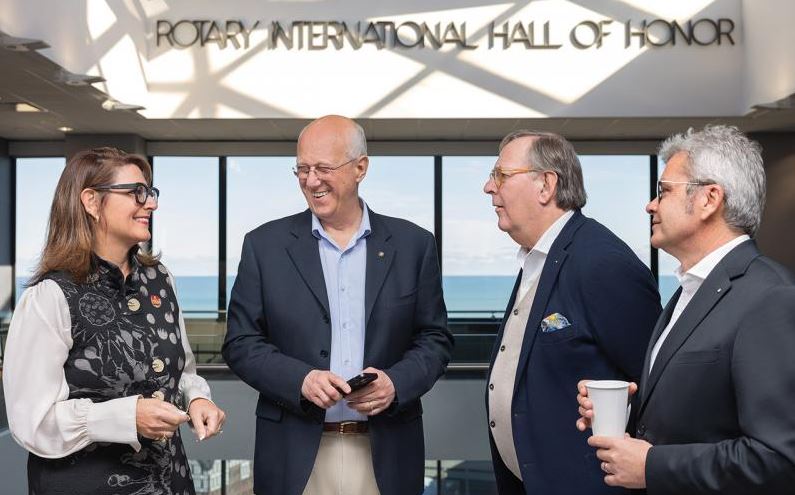
RI President-elect Mário César Martins de Camargo and 2024-26RI Directors (from left) Christine Etienne, Alain Van de Poel, and Daniel V. Tanase at One Rotary Center in Evanston, Illinois.
Image credit: Clare Britt
Professionally, de Camargo was president of the printing company Gráfica Bandeirantes and has been a consultant to the print industry in Brazil. He has served as president and chair of several printing and graphics trade associations. He has been on the board of Casa da Esperança (House of Hope), a medical center in Santo André sponsored by his Rotary club that sees more than 200,000 patients a year.
That’s his official biography. But we wanted to know, What’s de Camargo really like, what makes him tick? Here’s what we found out.
His biggest regret is that he stopped playing piano.
From the ages of 8 to 21, de Camargo played piano. He even attended a music conservatory for nine of those years. While in Germany apprenticing at a press manufacturer, he attended German language classes at the Goethe Institute. The school had a Steinway piano that “to me, was the Rolls-Royce of pianos,” he recalls. The school’s dean allowed him to play it under one condition: he perform for the school when his training was finished. “It was the last time I played the piano,” he says, explaining that family and work obligations began to take more of his time. “I really regret not being able to continue because it is a self-rewarding experience.”
He believes printers have a noble cause.
Printing presses have their origins in China, where movable type was invented in the 11th century. When Johannes Gutenberg created the mechanized printing press in Germany 400 years later, it launched the mass production of books, newspapers, and more throughout Europe. “The press and the publication of books and ideas changed the world,” de Camargo says, allowing scientific findings to be shared more widely, decreasing censorship as it was harder to destroy a “dangerous idea,” and giving the general public access to educational materials.
De Camargo’s business used to print 25 million to 30 million items per year: coffee table books, romance novels, automotive industry manuals — “you name it,” he says. “We were replicators of ideas. Printers have a mission to reduce ignorance.”
Rotary is the best leadership training he’s ever had.
De Camargo has been on several boards in his industry, but it was through Rotary that he learned how to be a leader. “Rotary is the best school of leadership I’ve had,” he says. De Camargo says Rotary taught him to speak in public, one of people’s biggest fears, along with flying. (“If I was still afraid of flying and speaking in public, I wouldn’t be president of Rotary International, because all we do is public speaking and flying!” he says.) He also learned when to stop talking and listen. “You have to pay attention to what people are telling you,” he says. “It is an exercise of humility.” And he learned how to motivate people who aren’t getting paid to perform a task. “When you’re motivating volunteers, you don’t have that tool of payment. The only tool you have is inspiration, motivation, and challenge to make them a better person.”
This is the most memorable Rotary advice he’s received: Never ask for anything, never refuse anything.
As co-chair of the Host Organization Committee for the 2015 Rotary International Convention in São Paulo, de Camargo received these words of wisdom from John Kenny, a past Rotary president who was The Rotary Foundation trustee chair at the time. “That has oriented my Rotary journey,” he says. “I never refused any job that was given to me by Rotary or The Rotary Foundation, but at the same time I offered myself for different positions without knowing what the result would be,” he says. “I could never fathom that I would be here someday.”
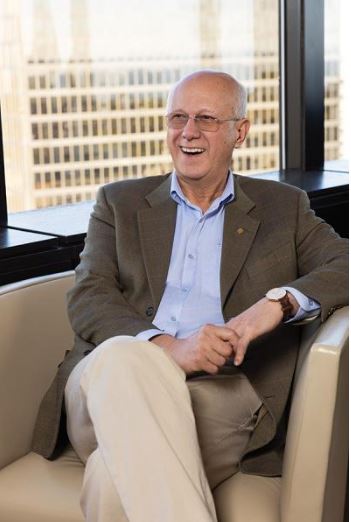
People call him Membership Mário.
“It’s not rocket science,” he says. “If you look at our numbers, some people say we have stabilized at 1.2 million. I say we have stagnated at 1.2 million.” The word “stabilize” makes people sit back and relax, he believes, whereas the word “stagnate” makes people want to sit up and do something.
The puzzle, he says, is figuring out why membership is increasing in some areas and decreasing in others. “Maybe it’s demographics, maybe it’s economics, maybe it’s an age thing,” he says. “The challenge motivates me so much because it’s a mosaic of different regions and different performances that makes it very challenging and at the same time very attractive.”
What works in Korea may not work in Germany, and what works in Germany may not work in Brazil or the U.S., he says. “We have to be humble and very attentive to the different scenarios.”
The 2025-26 presidential message is Unite for Good.
“I think ‘unite’ is a very powerful word,” he says. “It’s a very powerful word in a divided world.”
It’s easy to sow division, he says, but much harder to find common ground. “We are always looking for somebody’s defects,” he says. “We should be looking for somebody else’s talents.” That’s where Rotary comes in, offering the opportunity for people to connect with others in their community and around the world.
He believes a focus on the environment will draw younger members.
Before de Camargo, the last RI president to come from Brazil was Paulo V.C. Costa in 1990-91. Costa is best known for the environmental program he started, Preserve Planet Earth, which launched shortly before the 1992 United Nations Earth Summit in Rio de Janeiro. Had Rotary kept the environment as a central focus then, de Camargo says, “we would be far ahead, bringing a visionary agenda to the world.” As a Rotary director, de Camargo helped secure approval of the environment as the newest area of focus. “We still have a lot of room to grow,” he says.
In 2025, the annual UN conference on climate change, COP30, will be held in the Brazilian Amazon, and de Camargo sees a place for Rotary to get involved. “Rotary should have its logo, its brand, associated with environmental protection in the Amazon,” he says. “We have a unique opportunity to do that.”
He gets to know a city by walking.
“When I go to Chicago or New York or São Paulo or wherever, when I have the chance, I just put on my tennis shoes and I start walking,” he says, “just seeing the colors, the smells, the different foods, the people.” It’s the best way to feel like a local, he says. “You cannot do that by Uber or by driving a car. You’re not part of the environment. But when you’re walking, you feel like you are.” But he doesn’t stop at the city. De Camargo is a fan of hiking. “I love the outdoors, to be able to breathe fresh air,” he says.
Yes, he once dressed as Super Mario.
Step into de Camargo’s office at One Rotary Center in Evanston and you’ll notice a collection of figurines based on Super Mario, the Nintendo character. “That was the idea of Trustee Akira Miki, who was a director with me on the Board in 2019-20,” he says. “He immediately called me Super Mario, and it started catching.” At the 2024 Rotary institute in Toronto, de Camargo dressed up as the character and engaged in a mock battle with Past RI President Holger Knaack, part of a Rotary Foundation fundraiser that netted $115,000. “I put the moustache upside down, but I’ll get better,” he says. “Whatever it takes to raise money for The Rotary Foundation.”
This story originally appeared in the March 2025 issue of Rotary magazine.
The Rotary Foundation transforms your gifts into service projects that change lives.


.png)






.png)







 People call him Membership Mário.