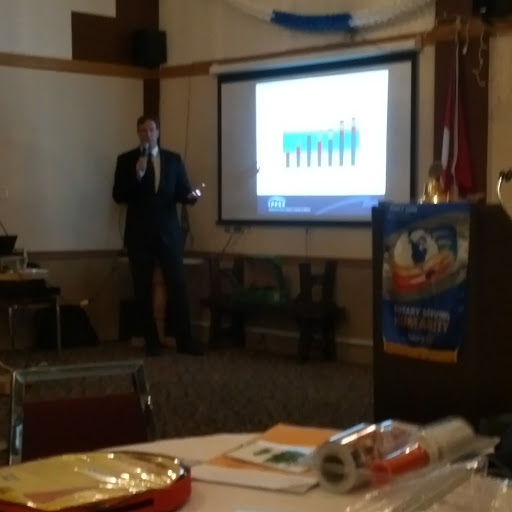
This week, our speaker was Evan Bahry, the Executive Director of the Independent Power Producers Society of Alberta (IPPSA). The IPPSA represents all of Alberta’s major power producers along with their supporting industries. It was founded in 1993 as a trade association of power producers and currently has about eighty members.
Alberta has a unique in Canada business environment for power producers in that our power producing industry has been deregulated. When a system is regulated, the government approves all capitol expenses and the consumer covers all of the cost, whether the project comes in on budget or not. When the industry is deregulated, they approve the capitol cost of projects and also take any risk if the project does not come in on budget. Losses can not be passed along to the consumer. A deregulated industry is better in many ways in that the competition between producers creates a lower overall cost, the market is based on actual demand, it is expedient for industry to incorporate new technology, and project timelines are shortened substantially. All of this creates more consumer choice, and means that the industry is able to efficiently keep up with demand.
The power industry in Alberta consists mainly of four components. The government regulated Alberta Electric System Operator (AESO), who decides how much power is needed, when and where, which producers to purchase the power from, and then purchases and sets the hourly pricing. The regulated power transmission system (power lines). The unregulated power retailers, who add another layer of complexity on top of this.
The power transmission grid in Alberta is behind the times, as we do not currently have a five hundred kilovolt backbone, as most of the other provinces do. The planning for this grid is done by government and built by private contractors, who bid on the projects. The full cost is borne by the consumer. For the average household the transmission line cost is the highest portion of their power bill.
The independent power producers come in many different types, depending on the type of plants that they operate. The major sources of power are gas, coal, wind and hydro. Some older types of plants, such as coal and gas powered steam generated, must run continuously in order to be efficient. These, along with wind and solar power are what is known as price ‘takers’ in the industry as they must take what ever price they can get for their product. Other producers, mainly hydro and gas, who can turn their systems on and off efficiently, and are known as price ‘setters’ and can sell their power at times, in amounts and at prices set by them.
The regulated AESO is tasked with meeting power demand. In order to do this, they determine how much power is needed per hour, and then look at the amounts and prices of power for sale, ranking them by cost and then by amount. The highest bidder at the demand cut off determines the price for power for that hour. This way the consumer pays the lowest possible price for their power.
The environmental aspect of power generation is becoming more of an issue now. Coal generates about one tonne of carbon dioxide per hour, gas generates about 0.4 tonnes per hour. Wind and solar have no carbon dioxide footprint, but are currently far more expensive at ninety-five dollars per mega Watt hour for wind and over one hundred and ten dollars per mega Watt hour for solar.
Overall, the power industry in Alberta is very complex, and Evan gave us a very comprehensive outline of how it works.


















 RI link:
 ?_=636108572094568063)