|
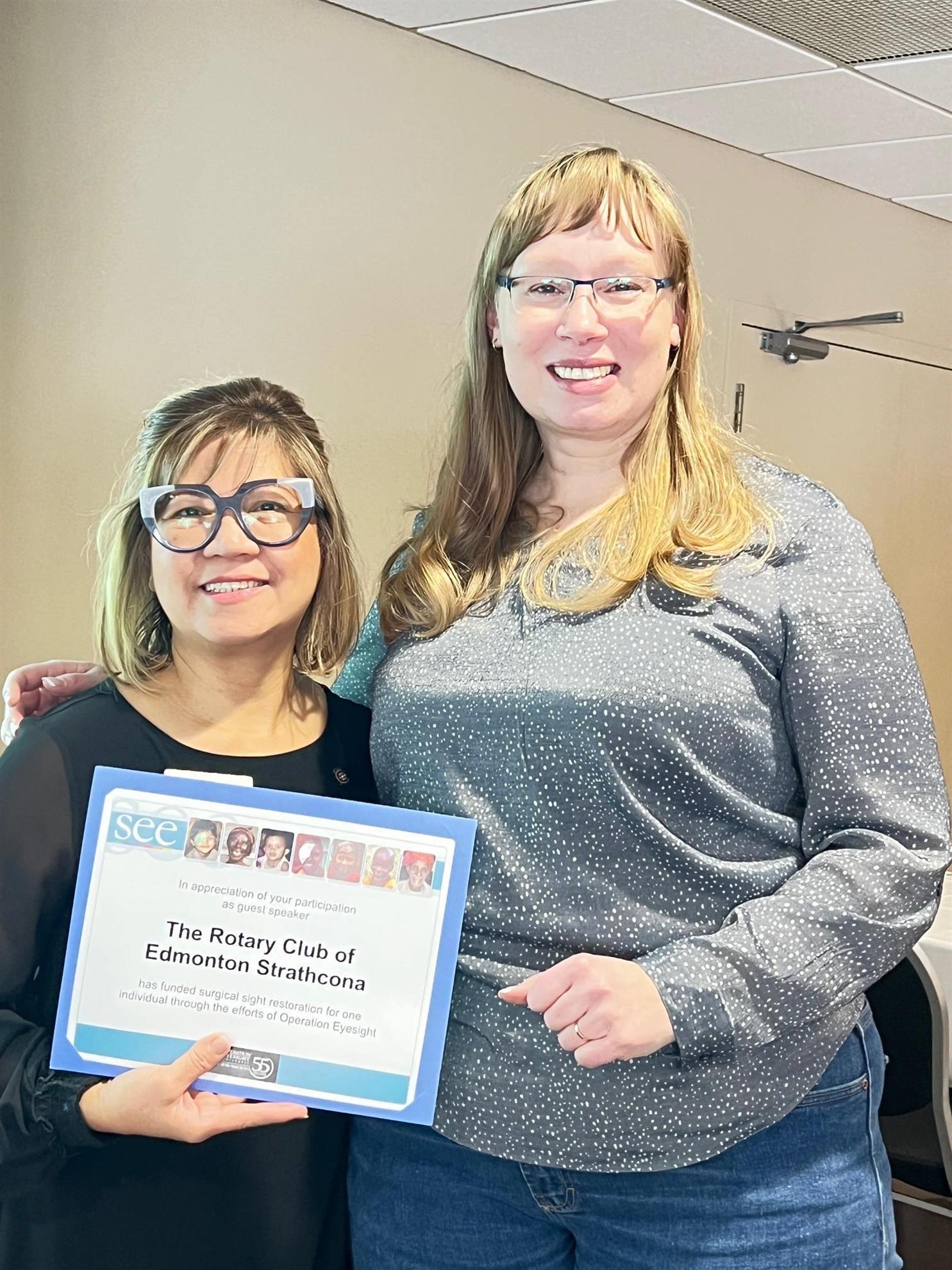
Club President Loida Lumanlan with Catherine Shier, Conservation Co-ordinator, Edmonton Valley Zoo This week we heard from Catherine Shier, the Conservation Co-ordinator for the Edmonton Valley Zoo. Catherine told us that zoos have and are continuing to change. In the distant past, beginning around five thousand years ago, zoos were mainly private collections of exotic animals, kept for the enjoyment of their owners. The first public zoo opened in 1793 in Paris, and in 1874 North America got is first public zoo, in Philadelphia. The Edmonton Zoo first opened in 1926 in Borden Park and later in 1959 moved to it’s current Laurier Heights location as a children’s zoo known as the Storyland Valley Zoo. In the 1970’s people began to question the living conditions in zoos, concern for their role in conservation of wild animals came to the fore and subsequently Endangered Species Acts were established in many places. Zoos began to be accredited and in 1981 the Storyland Valley Zoo received CAZA (Canadian Association of Zoos and Aquariums) accreditation. At about that time the Valley Zoo started taking part in breeding programs for endangered species, one of which was the Swift Fox. In the 1990’s the Species Survival Program was established and our zoo took part by housing older animals retired from breeding programs such as Cougars and Snow Leopards. In today’s zoo the habitats are now much more natural and the emphasis is on protection, conservation and education of the public about our local wild animals and the need to preserve their habitat. In 2005 the zoo Master Plan brought in a formal Conservation Program and started bringing in wild animals to breed and then releasing their off-spring into the wild. They now have financial support for the conservation of Snow Leopards, Red Pandas and River Otters. They have helped to re-establish the endangered Northern Leopard Frog back into it’s Central Parkland habitat, surrounding Edmonton. They help off site with local conservation programs by supplying their expertise to help with such things as neutering the invasive wild boar population in Elk Island Park. They also host researchers who wish to come and study the animals that they have at the zoo. In 2022 they established and formal conservation program and hired a Conservation Co-ordinator. Our Zoo has over four hundred thousand visitors a year with more than twenty thousand children who take part in educational programs. It has been very busy lately expanding and updating it’s old infrastructure, building new habitats and structures and repurposing older ones. One of the old infrastructures that has been refurbished and updated is the children’s carousel where the old carousel animals have been replaced with endangered species for the children to ride. Many Central Parkland animals and birds are still found in our river valley and surrounding areas, but we have also lost many since the 1950’s due to the expansion of farmland and cities. We need to be more aware of the wildlife around us and how to conserve it. The zoo is now there to increase our awareness and to educate us and future generations on the importance of our natural wildlife. |






.png)