Cliff Top Walk History
Arguably one of the jewels in the crown of Waikerie, the Rotary Cliff Top Walk has a long history that reaches way beyond our memories. Certainly, the traditional owners of this land, the Ngawait would have walked along there, and we pay our respects to them in this story.
Much later, in the latter part of the 19th Century, as European Settlement began changing the scenery, a path was beaten along here through thick scrub to allow movement between the new settlements of Holder, Waikerie and Ramco.1 This path allowed surveying of the land from the 1890s to early 1920s, when land was divided and marked for telegraph routes1. The surveyors would not have been able to complete their tasks without the help of cameleers and their camels. The cameleers –young and middle-aged men, collectively known as Afghans – started to arrive in Australia around the 1860s from Afghanistan and British India (now Pakistan) and helped open up all of Australia2. They were, in the majority, Muslim, and many of the young men ‘married’ Aboriginal or European women. For a while the families remained Muslim but eventually became assimilated into mainstream Christianity. However, as distrust of brown-skinned people developed after 1901, most had drifted back to their homeland by 1920, and Australia did not see immigration from Afghanistan again until 1979. The camels remained. Australia now has the largest population of feral camels in the world2. Local folklore tells that the date palms scattered along the base of the cliffs beneath the cliff top walk originated from the dates these Afghans ate3.
Over the next hundred years, the town of Waikerie grew and prospered, but the walk deteriorated. The cliffs beneath the walk were often used as a convenient rubbish dump and, of course, there was a railyard and railway station by the silos. The land, unfortunately, became degraded. The ruins of an old stone crusher can be found here, last used in the early 1940s1. An amusing early anecdote relates the tale of two cattle who, deciding that they would not be going to market, escaped over the cliff into the river. Surprisingly, they survived the very long drop and swam off down the river to the other side, we can envisage them enjoying their freedom at last, but they were, sadly, eventually caught3.
So it remained until 1988/1989, when the Rotary Club of Waikerie began a major community service project to reconstruct the Cliff Top Walk, with Rotarian Bob Fowler responsible for stage one. This project saw cement steps from the Waikerie pumping station up the cliff to the chimney stack. Rotarian Richard Hall was responsible for the steelwork of the steps and the lookout tower. Anyone who has ever walked up those steps will appreciate the hard work and dedication of these volunteers to build these by hand!
In 1994/95, Rotarian Lou Gagliari undertook to oversee the completion of the second stage of the project. Thanks to a grant secured by then member for Chaffey Kent Andrew, further stairs were placed along the path and fenceposts were installed. Waikerie Council prepared the land and Rotarians undertook the work, plus planted trees and further beautified the local environment. Over the years, this has been an ongoing project, with hundreds of volunteer hours and thousands of dollars spent in community-raised money, as well as proceeds through the Opportunity Shop and the Rotary Food Fair.
By 2016/17 however, it was becoming clear that a good deal more than touch-ups here and there were required to maintain the walk. Some urgent repairs were completed along with new signage, but unfortunately a large amount of money was still needed. Nonetheless, under the auspices of Rotarian Graeme Thompson, a large-scale survey of the walk was undertaken which highlighted the major areas of need. This was in late 2020/early 2021, and the Rotary International theme at the time was “Rotary Opens Opportunities” which proved to be prophetic. With the help of a grant writer from The District Council of Loxton Waikerie, the Rotary Club of Waikerie submitted an application to the Murray–Darling Basin authority in the Department of Agriculture of the Federal Government and was subsequently awarded a grant of $396,000, including GST, from Round 3 of the Murray–Darling Basin Economic Development Program.
Work began in earnest in late July 2021, as there was a limited amount of time in which to complete such a huge task. Gradually, mostly local tradespeople and volunteers transformed the Rotary Cliff Top Walk, sourcing 99% of the materials locally or from South Australia. Tonnes of rubbish were cleared and removed from the sides of the cliffs, but unfortunately some of the old rubbish had to be left behind – a timely reminder, we hope, to take care of our precious land. Old pine fencing has been removed and replaced with smart modern recycled posts. The steps have been replaced with ones that fit in with modern safety standards, as has an old bridge. The look-out tower placed there so many years ago by Rotarians has been given a new lease of life with a coat of paint and new safety features, overseen once again by Richard Hall. The path has been levelled and totally resurfaced so much of it is now accessible to child-pushers and mobility scooters. Four picnic shelters have been placed along the walk, all commanding impressive views over the river Murray. Between the beautifully painted silos and the cliffs there is now a native garden, including native “bush-tucker” plants that people can walk amongst. We can envision what that will look like once it becomes established.
For now, the main work is completed, but there is more to be done. The Rotary International theme for this year 2022/23 is ‘Imagine’. As we look across the beautiful river to the ancient land of Pooginook, so called by the Ngawait tribe as a “place of good food”4, we can only imagine what it would have looked like before European settlement in 1850, when it was thick with native bush and large amounts of native animals, and we can only imagine what it will look like in the future. We can also imagine what else we can do as a community to improve and continue our Rotary Cliff Top Walk. For now, it is fulfilling our dream of giving its benefits to locals and visitors alike.
Maureen Phillips
On behalf of The Rotary Club of Waikerie
- Nunn, J.M 1994 History of Waikerie: gateway to the Riverland. Waikerie Historical Society, Waikerie
- Ghai, R. 2016 https://www.downtoearth.org.in/news/wildlife-biodiversity/back-of-australia-52483 accessed online, 10/07/2022
- Arnold, M. 2022, Local historian, personal communication
- https://www.parks.sa.gov.au/parks/pooginook-conservation-park accessed online 10/07/2022

Pouring concrete for the steps. (circa 1980's)

Lookout Tower (circa 1970's)
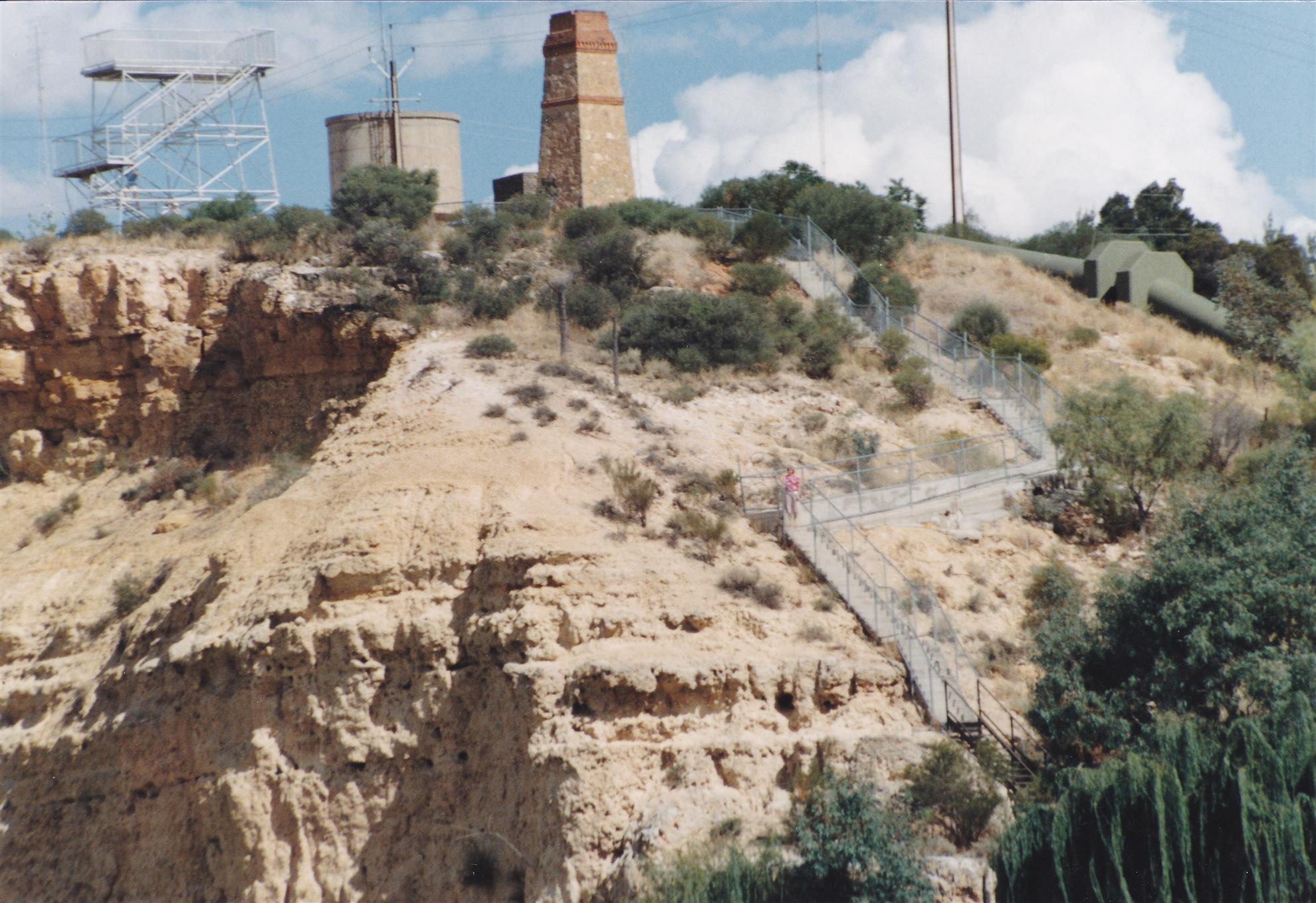
Completed steps (1989)

Stage 1 Opening (1989)

Centenary Sign

Top of steps

Panorama near silos

New posts and stairs (2023)

Reflection seat on the walk (2023)

Painting of the mini silo

'Murray'

Opening of Cliff Top Walk Stage 3 (21st Sept 2023)