
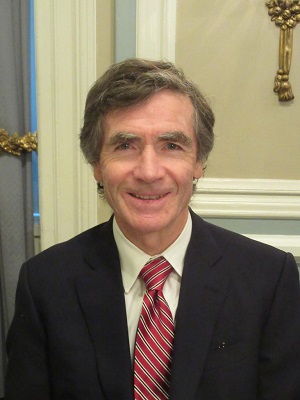
 Our Speaker Jeff McCaig 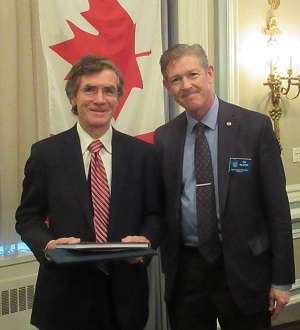 Tim Heaton Thanking Our Speaker | Brian Guichon introduced Jeff McCaig, who delivered an interesting three-part presentation. He tied his discussion of Trimac Transportation, Calgary Sports and Entertainment, and the McCaig Institute for Bone and Joint Health together by recognizing that none of these would be possible without the dedicated efforts of many people. His presentation provided credit to these people. He began by providing a brief overview of Trimac Transportation, a family business founded by his grandfather and his partners. Our speaker was the third McCaig to serve a president of the company, which began operating in 1945. Trimac Transportation is in the bulk trucking business, a large and highly competitive segment of the transportation sector, which employs more men than any other industry. Within the trucking industry, Trimac operates in the bulk or tank segment, i.e., the transportation of bulk commodities that flow. Trimac also operates several trucking-related services, including tank cleaning, truck maintenance, and third-party logistics. The bulk transportation segment is highly competitive, with narrow margins, and is fully mature. Companies in this segment typically grow only through acquisitions. Turning his attention to Calgary Sports and Entertainment, our speaker provided an overview of the Calgary Flames organization, which is celebrating 40 years in Calgary this year. While the hockey club has previously had as many as eight owners, the current ownership comprises Murray Edwards, Alvin Libin, and Allan Markin, in addition to Jeff McCaig. The Calgary Flames organization holds corporate membership in our club, and Flames executives Ken King and Rollie Cyr are club members through the Flames organization. The Calgary Fames Foundation has donated close to $40 million to the community. Mr. McCaig stated that professional hockey is even more competitive than the trucking sector and that teams in small markets such as the Flames can only turn a profit if they reach the playoffs. |
Describing the need for a new event centre, Mr. McCaig presented a graphic showing the timelines of ageing NHL facilities that showed the Scotiabank Saddledome as being far older than any other facility used by an NHL team. The age of the Saddledome is a critical concern because the 1990s saw a shift from simple structures that could seat 20,000 spectators to facilities emphasizing the total fan experience. Newer facilities provide their patrons with restaurants, suites and large lower bowls that offer experiences based on new technology. He told us that the Calgary Stampeders face a similar problem as McMahon Stadium is the only CFL venue that has not been replaced or modernized since its inception.
Calgary Sports and Entertainment and the City of Calgary signed a definitive agreement to develop a new event centre as the centrepiece of the Victoria Park redevelopment on December 5, 2019. The total development cost of the new event centre will be $550 million, shared evenly between the city and the Flames organization. The Flames are planning to begin playing in the new facility at the start of the 2024 hockey season.
Finally, Mr. McCaig described the McCaig Institute for Bone and Joint Health, one of seven centres of excellence at the Foothills Hospital. The McCaig Institute is leading the improvement of musculoskeletal health for patients of all ages through research and education. It seeks to enhance the musculoskeletal health of Albertans by focusing efforts on a “precision medicine” approach to research: tailoring the right intervention for patients at the right time.
After an informative question and answer session, Tim Heaton thanked Mr. McCaig for his wide-ranging presentation.