
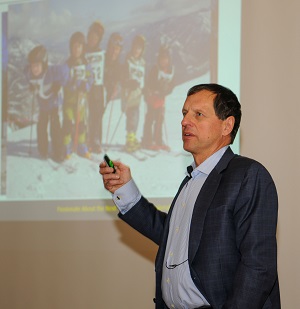
 Our Speaker Chris Slubicki .jpg) Dave Macdonald Thanking Our Speaker | Carmen Goss introduced our speaker Chris Slubicki, President and CEO of Modern Resources, whose presentation to the club drew attention to the current state of Alberta's energy sector. A self-described fan of engineering, he is passionate about Canada, all things energy-related and ensuring that the next generation of Canadians receives the tools they need to advance the country. Mr. Slubicki's opening comments on the significance of energy scarcity included the stark reminder that people without access to energy do not have adequate water supplies, food, shelter, roads, medical care or education. He also pointed out that it is easy to criticize the energy industry from a position of energy abundance, and that most Canadians live in a world of abundance. Of the 7.7 billion people on earth, approximately 1.4 billion live as we do with a mean life expectancy of 79 years, an average of 16 years of schooling, and an average of 22 deaths per 100,000 due to air pollution. To maintain this lifestyle, each of us consumes about 34 barrels of oil per year based on the conversion energy from all sources to a barrel of oil equivalent (BOE). By way of comparison, the next 2.5 billion people in emerging economies (including Brazil, Mexico and Iran) consume an average of 14 BOE. The average life expectancy in these countries is 76 years, and the average number of deaths due to air pollution is 85 per 100,000. Finally, the poorest billion people have a life expectancy of 59 years, receive an average nine years of schooling and experience 159 deaths per 100,000 from air pollution. These people consume one BOE per person. |
These statistics clearly show how energy is required to improve global living conditions. Mr. Slubicki reminded us that the debate around replacing energy supplies, which takes place from a position of energy abundance, is a debate based on arrogance. All energy sources are required to lift significant parts of the world out of poverty so that all of its citizens can enjoy the lifestyle we take for granted in Canada. Given our circumstances of geography, climate and population density, Canadians consume an average of 67 BOE annually, which is the highest in the world. Beyond this, our industries, which supply need products to the world, use energy intensively.
Turning his attention to renewables, Mr. Slubicki described the rapid advance of renewables. However, despite an impressive 14 percent growth rate in adoption in each of the past fifteen years, renewables still account for only a small fraction of energy supplies. Beyond this, the impressive growth in renewables is not keeping pace with the growth in oil, natural gas and coal consumption. He also indicated that while nuclear energy has an important role to play, and will inevitably increase, the potential for hydroelectric growth is limited as most of the suitable rivers for generating hydropower have already been dammed. Therefore, it is essential to distinguish between the physical impossibility of a no-carbon world with a "low carbon" world, which is a worthy objective.
Mr. Slubicki pointed out that achieving a low carbon society requires much higher energy efficiency than is the case at present where 68 percent of the energy we consume is rejected to the environment, chiefly as heat. Expounding on the idea that current energy policies are not sustainable, he quoted the nineteenth-century economist William Stanley Jevons who observed that technological innovations that increase energy efficiency lead to increased consumption. The best example of this is that low fuel costs lead to consumers driving larger vehicles, such as SUVs.
On the subject of emissions, Mr. Slubicki described how 86 percent of natural gas emissions and 82 percent of oil and gas emissions result from the personal decisions of individual consumers. These emissions completely dwarf those of production, transportation to markets and manufacturing.
He concluded his presentation with his thoughts on the limited investment options facing oil and gas investors. Referring to the well-funded campaigns to deny Canadian oil and gas companies access to equity markets, borrowing sources and insurance, he reminded us that Canada continues to have the best track record in environmental protection, first nations consultation, health and safety standards, labour laws, gender equity and human rights standards. He finds it frustrating that our best in the world energy industry, and the country as a whole, continue to be denigrated by groups pursuing their self-interest. He encouraged Canadians to stand-up for their energy sector, referring to getting any project built as a "Canadian moonshot." He quoted a Shell executive as saying that getting a Canadian LNG project to a final investment decision is as hard as landing a man on the moon. In contrast to the eight and a half years that it took NASA to land Apollo 11 on the moon, it appears the Shell LNG facility will take a minimum of fourteen years to come to fruition. His parting question was whether Canadians could regain the courage to build.
Dave Macdonald thanked Chris Slubicki for his information-packed presentation.