
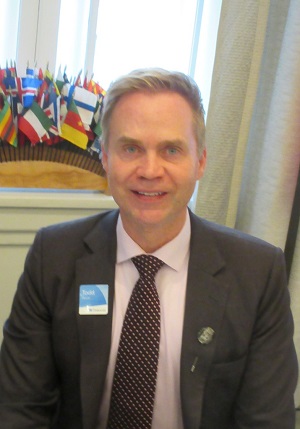
 Our Speaker Todd Hirsch | Bruce Graham introduced our speaker Todd Hirsch, Vice-President and Chief Economist at ATB Financial. His presentation, A New Trajectory: Trends in the Alberta and Global Economies, provided an overview of our current economic situation. He began with a quotation by Yuval Noah Harari, "In a world deluged by irrelevant information, clarity is power." The first part of his presentation considered the future of work in Alberta, particularly evolving relationships between employers and their workers. He began with an example in which the automation of a simple activity, such as going to a doctor to obtain prescriptions for routine medications, will transform radically in the next few years. In his scenario, a wearable monitor orders a personalized pill that replaces multiple drugs, such as a statin, and medicines for hypertension. Once ready, a robotic aircraft delivers the tablet directly to the patient at home. This automated process eliminates the pharmacist, doctor, nurse and receptionist in the doctor's office. Technological disruption does not mean the replacement of workers by robotics. Instead, it means process automation will render many traditional jobs unnecessary. |
While this displacement might be inevitable, society must be aware it could create new problems of social isolation and social poverty.
Our speaker went on to describe how work has evolved from relatively fixed periods of education, productive work, and a brief retirement that was typical of the first half of the twentieth century to a more complicated picture. Tomorrow's workers can expect to encounter periods of paid employment mixed with periods where they are not working for pay, interspersed with periods of educating and skills updating. We can expect the lines between education, paid work and retirement to blur completely. This shift has profound implications for workers and employers. The key attributes required of future workers will be flexibility and adaptability. Similarly, employers will need to offer flexibility to workers as they move in and out of paid work to care for children and ageing parents.
Building on his early healthcare example, Mr. Hirsch told us that while process automation will eliminate large numbers of today's jobs, it will create many new ones, some of which are not obvious today. Our speaker believes we can already see the appearance of "green shoots" heralding the arrival of a new, diversified economy. He emphasized that this transformation will not lead to the immediate reversal of the job losses we have experienced in the energy sector and that high paying jobs in oil and gas likely will not return. That is, employment in the emerging market will offer lower wages. He also indicated that the energy sector will not disappear but will form the backbone of Alberta's future economy.
The second part of his presentation considered the future of the global economy. He suggested many situations at play in the world, some of which present risks for Canada and Alberta. Our primary macroeconomic risk is that we are heavily reliant on one trade partner, the United States. Over the past twenty years, the US has become more unpredictable because it feels more threatened than in the past, and protectionist sentiment has grown.
Alberta also faces microeconomic risks in that it falls to individual companies and industries to diversify trade. The federal government has done its part by negotiating several free trade agreements, including an updated NAFTA agreement with the US and Mexico, and a comprehensive trade agreement with the European Union, among others. However, beyond these agreements, developing trade with countries such as India and China is very complicated and time-consuming. While very worthwhile for Canada and Alberta, growing business is risky for the companies involved. This risk will lead to slower growth in the Canadian economy.
Mr. Hirsch wrapped up his presentation by predicting that the Alberta economy will grow at a rate of one percent in 2020, which will seem a disappointment to people when they reflect on the spectacular growth seen in the years before 2014.
Peter Giuffre thanked Mr. Hirsch for a most informative presentation, our last of 2019.