
Our Speaker Todd Hirsch
Posted by David Holden
Gerard D’Mello introduced our guest speaker Todd Hirsch, Chief Economist of ATB Financial.
Title: Rebuilding Alberta’s Economy and Economic Outlook for Winter and Spring 2017
- News is a little bit better than the last couple of years
- Recessions historically every 6 or 7 years (over the last 40 years) but not spaced out evenly
- Not unusual to see a down turn
- It is, however, unusual to see back to back years of retraction
- 2015 and 2016 was that … not since the 1980s has that happened
- Some things are unforeseen and unexpected, like the Fort McMurray forest fires last May
- Where we are at now: 5 components
- How did we get here
- Give some thoughts and suggestions about what we might be able to expect
- Employment has contracted from the peak in 2014, record earnings, record employment
- Employment has decreased 3.7%, whereas total wages have decreased 5.8% due to the high number of highly paid jobs that have disappeared (from Oil & Gas, Construction, Professional, and Manufacturing)
- Oil & Gas down 23%, pay not down
- Construction down 9%
- Professional, scientific and technical down 12%
- Manufacturing down 11%
- Total wages down show why there have been the hits to retail and other consumer driven sectors
- Oil and Gas: the sector is so important because it affects almost all aspects of Alberta society
- Where are oil prices going? There has been stability over that last few months ($51-$54 range)
- This will continue ($50 to $60 range) although anything could happen
- Stops saying “never”
- Quantity of US Shale should prevent a price run up above $60
- Good news is that range will allow even more stability
- Bad news is it is too low to allow big new oil sands development from making sense
- Petroleum sector is put into a different role, with $55 range and stability, sector also stabilizes and continues to be the backbone of the economy but it does not remain the growth engine
- This will have employment implications
- Construction: Has been a lot of anxiety over being overbuilt
- Building permits is the best forward looking indicator
- They are down 26% from where they were 2 years ago
- The stats are not as grim when historical patterns of a 10 year average with building permits are down 4% when compared to the 10 year average
- This suggests 2017 will see a slowdown but not a collapse. Some of this slowdown may be offset with the lefties’ dream of increased infrastructure spending but both are dependent upon the next budgets and the political implications of running unchecked deficits. Editor’s note: Keynesian economics does not work but the Federal Liberals and Provincial NDP appear to be committed to infrastructure spending evening out the economy
- Good news in non-energy sectors: tourism (record setting years) and agriculture and agri-foods (cattle and crops should be fine in 2017 but growth potential is in the agri-foods side, which is small niche food processing, organic honey to micro-breweries as “local” is now worth a premium)
- Wild-Cards? Beyond our borders with challenges in USA and what will the policy be and how insular will their economies be
- Message from the USA after the Trump-Trudeau meeting was “Canada don’t freak out too much”
- Agriculture and forestry are worried
- Europe will have their own challenges (increased populism throughout Europe)
- Russia and China are always interesting with potential for disruption
- Adaptation is the key Noah McVicker wall paper cleaning product evolving after electricity
- Later with insight from the second generation, nephew Joseph, Play-Doh was born
- Alberta needs a similar stepping back to see new opportunities with Oil& Gas remaining the backbone
- Other industries
- 2017 is a rebuilding year, stability but not much growth with construction slowing, job market to remain weak as labour market indicators always lags the economy in both directions so some gradual improvements in the second half of 2017, global wild cards is fascinating but can be characterized as a great big unknown, non-energy sectors will generate growth with forecast presently at 2.1% and should be revised upwardly ever so slightly in early March. Editor’s note: ATB revised their growth forecast for 2017 to 2.2% on March 1, 2017. That report also suggested Alberta’s growth will be 2.3% for 2018.
- This will end 2 years of contraction but is only half the growth we saw between 2010 and 2014.
- Moderate and steady growth rates should help other sectors
- His 3rd book (Spiders in Space – successfully adapting to unwanted change) is available after the meeting and will be formally launched shortly
Michael Broadhurst thanked our speaker.
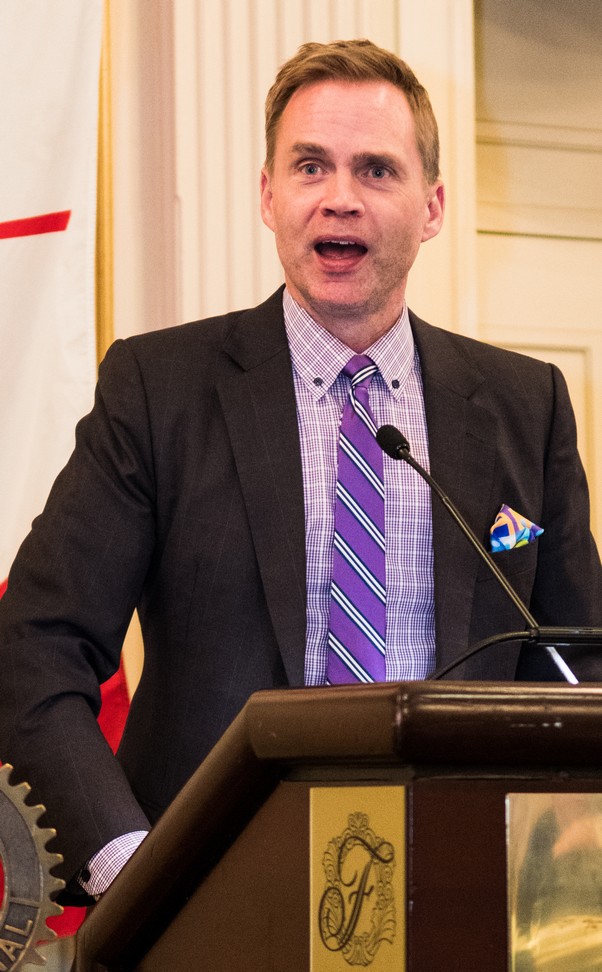
Todd Hirsch