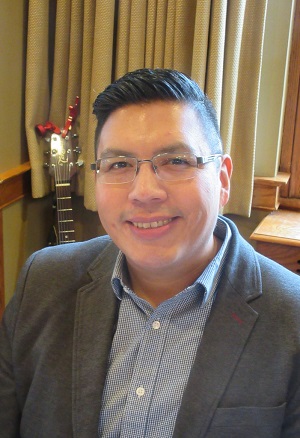
 Our Speaker, Tim Fox
|
| Stay-In-School coordinator introduced our speaker Tim Fox, member of the Kainai Nation, and Director for Indigenous Relations with the Calgary Foundation. In this capacity, Mr. Fox works with local communities, and on the national stage, to mobilize reconciliation. He also sits on the board of the Circle on Philanthropy and Aboriginal Peoples in Canada, and works as a facilitator with the men's domestic violence treatment program at the Calgary Correctional Centre. He began by presenting a video clip from Senator Murray Sinclair, the former Chair of the Residential Schools Truth and Reconciliation Commission, which explained the work of the commission as memorializing the victims of a great wrong. In the video Senator Sinclair stated that it is important that all Canadians learn from First Nations' residential school experiences as they are part of who we are as a nation, and that we must never forget what our country did to its most vulnerable people. Working with the Calgary Foundation provides opportunities for Mr. Fox to gain insights into his experiences growing up on the Blood Reserve. |
In his youth he experienced domestic violence, addiction, poverty and shame, but he came to understand that his negative experiences were only a fraction of those experienced by his parents in residential school. He indicated that although he has formally worked to mobilize reconciliation since 2012, he had been preparing for this work his entire life. His key takeaways from this work are that true reconciliation defies easy fixes, and can best be thought of as a journey that all Canadians are on together.
Mr. Fox has identified that a first step towards reconciliation must be a "deep dive" into the hard truth regarding our shared experience, much of which has been supressed for a long time. Organizations and communities are now recognizing and acknowledging land, which is a great step. Other issues, including missing and murdered women and girls, are also moving to the forefront.
In his view, the Harper government's formal apology to former students of residential schools on behalf of the Government of Canada was a significant step on the road to reconciliation. Another key step is the development of a true indigenous voice, and this is a cornerstone of a framework he has contributed to. One of this work's outputs is a workshop on the impacts of intergenerational trauma.
Mr. Fox indicated that it will take time to reach a fully reconciled state, and we may not see full reconciliation in our lifetimes, but he remains hopeful that progress is being made. He also quoted a presentation made by Mr. Leroy Little Bear, also of the Kainai nation, during the Canada 150 celebrations. Mr. Little Bear indicated that indigenous peoples find it hard to see themselves reflected in the symbols of Canada. Canadian customs, values and beliefs need to be extended, and acknowledging traditional territories is a way of creating space to include First Nations peoples.
Mr. Fox concluded his presentation by referencing three documents that should be read by all Canadians.
- Final Report of the Royal Commission on Aboriginal Peoples (1996)
- UN Declaration on the Rights of Aboriginal Peoples (2007)
- Truth and Reconciliation Commission of Canada Calls to Action (2015)
These documents, which guide Mr. Fox in his efforts, are calls for all of us to work together to better the lives of aboriginal peoples.
At the conclusion of a lively question and answer session, Bob Ermter thanked our speaker.