
.jpg) Our Speaker, Scott Hutcheson 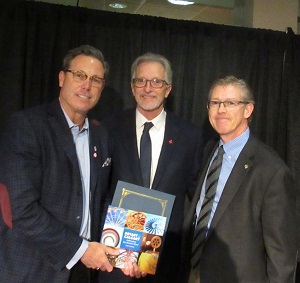 Rollie Cyr and Tim Heaton Thank Our Speaker |
| Gene Edworthy introduced Scott Hutcheson, who provided an update on Calgary's bid for the 2026 Winter Olympics and Paralympics bid. His presentation addressed the following topics.
The Calgary 2026 Bid Corporation emerged from a City of Calgary initiative, based on a recommendation from the Calgary Bid Exploration Committee (CBEC), with the mandate to put together a responsible bid. The International Olympic Committee (IOC), a Swiss-based non-profit organization, has been modernizing the processes for bidding on and hosting the games. Calgary can expect to host games that are:
|
The Calgary 2026 bid has the advantage that many of the venues from the 1988 Olympics can be repurposed, with varying degrees of updating required. As in 1988, the mountain Olympic events would be held at Nakiska (downhill ski events) and the Canmore Nordic Centre (cross-country skiing and biathlon). Ski jumping and the sledding events would reuse the 2010 venues at Whistler Olympic Park.
The remaining events would be held in the city, with event clusters at Winsport Canada, Stampede Park and the University of Calgary. In addition to the sporting events, a Calgary Olympics would include extensive arts, cultural and educational events. The 1988 Olympic Arts Festival attracted 1.25 million patrons, while Vancouver 2010 included a four-year cultural Olympiad that drew 5.8 million visitors. Calgary 2026 could be expected to build on these successes.
The Calgary 2026 Olympic bid, which has been assembled under the guidance of approximately 30 games experts, includes more than 30,000 line items. The bid corporation has responded to more than 3,000 questions from the three levels of government and professional accounting firms. As the anticipated operating expenses of $2.45 billion will be offset by $2.23 billion in revenues, the expected public contribution to the operating budget is expected to be $200 million, mainly to support the Paralympics. The total public investment is expected to be $3.0 billion, broken down as follows.
- $1.6 billion for urban development ($620 million for housing, $530 to update existing venues, and $430 million for new venues)
- $600 million for security
- $300 million for essential services
- $220 million for the Paralympics
- $180 million to establish a legacy fund
- $120 million for an unrestricted contingency
The legacy for these games would be substantial. With $2.2 billion of private investment matched by $1.75 billion from the government of Canada, Calgary could expect to receive $2.0 billion of GDP growth, $200 million tax revenue, eleven renewed venues and two new venues, plus 2,850 affordable housing units.
It's up to Calgarians to decide in the November 13th plebiscite whether the bid will proceed. We can do this. Calgary '88 and Vancouver 2010 were two of the most successful Winter Olympic and Paralympic Games in history. The games would be a catalyst for nation building, and unparalleled community building. It is worth noting that the Bow Valley hosts more winter World Cup events than anywhere else in the world. There were fourteen World Cup events in 2018-2019, and more than 275 World Cup events in different disciplines have been held since 1988.
It is important that the voices of all Calgarians be heard, and November 13, 2018 is your opportunity to have your say. At the conclusion of the presentation Rollie Cyr thanked our speaker.