
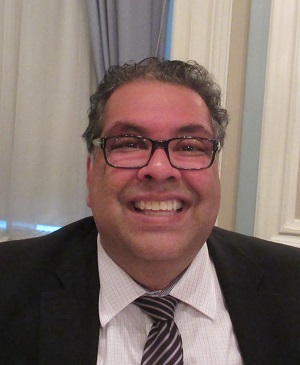
 Our Speaker, Naheed Nenshi 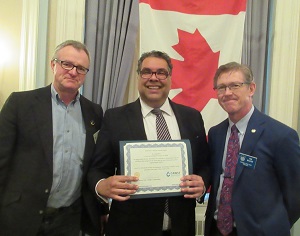 Brian Guichon Thanks Our Speaker |
| Bruce Graham introduced Mayor Naheed Nenshi who delivered his annual "State of the City" address to the club. The Mayor's address was timely, given the well-publicized City Council deliberations on the state of municipal taxation in the wake of the oil price collapse in recent years. Referring to his remarks as "Calgary Beyond the Headlines", the Mayor reminded us all that we are truly fortunate to be living in this place. He noted that people have long been drawn to the area because of its abundant water resources, and that First Nations have a long history on the land. He also told us that we are about to celebrate the 125th anniversary of the city's incorporation, and thanked Rotary for everything we do to build our community. We are living in a moment of profound change. The economy is shifting, expectations of government are shifting, and previously abstract concepts of reconciliation and inclusion are becoming real and important. Our challenge is to create opportunity and wealth for everyone in our community. As our population continues to grow, we face great new challenges and great new opportunities. Reflecting on the cyclical nature of our primary industry, the Mayor reminded us that this time is different, and that we are unlikely to see oil prices return to the lofty heights of 2014. He also noted that while previous downturns resulted in workers leaving Calgary, the city's population has continued to increase during the current downturn. This is because "our valleys are most people's peaks", and despite the downturn we are still in a better position than anywhere else in the world. |
People continue to come to Calgary for its quality of life. The Mayor quoted a report by The Economist that ranked Calgary as the best place to live in the western hemisphere, and as the world's fourth-best city. We achieved scores of 100 per cent in each of The Economist's metrics with the exception of climate, where we achieved a 90 per cent favourable rating.
The Mayor went on to address the recent City Council meeting, and provide an overview of our current taxation situation. He reminded us that Calgarians enjoy the lowest residential taxes and some of the lowest commercial taxes of any Canadian city. This has been due in part to prudent financial management of the city's finances, but mostly to the extraordinary commercial success of our downtown core, which provided considerable benefit to businesses outside the core. Beginning in 2015, a number of property sales in the downtown core resulted in significant changes to the assessed values of downtown properties. This resulted in a significant shift in the distribution of the tax load to businesses outside the core despite the fact that the overall tax levy actually decreased by three per cent. The city was able to deal with this in the short-term by drawing on its reserves; however, downtown property values did not rebound as expected. While City Council agreed last autumn to set aside $71 million to buffer small businesses against excessive tax hikes, it could not come to agreement on the proper mechanism to release the funds to small businesses. Accordingly, businesses have recently received tax bills that did not include any tax relief. At the June 10thmeeting, City Council reached an agreement on how to release the relief funds.
While this addresses the short-term problem, City Council still needs to address the structural problems in the current tax system to achieve the objective of having a fifty-fifty taxation split between residential and commercial property taxation. The result of recent deliberations is to have the vast majority of businesses pay property taxes that are at least ten per cent lower than last year. In order to achieve this, City Council has asked the city's administration to develop a plan to reduce its spending by five per cent within the next three weeks. As a result, the city will be forced into making some tough cuts. This is in addition to the $605 million in cuts out of its $4 billion budget over the last five years, which has led to 500 job cuts at the city.
The Mayor wrapped up his presentation by talking about where the city can go from here. He mentioned that the Conference Board of Canada has reported that our growth is slowing, and he is worried about jobs. Our current recovery has proven to be a jobless one, and automation is radically changing the way we do business. The oil industry has learned how to make money at $50 per barrel oil, but these conditions will not lead to large numbers of people returning to the downtown office towers. Our response to these conditions must be well considered, and the Mayor briefly mentioned a number of initiatives to support business investment in the city.
- Calgary Economic Development has established the Opportunity Calgary Investment Fund as a tool to attract and support transformative investments in the city. The $100-million fund offers opportunities for private sector companies, non-profits and public institutions making transformative investments in Calgary that will be catalysts for economic growth, diversification, increased employment, and expansion of the property tax assessment base.
- The city is continuing to invest in flood resiliency, as continuing uncertainty in our ability to protect the downtown core from upstream rainfall events is a disincentive for businesses to establish themselves downtown.
Reinforcing his message that the city cannot be successful unless everyone is successful, the city continues to focus on mental health as a strategic priority.
Mayor Nenshi concluded his presentation by talking about the new public library building. He stated that the real significance of this architectural masterpiece is that it delivers the message that every person in the community deserves a place to launch their dreams. Its vision is that anyone, including a newly arrived refugee, understands that this is a place for them. The building is a manifesto, and a statement of who we are.
Following a lively question and answer session, Brian Guichon thanked our speaker.