 Our Speaker Mary Ellen Nielson 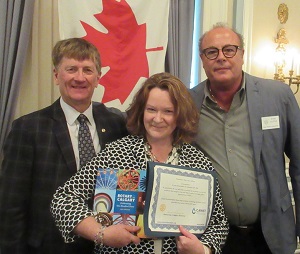 Peter Giuffre Thanks Our Speaker |
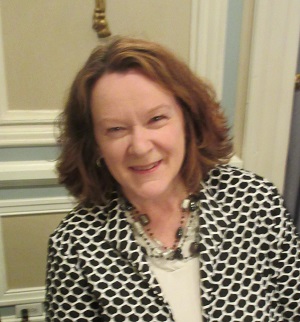
| Phil Libin introduced Mary Ellen Neilson, Executive Director of the Association for the Rehabilitation of the Brain Injured (ARBI). Ms. Neilson has previously addressed our club, and her presentation provided an update on happenings at ARBI. ARBI began in 1972 when Alice Laine’s son Mel suffered a severe brain injury when struck by a hit-and-run driver. While the family was given no hope for recovery by the medical system, Alice's friend Audrey Morrice uttered four simple words, “I can help you.” Audrey lived up to her promise, and Mel relearned how to talk, walk, think and write, allowing him to return to an active life. Audrey, Alice and other volunteers began helping other brain injury survivors in the basement of the Woodcliff United Church and founded ARBI in 1978. ARBI offers a unique on-site, intensive rehabilitation program that bridges medically delivered rehabilitation with community-based programs. These programs sustain long-term recovery, and every patient receives a personalized program based on his or her specific goals. The on-site program's individual and group activities may include traditional therapy, new methods for managing daily tasks, as well as social and emotional support. Ms. Neilson reminded us that in 1996 our club was instrumental in building the Rotary Auditorium, which was a major milestone for ARBI. More recently, Phil Libin led the club in an initiative to update the iPads used at ARBI, which are key rehabilitation tools for stroke survivors suffering from aphasia. |
She also described a significant shift in ARBI's clients. In the past, brain injury survivors came to ARBI following two years of primary treatment. Today's clients typically arrive at ARBI two months after their injuries, and often arrive with their families in crisis. One of the main reasons for this is that a traumatic brain injury removes both the patient and his or her partner from the workforce.
One benefit of being a small organization is that ARBI can partner with other groups to achieve specific objectives. In addition to Rotary, ARBI has been partnering with the City of Calgary to improve accessibility for former clients, who can only be with ARBI for a year, that are returning to active life. ARBI has also partnered with the Calgary Immigrant Women's Association (CWIA) to provide services to brain injured clients whose first language is not English. Impressively, CWIA can offer support to ARBI clients in forty-two languages. ARBI clients can also benefit from the services of the Tetra Society, which is composed of retired engineers who find solutions that enable clients to overcome physical barriers. Tetra volunteers work with ARBI clients to build custom-made assistive devices.
Following a lively question and answer session, Phil Libin thanked Ms. Neilson for her inspirational presentation.