
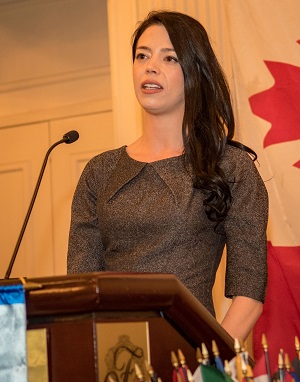
 Alexis Evdoxiadis Introduces Our Speaker 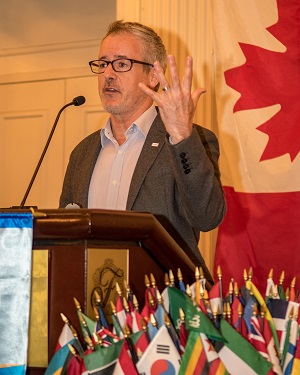 Our Speaker, Jim A. Gibson 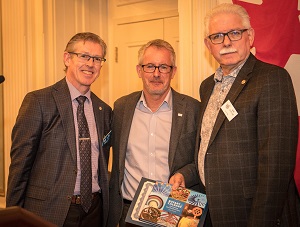 Thanking Our Speaker |
| Alexis Evdoxiadis introduced entrepreneur and author Jim A. Gibson, whose 2018 book Tip of the Spear: Our Species and Technology at a Crossroads formed the basis of his presentation to the club. In his book, Mr. Gibson describes how technological disruption is accelerating, and expresses his concern for the "future disenfranchised" that are being left behind. He began by describing his three laws of technology.
The implications of these laws will profoundly affect the world because rapidly advancing technologies are combining to reinforce technological disruption. The following are just some of the technologies that are evolving exponentially.
It is difficult to imagine the possibilities that can arise when these technologies combine; e.g., when robotic aviation combines with artificial intelligence to enhance virtual reality experiences. However, our linear ways of thinking are increasingly unable to keep up with this wave of technological disruption. |
It is particularly concerning that the decline of human discourse, the rise of fake news and a geo-political slide is amplifying the disruptive effects of the three laws because in the next 10 to 15 years our species will face a fundamental choice.
- For the first time in human history we will have the technology and tools to solve all of the world's problems; or,
- The same tools will end life as we know it.
The real problem is inequality. Will these tools be used to benefit all mankind, or will the "future disenfranchised" be left behind? Our speaker left us with some final thoughts.
- We overestimate the impacts of technology in the near term, and underestimate their long-term impacts.
- The innovation of "things" must become the "innovation of ways".
- The path forward must begin with a new "social contract".
- Trust builds connections exponentially, and exponential trust creates "velocity".
According to Mr. Gibson the future must be created with intention. The challenge for coming generations is to develop different ways of relating socially, economically and politically that will integrate the biological and technological disruptions facing us.
Following a thought-provoking discussion, Bob Taylor thanked our speaker.