
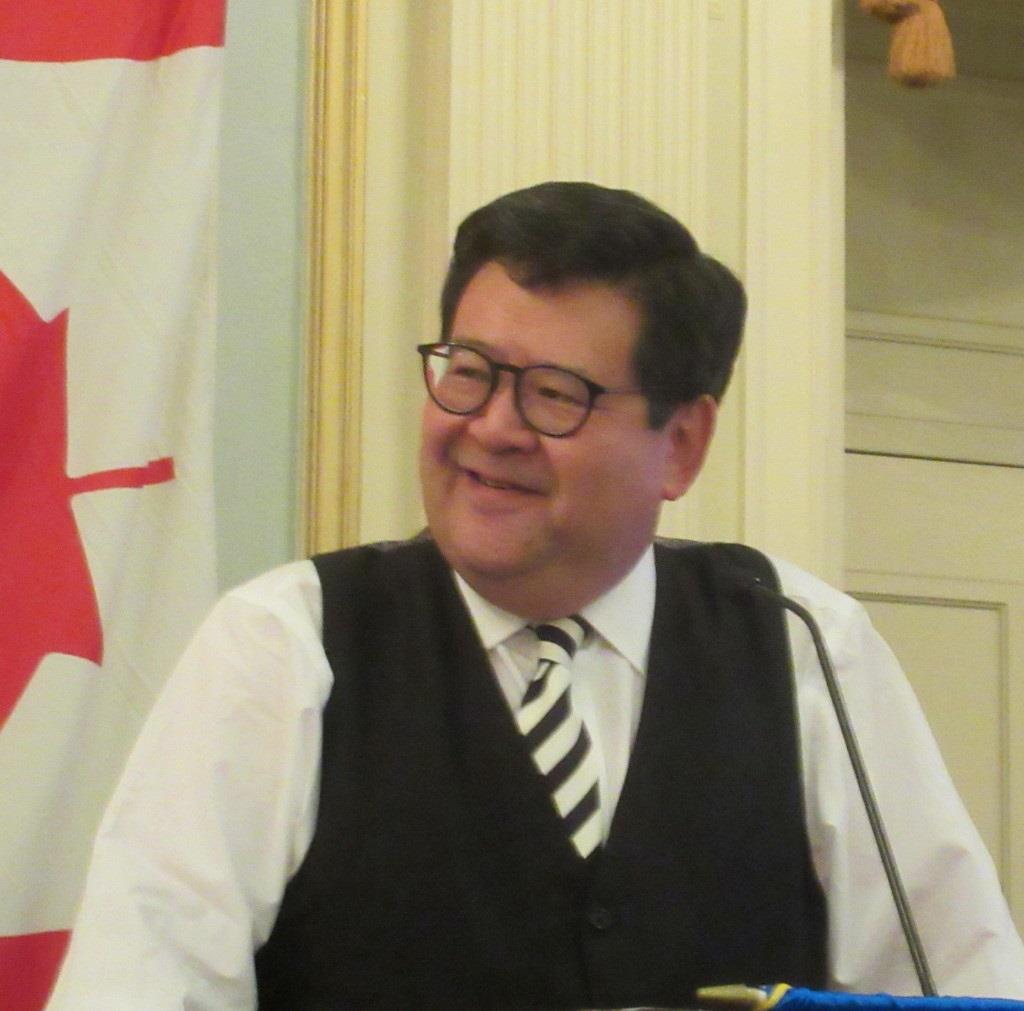
 Our Speaker Gary Mar 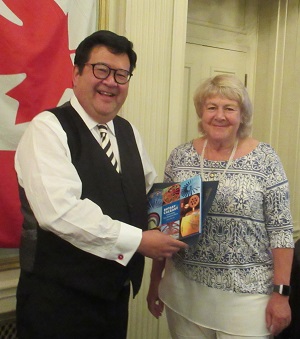 Madeleine King Thanks Our Speaker |
| Paul Gagnon introduced Gary Mar, who delivered several timely insights into the ongoing NAFTA trade negotiations. The former cabinet minister structured his remarks in the form of several key questions, the answers to which are most illuminating.
|
3. What are the deal breakers? Canada in particular has objected to the U.S. proposal to eliminate the international expert panels that hear challenges to anti-dumping and countervailing decisions. U.S. proposals to dismantle Canada's supply management systems for dairy and poultry, and for a five year sunset clause on any renegotiated deal will be potential impediments to an updated NAFTA treaty. Our speaker pointed out that tariffs only benefit small, yet politically active constituencies. For example, tariffs on softwood lumber add $10,000 to $12,000 to the price of a new home in the U.S. 4. Does the U.S. President have the ability to unilaterally withdraw from the current NAFTA? The answer to this is yes, and no. Donald Trump has formally notified congress of his intention to transform the current NAFTA agreement into a bilateral treaty between the U.S. and Mexico. He has signalled his intention to drop the name NAFTA, and to proceed without Canada if necessary. However, this approach will face an uphill struggle in congress, and many court challenges are likely. Furthermore, the President's ability to renegotiate NAFTA is rooted in the Trade Promotion Authority (TPA) granted by congress for a three-way trade treaty. 5. Can any new deal be fast-tracked? Again, the answer is probably not. Fast track TPA requires a 60 per cent super-majority approval in the U.S. Senate. Additionally, it is not certain that the Mexican Chamber of Deputies or the Mexican Senate will ratify the deal. The essential message of Gary Mar's presentation is that we are in uncharted territory. In particular, the current Canadian government and the Canadian media appear to have been caught off guard by recent developments. The Canadian government under the Liberal party has approached international relations by leading with its progressive agenda, which does not carry much weight outside the country. He pointed out that as a result of this, none of our trade relationships are particularly healthy at the present time. Madeleine King thanked our speaker for his timely remarks. | ||