
Bruce Graham introduced our keynote speaker, Dennis McConaghy, formerly of TCPL who spoke about the state of the petroleum industry, how demand relates to environmental issues and geopolitical circumstances such as Trump, Paris Accord, Carbon Tax and competitiveness. Dennis had a 30 year career in the Canadian energy industry, was on the executive team on the Keystone pipeline projects, Dennis is a public policy and energy studies fellow with the Ivey School of Business, and has worked his whole career to find the balance between the energy industry and the environment. For more information about this, you can go to his blog “Dialogues on Canadian Energy”. | 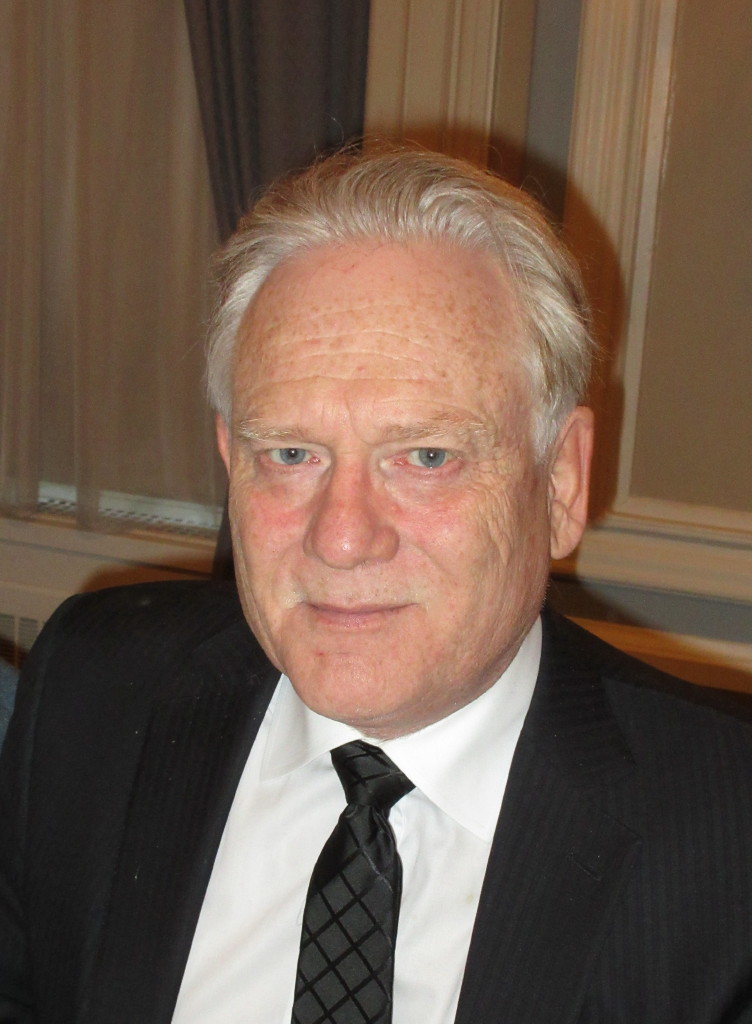 Dennis McConaghy |
Purpose is to stimulate thinking on this topic … the question of our hydrocarbon industry and what is means to this community, this province and the entire country while at the same time trying to find a position with respect to how Canada contributes to climate change and how those two thoughts intersect.
4 graphs:
1st graph shows ever increasing demand (BP’s outlook) from 90MM BPD now to over 110 MM BPD and will out to 2035. Notwithstanding Paris and amount used in developed countries is stabilized, world demand still is growing.
2nd graph ExxonMobil believes there will be a continuing contribution from the Canadian Oil Sands. This should be fundamentally heartening for Calgarians, Albertans and all Canadians.
3rd graph shows all sources of oil production (CAPP outlook to 2030) and that slope is also increasing. It accounts for the drop in oil prices since 2014, it accounts for the national carbon policy and shows an anticipated increase in production and Oilsands production increase of 1 MM BPD with all associated investment and employment.
4th graph shows information from the Federal Department of Environment showing high medium and low expected carbon emissions based on different growth and oil prices scenarios. It also show the Canadian Paris target for emissions which in no way is realistic based on reality. This was a political and arbitrary target. For perspective Canada produces approximately 2% of world carbon emissions. Paris target is to reduce carbon emissions by roughly 25% by 2030. An implausible commitment and if it were to be met would make the overall increase of Oilsands of 1MM BPD unlikely.
Our Federal government is committed to our Paris commitment, however, they have not said how we would ever be able to meet that commitment or at what cost.
Climate Change is a difficult problem to deal with because of the potential enormous costs and (Editor’s Note: and the uncertainty of everything we try being ineffective as a thermostat lowerer). Dennis’ premise why the developed world has to take the lead in this fight is because the bulk of the airborne CO2, that does not breakdown in the atmosphere is due to Europe and NA industrial revolution contribution. In any event, Dennis’ belief is that it is not credible to dispute that there is a huge risk in not dealing with this issue. (Editor’s Note: If the contribution premise of carbon never dissipating is true and it is also true that the Earth was at other times uninhabitable due to high oceans and high carbon atmosphere (before the last ice age as has been postulated) how did that carbon decrease?)
There are a couple of ways to potentially deal with this risk …
Mitigation: doing actual things to reduce carbon emissions to keep the temperature increase to under 2C (ideally under 1.5C) – would require “us” to stop emitting incremental carbon within 20 years. Decarbonize by substituting fossil fuels with electricity (generated by non-fossil fuels sources (nuclear, hydroelectricity, and wind / solar). Decarbonization implies carbon pricing in the $200 / tonne range. Alberta has $30 / tonne and this is a stringent as any jurisdiction on earth.
Adaptation: is one alternative (living with these changes). Models suggest that if we do not take action the temperature on earth will increase 3C over next 20 years. This premise requires the world to live with the risk and based on everyone (all jurisdictions) having some form of carbon tax and that tax funding low or non-carbon solutions, making renewables more economic and the world having some kind of technological breakthrough, perhaps in electricity storage – which is one of the biggest stumbling blocks now.
Our government: Federal government is committed to Paris but have not acknowledged publically how this target could be met. Have not acknowledged the required carbon tax is way in excess of any jurisdictions present carbon tax. Have not come out and stated they will prohibit hydrocarbon production. Have shown a commitment to incremental hydrocarbon production with Federal approval of Trans Mountain expansion, approval of Keystone XL, and some BC LNG facilities. However, they also presided over the Energy East approval’s changing landscape. Our Federal government is conflicted by this.
Provincial government is going the social licence route (of a credible carbon tax) with no commitment from the rest of the country (Burnaby and Montreal) that there will be a quid pro quo. This leads Albertans to ask “what do we get for this carbon tax?” On the other hand, the Alberta government has chosen to not make this carbon tax revenue neutral. (Editor’s Note: this is a piling on of taxes during already difficult times. This hurts individuals and removes investment incentive further). Pipelines is the battleground in the big environmental industry’s plan (and all their supporters) to frustrate the oil and gas industry.
Close with this … what is a rational plan? Dennis’ belief is that would include accepting carbon pricing, ideally through a revenue neutral and transparent tax, that overtime is aligned with that of our trading partners (that is, cannot be in excess of that of our trading partners and the rest of the world).
Finally, it would be absurd in a world with ever increasing oil and gas demand for Canada to not exploit our resources even in the face of incremental emissions as those incremental emissions would be subject to a world level of carbon tax. This is a rational position that Canada could and should espouse.
After many interesting questions and answers …
President Bill thanked our speaker, presented the CAWST certificate, and adjourned the meeting.