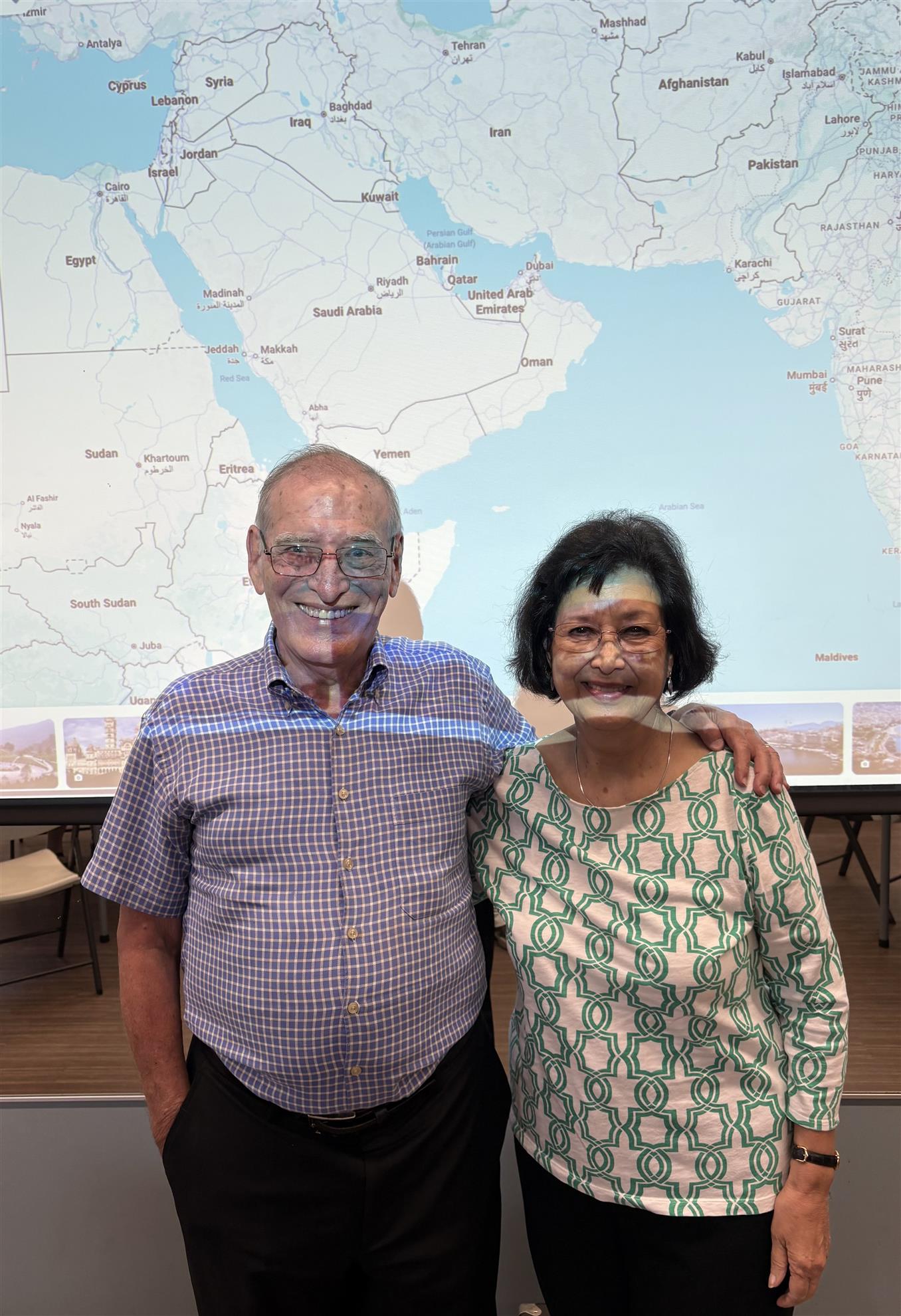
Our speaker on Tuesday, August 11th was former Old Mission Rotarian and past president of the club Jerry Hosenkamp. Jerry spent a significant part of his life in the Middle East and presented firsthand knowledge of the region’s countries, cultures, and political affairs. Over the years, Jerry has given several insightful presentations that have helped better understand this complex and important part of the world.
Jerry grew up in Michigan and attended the University of Michigan and is a very proud alumni: GO BLUE! He then earned a law degree from Wayne State University in Detroit.
His first job was in San Diego as a Corporate Lawyer for the Wickes Corporation. Other jobs included Information Magnetics in Santa Barbara and Carrows Restauraunts and Raynewater Water conditioning.
Jerry’s first connection to the middle east was with a joint venture between the Parsons Corporation and the Daniel International Corporation to build the massive King Abdulaziz International Airport project in Jeddah, Saudi Arabia during the late 1970s and 1980s.
Over his career, Jerry worked for Saudi Arabian Airlines and for a group of bankers that specialized in the middle east.
He moved to Beirut to work for the Hariri Capital Group (HCG); A private international investment firm based in Beirut and part of the prominent Lebanese Herari family.
Jerry was stuck Athens waiting for travel documents and reading the Herald American newspaper at the bar of his hotel. He noticed two English women having lunch in the hotel restaurant and introduced himself. Jerry took the pair out to dinner and the three went their separate ways. Later Jerry was interested in Jean but only had the London number of her roommate Ann. Fortunately, Jean’s friend gave Jean's number to Jerry and within days Jerry was off to London and they were married two weeks later!
Today Jerry and Jean live in Santee close to their daughter, her husband and two grand children.
Jerry presented with a map of the Middle East projected on a large screen. The focus of his talk was the religious make up of the region that are ultimately the root cause of the present situation.
The Middle East is the birthplace of the three major Abrahamic faiths: Judaism, Christianity and Islam. Today, Islam is the dominant religion across the region, practiced by over 90% of the population, while historic Christian, Jewish, and various smaller minority traditions maintain a deep-rooted presence.
- Islam: The largest faith in the region. It is split into two primary branches—Sunni (the majority) and Shia (with significant populations in Iran, Iraq, and Lebanon).
- Christianity: The oldest continuous Christian communities in the world live here, largely belonging to Orthodox and Eastern denominations, with notable populations in countries like Egypt, Lebanon, and Syria.
- Judaism: The oldest of the Abrahamic faiths, primarily centered today in the modern state of Israel.
- Druze: An esoteric, monotheistic faith blending elements of Abrahamic and other philosophies, found mostly in Syria, Lebanon, and Israel.
- Yazidis: An ancient, Kurdish-speaking ethnoreligious group with a unique monotheistic tradition centered primarily in northern Iraq.
- Zoroastrianism: An ancient Iranian pre-Islamic religion that still retains small historical communities in Iran.
- Mandaeans: A small, distinct ethnoreligious community tracing its lineage and baptismal traditions back to John the Baptist.
Jerry noted that there are irreconcilable differences between the Sunni and Shia sects of Islam and that not all Arab countries share the same politics. For example, after the first Gulf War, the Saudi government expelled huge guest worker populations of Palestinians and Yemenis because their governments were aligned with Iraq.
The situation between Israel and the Palestinians in Gaza and the West Bank are more convoluted than ever especially as ultra-orthodox Jews continue to build settlements in the West Bank. Once again, Lebanon is caught in the middle between the battling Israelis and Hezbollah.
Jerry warned anybody about trying to do business or diplomacy with Iran. Since the Islamic revolution in 1979, it is impossible to know who is actually in charge there and Jerry related an amazing story of a corporate team completely flustered during a visit to Tehran to discuss major infrastructure deals.
Our members were captivated by Jerry's insights and all agree that the region is more complex and dangerous than ever.