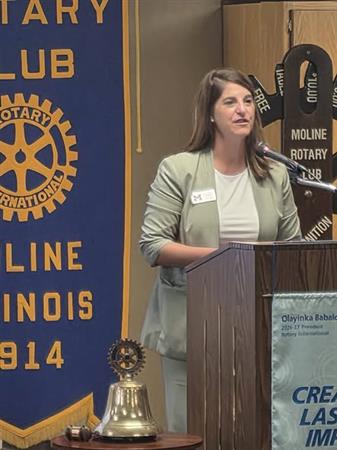
MOLINE — Moline-Coal Valley School District Superintendent Dr. Rachel Savage told Moline Rotary members Monday that the district is seeing continued progress while also facing ongoing challenges tied to attendance, mental health, school safety and growing student needs.
Savage said the district serves about 7,300 students and employs just over 1,000 full- and part-time staff members. The district includes 15 schools: 10 elementary schools, an early childhood center, two middle schools, Moline High School and Aspire, the district’s alternative school.
She said diversity continues to be one of the district’s defining characteristics, with more than 60 languages reported as being spoken in students’ homes.
About 62% of district students qualify for free or reduced-price lunch.
Savage said that level of need requires the district to use its resources carefully and work closely with outside organizations to provide additional support to students and families.
“Our community partners help fill in all the different nooks and crannies and cracks of needs that our families have,” she said.
The district’s stated priorities include fostering student growth, creating safe and welcoming schools, strengthening community partnerships and helping students become more resilient.
Savage said one of the district’s strongest indicators is its teacher retention rate, which stands at about 95%.
She said Moline-Coal Valley has largely avoided the teacher shortage problems facing many other districts.
“Our teachers come and they stay,” Savage said.
Average elementary class sizes are about 21 to 22 students.
Moline-Coal Valley is the 26th-largest school district in Illinois and is a member of the Large Unit District Association, which connects larger pre-K through 12 districts throughout the state.
Savage also provided an update on several district construction projects.
At Moline High School, the district is renovating restrooms and developing a new trades suite in Room D101. The space will give students hands-on experience in areas such as electrical work, plumbing and other skilled trades.
Savage said the goal is to better prepare students who may later enter trade programs at Black Hawk College or other post-secondary institutions.
She also said a new right-turn lane at Moline High School has helped improve traffic flow during arrival and dismissal times.
The district’s largest current project is the construction of Ontiveros Elementary School at the Lincoln-Irving site.
The existing Lincoln-Irving building is being renovated, while a roughly 44,000-square-foot addition is being constructed.
Ontiveros is expected to open next August and will combine students from Lincoln-Irving and Willard Elementary.
Students will become the Ontiveros Owls.
Savage said this will be the final school year for Willard Elementary, which is about 128 years old.
She said the district prefers to describe the building as being “retired” rather than closed.
Willard has served the community for more than a century, but Savage said the building has major limitations, including a lack of full ADA accessibility and the inability to fully air-condition the school.
Lincoln-Irving students are currently attending school in Buildings A and B at Western Illinois University’s Quad Cities campus while construction is underway.
Savage credited Western, MetroLINK, staff members, families and students for making the temporary move successful.
The district is also looking ahead to a possible future project involving the old Coolidge School site.
Savage said Coolidge will likely be torn down and the site could eventually be used for another larger elementary school.
She said the district has found advantages in larger elementary schools with multiple classrooms at each grade level because staffing and support services can be consolidated more efficiently.
Savage also addressed several areas where the district continues to struggle.
Attendance remains one of the biggest concerns.
She said attendance rates have not rebounded as quickly as district leaders had hoped following the COVID-19 pandemic.
Students who attend school regularly are significantly outperforming students who miss school frequently, Savage said.
The district’s chronic absenteeism rate declined by 16% last year, although she said more improvement is still needed.
Savage also discussed school safety, saying planning for physical, mental and psychological safety is ongoing.
“That work is never done,” she said.
The district continues to update safety plans and practices while adapting to changing technology, staffing and other circumstances.
Mental health is another growing concern.
The district has counselors, psychologists and social workers and also works with organizations including the Youth Service Bureau, Robert Young Center and local hospitals.
Savage said those resources are important but still do not meet the full level of need seen among students.
She also described social media as a major challenge for schools.
While social media can be used to promote positive events and student accomplishments, Savage said it can also contribute to bullying, threats and conflicts that carry into school.
Savage said the district is making progress in other areas, including results from the Illinois 5Essentials Survey.
The survey measures five areas: involved families, collaborative teachers and staff, ambitious instruction, effective leaders and supportive environments.
The district has set a goal of earning strong ratings in all five categories by 2028.
Savage said she is also proud of the district’s Board of Education, calling members dedicated volunteers who give their time to the district.
She said the board currently includes parents of district students and praised members for taking on what she described as a difficult but important role.
Savage said the district remains proud of its progress, but acknowledged that many of its greatest challenges cannot be solved by the schools alone.
She said continued cooperation among families, educators and community organizations will remain an important part of the district’s work.