

Linda Christesen joined the RiceGrowers’ Association of Australia Inc(RGA) as Acting Policy Manager in July 2021 as maternity leave position. Linda has extensive experience in the water and public policy space, having worked in water for the Victorian Government for many years, and having more recently worked as Water Policy Manager for Murray Irrigation.


Murray and Murrumbidgee Water-Use
Irrigators in the Murray and Murrumbidgee have noticed a decline in water access in recent years:
- Allocations are much lower when compared to historical expectations.
- Allocations are growing more slowly across the water year.
Both factors impact on rice production, as irrigators don’t always have enough certainty, early enough in the year, to input to their planning processes.
This issue is the subject of current lobbying and negotiation between irrigation and industry groups, including:
- RGA and southern NSW irrigation companies (MIL, MI, CICL)
- Peak bodies – National Farmers Federation, National Irrigators Council, NSW Irrigators Council

And State and Commonwealth politicians and water agencies:
- MPs – water, agriculture portfolios; southern Basin electorates
- MDBA, NSW policy/operations, Commonwealth agriculture, water and environment
The aim is to improve outcomes for irrigators so they can confidently access the water they’re legally entitled to, at a time that’s productively useful.
As background preparation for our discussions/advocacy work, RGA has been reviewing historical data for the Murray and Murrumbidgee to see:
- What it might show about changed water-use patterns overtime.
- What policy/operational areas might be worth attention.
Murray Water-Use –
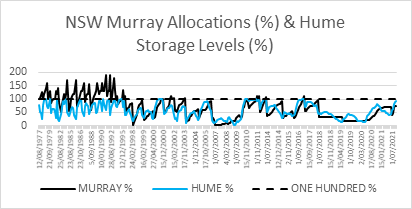
The graph below shows the pattern of Murray allocations from 1977 – 2021.
- Allocations are in black, and from early 2000 onward, include carryover.
- The black dotted line represents 100% allocation.
- The volume of water in Hume, as a percentage, is shown in blue.
Trends you can observe from the graph include:
- a clear reduction in allocations with the introduction of the Murray-Darling Basin Cap and the first NSW Water Sharing Plan for the Murray
- prior to the millennium drought, more frequent ‘peaks and troughs’ – reflecting a more traditional irrigation season – and Hume being operated to support this
- since 2017 in particular, a much more common pattern of allocations sitting below storage levels, even when carryover is factored in.
These trends matter because they show that:
- allocations in the Murray have been at sustainable levels for 20+ years
- trends around irrigation water access have changed significantly overtime, which is impacting on crop planning
- allocations no longer track closely against storage levels, especially this year
The Murrumbidgee has a similar story to tell…
Murrumbidgee Water Use
The graph below shows the following for the 1997-1998 – 2019-2020 water years:
- ‘Permitted take’ (in blue) = the volume of water allowed to be taken each year under the Murrumbidgee Surface Water Resource Plan.
- ‘Actual take’ (in orange) = which represents the actual volume of water used each year.
- The solid black line is the new take limit for the Murrumbidgee, and the dotted black lines are 20% above and below this limit.
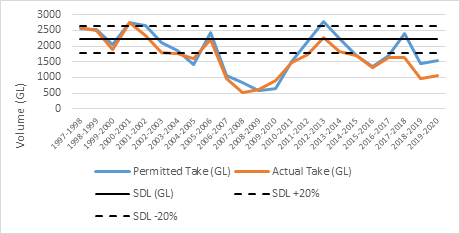
- By simple comparison, water-use in the Murrumbidgee between 1997 and 2020 already sits comfortably within the new take limit +/- 20%.
- We can also see from the graph that up until Basin Plan commencement (2012-2013), water use in the Murrumbidgee closely tracked against NSW annual allocation policies.
- However, since this time, there have been significant gaps between the water that can be legally used and what is actually taken, and this gap has been permanent since 2016-2017.
Data/trends like this allow RGA to advocate for the following:
- Reinstate pre-Basin Plan water use, so it better matches what can be allocated under the Water Sharing Plan, which is also what’s allowed under the Basin Plan.
- More routinely lift both allocation policies and actual water use back up to the SDL.
- In wet years in particular, push take higher within the +20% range.

~~~~~~~~~~~~~~~~~~~~~~~~~~~~~~
Director’s Roundup
- NSW Government’s ‘Reconnecting River Country program’ in southern NSW. Surveys have been sent to all, please complete and submit.
- 10th October 2021 Hat Day - Australian Rotary Health's - Lift the Lid on Mental Illness. President Laurie attempting to have Anna Celi attend our Club on 14th October to speak on Mental Health.
- World Polio Day – Sunday 24 October 2021
- Isabel Pretty from Coleambally, who is being sponsored by our Club to attend National Youth Science Forum (NYSF) will attend on 7th October to tell us her story.
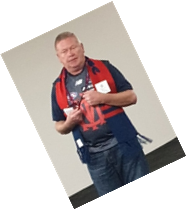
- Sergeant Bill – A very proud Melbourne Supporter.
~~~~~~~~~~~~~~~~~~~~~~~~~~~~~~
Rotarian’s Pick The Menu
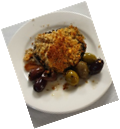
Lasagne was on this week’s menu chosen Bruer, the last ‘Rotatrian to pick the menu. Matt also treated us to stuffed mushrooms and flaming olives with a selection of breads.
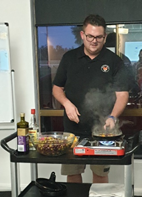

In future Matt has suggested we pick a cuisine. As no one was able to work out Matt’s riddle, he got to pick next week’s cuisine which will be ‘continental’ and has asked all Rotarians to dress for the occasion.
~~~~~~~~~~~~~~~~~~~~~~~~~~~~~~
Let’s Play ‘Which Rotarian?’
- Apparently doesn't eat vegetables? (What have vegies ever done to you?)
- Has a thing about rocket, being the only vegetable they don't eat? (What you got about poor innocent rocket?)
- Was told they had a small intimate table and they responded with it's because we are old and need to sit? (They said it not me!)
- Refuses to wear beanies because no one can see their blonde hair? (Sure that is the reason)
- When it comes to water gets understandably quite passionate? (As we all do!)
~~~~~~~~~~~~~~~~~~~~~~~~~~~~~~