“War”. I use quotes on the word war because the first part of the conflict was mostly a massacre (with a fair amount of rape and taking captured young women as ”brides”) inflicted upon unsuspecting European settlers (mostly German Immigrants who could not speak English or Dakota so no way to communicate with Dakota warriors) by Dakota fighters. Panic, fueled by lurid press stories, set in among the population of the state with settlers leaving everything behind and fleeing Minnesota. Early accounts from Faribault speak of the Catholic Church being filled with Refugees and of Alexander Faribault organizing about 40 men to help fight against the Dakota. Alexander, who knew many of the leading Dakota, was involved in the Battle of Birch Coulée. Of course, the Dakota War took place in the midst of the U.S. Civil War in which most able-bodied men and arms/ammunition was deployed against the Confederacy.
The U.S.-Dakota War was a vicious, ethnic based conflict that the Dakota lost and resulted in them being kicked out of the State. Anyway, I will get off my editorial high horse and the summary follows below. Have a great day.
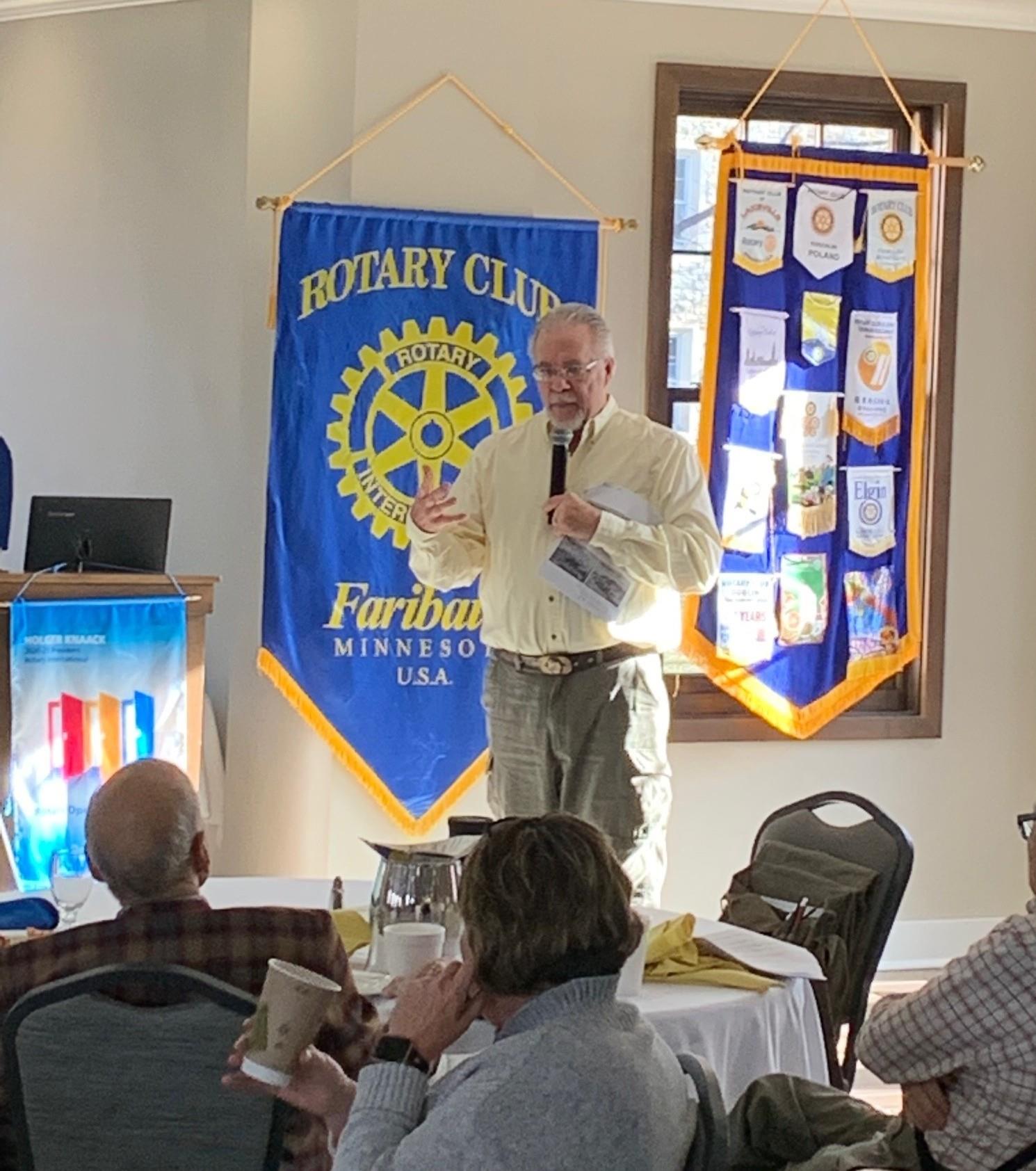
On December 1, Honorary Rotarian Dr. Roy Anderson and local artist Jeff Jarvis provided the Faribault Rotary Club with a presentation entitled the Faribault Dakota Project. Dr. Anderson began the briefing by outlining where the Dakota tribes were located starting in the early 1800s, the different tribal divisions and various Dakota place names for different land marks around Faribault. For example, the street name “Tatepaha” means “windy hill” in Dakota.
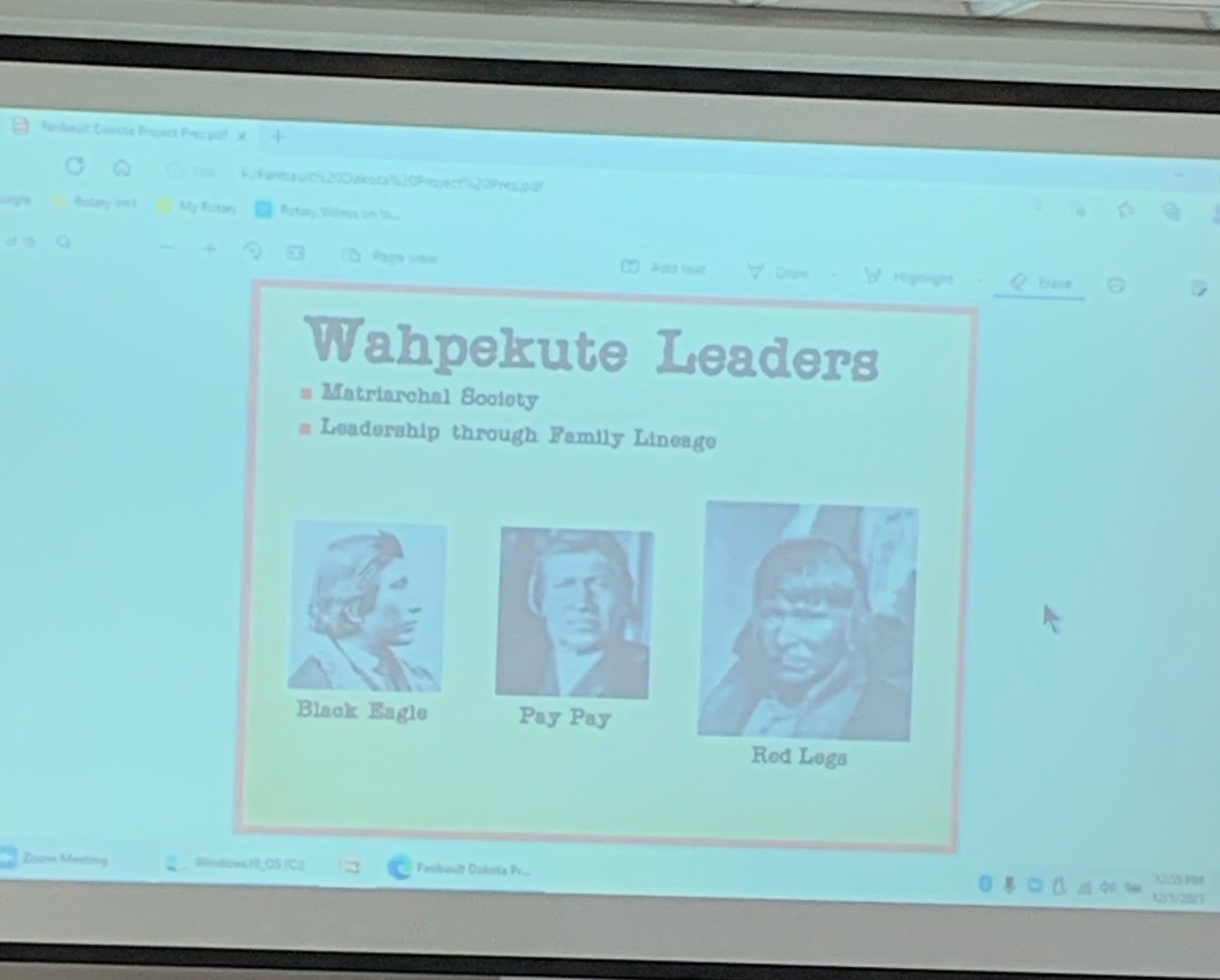
Mr. Jarvis spoke about the Wahpekute Dakota tribe which was initially active around Cannon Lake but later moved to the area around the banks of the Straight River near the present-day location of Buckham Memorial Library and the Alexander Faribault house. The Wahpekute moved to the Straight River for protection from other tribes as well as due to the urgings of Alexander Faribault perhaps trying to protect his own business interests with the Wahpekute.
Jarvis estimated in 1853 there were around 200-400 Dakota living along the Straight River starting at what is now Central and Division Street down to 14th Street NE. The Wahpekute lived in an estimated 40 bark huts with a school as well as farming being conducted. Mr. Jarvis highlighted Peace Park as an area of special interest. Peace Park was an Indian Burial ground. Jarvis emphasized the City of Faribault should designate Peace Park as a cemetery or, at the very least, have some sort of historical marker acknowledging the area as a Dakota burial ground.
Jarvis gave a brief discussion of the conflict between the Dakota and European settlers flowing into Minnesota. This culminated in the U.S.-Dakota war which led to the expulsion of the Dakota from Minnesota after their surrender to forces under the command of General Henry Sibley. Mr. Jarvis also noted the public execution of 38 Indians, which is the largest public execution in U.S. history.
Some Indians did not wish to fight and they were important in helping to secure the release of hostages taken by the Dakota during the fighting. Of these, forty-two members of the families of Taopi and Good Thunder were assisted by Episcopal Bishop Henry Whipple to be released from interment and were given land to live on by Alexander Faribault. They lived along the Straight River near the vicinity of Teepee Tonka Park.
Jarvis closed the briefing by highlighting prominent Dakota, including the St. Clair family. George St. Clair was ordained as a Minister by Bishop Whipple and his descendant Rueben St. Clair served the nation during World War II.
The club enjoyed the presentation and appreciated the efforts of both Dr. Anderson and Mr. Jarvis to bring forth some of Faribault’s rich history.