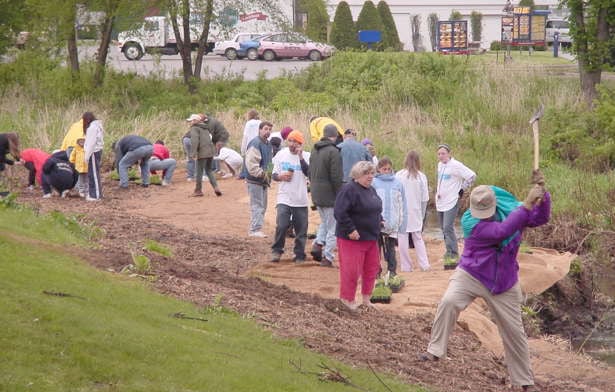
A restoration project in 2004 gathered a community of volunteers at Crockers Creek. Seventeen years later, the Faribault Rotary Club hopes the community will step up in a big way again for a new restoration project in the same area. (Photo courtesy of Kymn Anderson) |
|
|
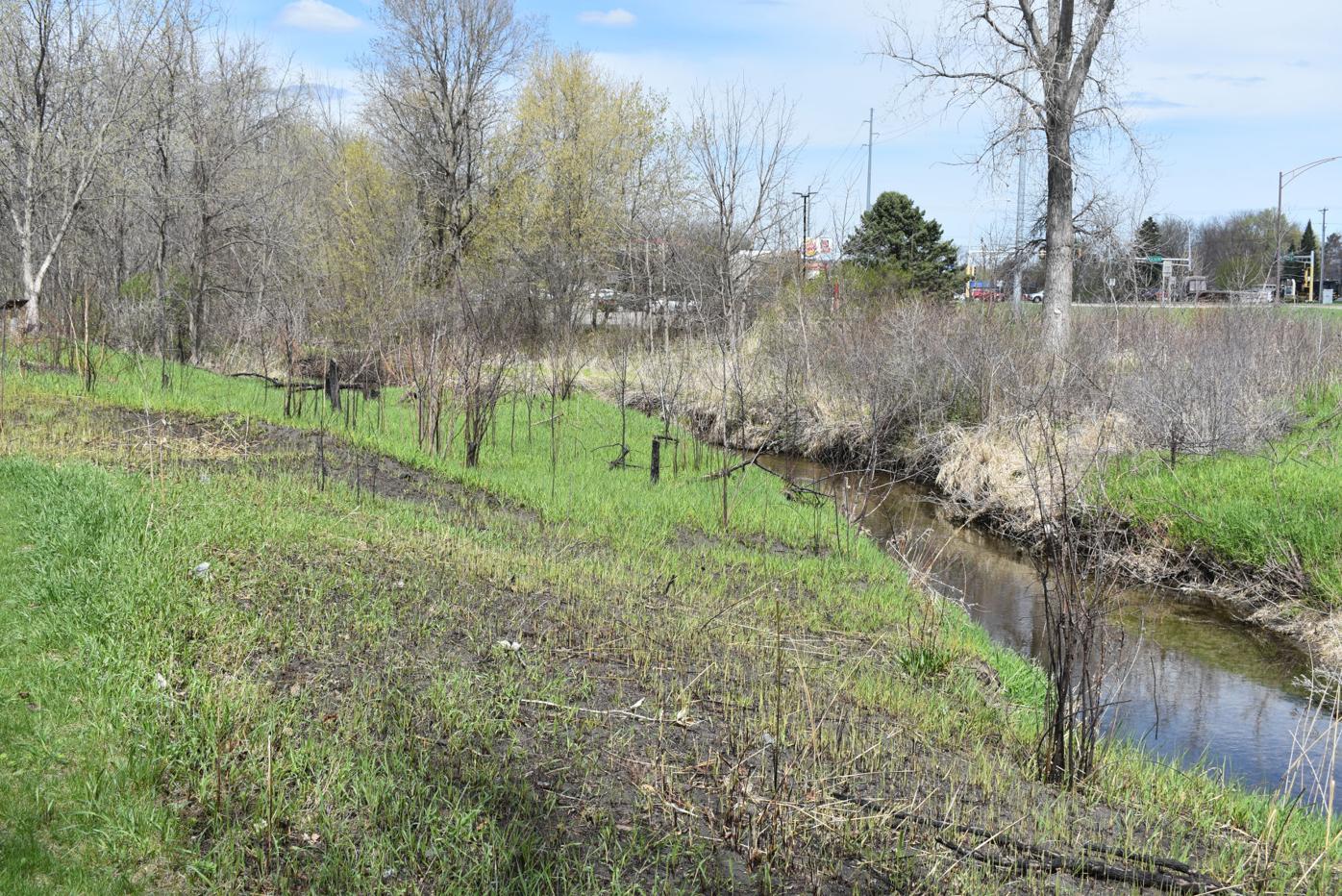
Located along Hwy. 21, Crockers Creek is the area the Faribault Rotary Club has selected as its beautification project. Rotarian Dick Huston has cleaned up the area outside the Chamber of Commerce the past several years, but there’s still much more work to do. (Misty Schwab/southernminn.com) The restoration of Crockers Creek, which spans from the A&W on Hwy. 21 to the Burger King at the Seventh Street intersection, kicks off 1 p.m. Saturday and continues 5 p.m. Thursday, April 29. Volunteers can simply show up outside the Faribault Chamber of Commerce office and bring loppers and chainsaws they own. “Depending on how many people show up, it’s going to take some time,” Huston said. “It’s a big, big job but it will have major benefits.” Invasive species are prevalent at the creek, but understanding how prairies work on his own farm, Huston said the native plants can return in the proper environment. Any woody plants that grow need to be cut down, he said, and the stump needs to be treated, or shoots will grow back in a year or two. Beautification aside, Huston pointed out another benefit to bringing back the restoration project. The roots of the current plants go down as far as 15 feet, he said, and that means they filter the contaminants of the runoff from both the road and parking lot. The plants start the filtering process, which means the chemicals don’t end up in the water. “To me it’s a big deal, and it can be for the city too, to make it look way way better than it is,” Huston said. Kymn Anderson, specials project manager of the Faribault Chamber of Commerce, said the Crockers Creek restoration project dates back to 2002. Throughout a two-year Business Retention and Expansion program within the Chamber, members gathered input from hundreds of businesses about what they viewed as important for the local community to thrive. A number of different initiatives were born from that interview process, including Gateway Beautification. Anderson recalled Master Gardeners, city staff, Boy Scouts, Girl Scouts, high school groups and more working on different aspects of the community throughout 2003 and 2004. These volunteers pulled weeds, and planted flower gardens and trees as part of the beautification projects. One of the major projects in spring and summer 2004 focused specifically on Crockers Creek. “It was a mess,” Anderson said of Crockers Creek at that time. “Just a pile of weeds and a place where garbage gets collected a lot. We were able to get a grant from the Department of Natural Resources for $13,000, and we began the restoration of that area.” With the grant, the community volunteers planted 17,000 native plants on both sides of the waterway. Following the big, sweeping effort of planting in 2004, Anderson said keeping up with the process has become an effort of the Chamber of Commerce. But Huston on his own has also made sure Crockers Creek is cared for properly. Huston began cleaning up the Crockers Creek area in front of the Chamber several years ago, ridding the shore of invasive species. Last summer, Huston spotted 12 prairie flowers blooming. He’s also invited the Faribault Fire Department to conduct controlled burns on the land regularly to rid the area of non-native plants and allow it to repopulated with native ones. “[Fire Chief] Dusty Dienst is awesome in getting that burned, and that’s important for reviving the prairie plants,” Huston said. “Fire is one of the things that stimulates their growth.” Added Anderson: “Every few years when it gets burned down, that helps those native plants become stronger, and it kills the invasive plants we want to get rid of. It’s a big project. It’s not perfect yet, but the idea is that every step of the way makes it easier for the native species to return rather than some of the weeds that had grown up along the way.” Reporter Misty Schwab can be reached at 507-333-3135. Follow her on Twitter @APGmisty. ©Copyright 2021 APG Media of Southern Minnesota. All rights reserved. |
|
|
|