Lower Murrumbidgee Floodplain-Bruce Spinks
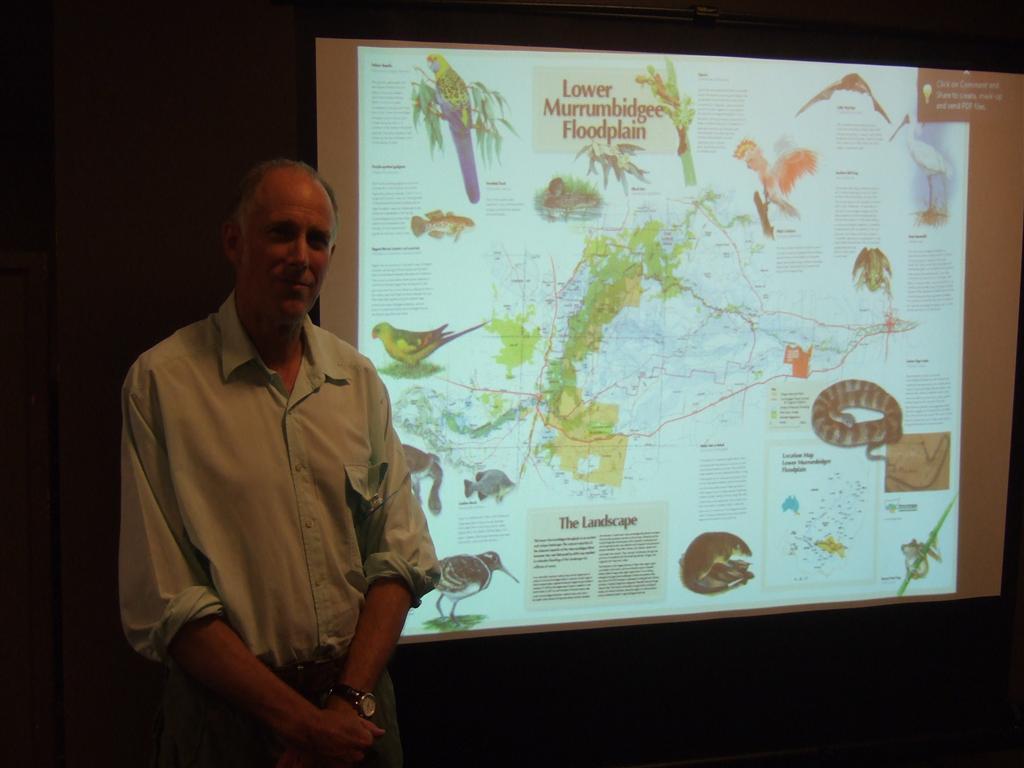 Member, Bruce Spinks gave an informative presentation to the meeting on the controversial issue of the regulation of the Lower Murrumbidgee Floodplain, the area bounded by Balranald, Hay and Maude. The area has shrunk in size by approximately 200,000 hectares in recent times.
The floodplain was formed around 30 million years ago as part of a much bigger floodplain. It has had a history of constant human occupation for around 50,000 years.
Early surveys were started in the 1880-1890's. Landowners concerned at the loss of water commissioned Sir John Monash, then an engineer to do a report on the loss of water through regulation and upstream development. Monash recommends that a minimum of five weirs be constructed to compensate landowners and reinstate flooding onto the floodplains in smaller flows.
Burrinjuck Dam is completed in 1925 for MIA development.
Two weirs are built at Maude and Redbank in the 1940's.
Blowering Dam is completed in 1968 to service the needs of the MIA. Lowbidgee landowners are informed that until the dam is filled they would not see water for ten years.
In 1988 the NSW Government halt all clearing and with farmer consultation implement the Floodplain Management Plan and create protected lands but with no water attached to maintain their viability.
In 2010 Lowbidgee receives an entitlement of 300,000 Megalitres which is the minimum on which to operate and represents 50% of what is actually needed. Remaining landowners negotiate to sell their land and water back to the Federal Government.
The Lowbidgee is the largest fertile self-mulching natural floodplain in the Murrumbidgee catchment. It is the largest organic area in Australia of which 45,000 hectares are cleared for cropping. It contains the second largest Redgum forest in Australia and is an important region for the breeding of native frogs and birds.
Bruce reminded us that " Floodplains are the lungs of the River".
He posed several important questions:
How is the government going to operate in this area?
What actual water savings will be involved?
What will be the ongoing costs of operating in this area and who pays?
What are the environmental outcomes?
John Flynn thanked Bruce on behalf of the meeting.
.