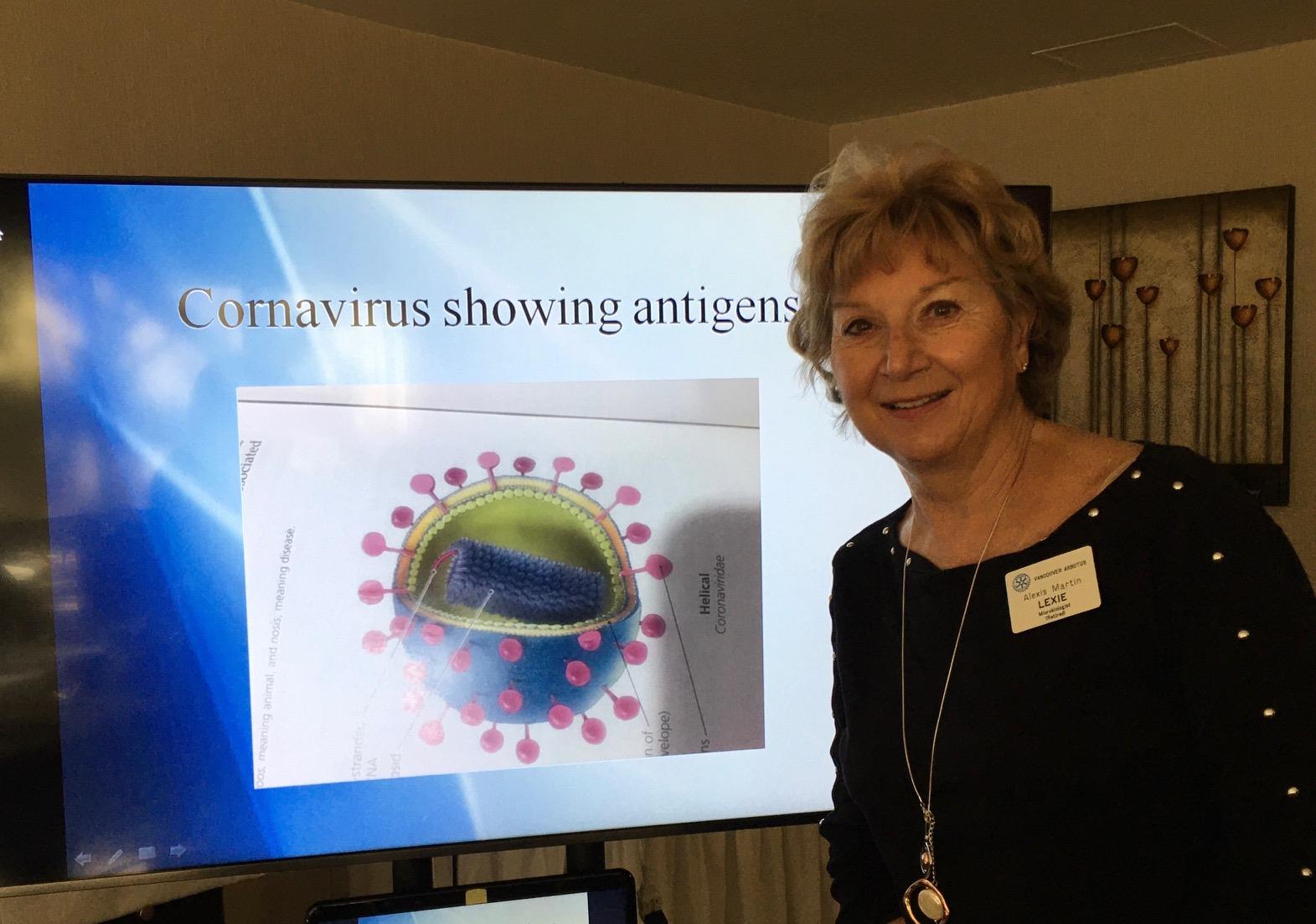
We are fortunate to have in our Club persons of both learning and clarity of mind. Today we welcomed our own Lexi to describe to us something of the complexity of the current coronavirus problem facing a majority of the world’s countries and whose situation changes day by day: when you receive this edition of the Bulletin the situation confronting us will likely be quite different from how it appeared on the 6th.
The nature of a virus is unique in that it has to exist within a host and is ‘released’ by budding from that host. Viruses (even at the beginning of any discussion, it seems odd that the word has no plural ‘viri’, as it is not a true latin word) exist not only in abundance, but there are many millions of types of virus, which mutate and alter form constantly and unreliably. Lexi, in the role of microbiologist lecturer, described a thing that can be almost as big as a bacterium but which can also be 1,000 times smaller than bacteria: to detect their presence generally requires the use of an electron microscope. The genus with which we are faced today is one of a relatively common type, being of a respiratory nature, generally spread rather easily by aerosol means. Mankind seems at the moment to be fixated on the use of the face-mask ‘preventive screen’, but the truth is that the nature of the beast is that it enters the human body most easily by the route of the nose or the eye, the mouth having its own protective mechanisms that blunt any attack (though, again, not entirely reliably) by its own germicidal properties.
As is readily apparent, particularly through the complex motives of our US neighbours, there is at present no vaccine available, and because of the multifarious forms that the virus can assume and the exhaustive nature of testing any vaccine, there is unlikely to be one for a considerable time. The fear that has been generated is not however entirely irrational, though some features (only a small proportion of humanity seems likely to be badly afflicted by the virus, and, fortunately, children appear to be less susceptible that otherwise compromised adults). Additionally, the use of the word ‘pandemic’ seems to be somewhat emotive, even though it actually is a technical term that has been generated by both myth and reason through the now-inbred fear of human experiences like the plague, the Black Death and the post 1917 flu epidemic, which killed more people than the war itself.
To summarize, the virus is not susceptible to any antibiotic (apparently because it has no cell wall), it can grow only in a living cell (usually, in the lab, in embryonic eggs) and is, even as we read, evolving and mutating. We seem to be at the beginning, and not the end, of a major health experiment, forced upon us and without a viable solution apparent to us … at least at this point.
The nature of a virus is unique in that it has to exist within a host and is ‘released’ by budding from that host. Viruses (even at the beginning of any discussion, it seems odd that the word has no plural ‘viri’, as it is not a true latin word) exist not only in abundance, but there are many millions of types of virus, which mutate and alter form constantly and unreliably. Lexi, in the role of microbiologist lecturer, described a thing that can be almost as big as a bacterium but which can also be 1,000 times smaller than bacteria: to detect their presence generally requires the use of an electron microscope. The genus with which we are faced today is one of a relatively common type, being of a respiratory nature, generally spread rather easily by aerosol means. Mankind seems at the moment to be fixated on the use of the face-mask ‘preventive screen’, but the truth is that the nature of the beast is that it enters the human body most easily by the route of the nose or the eye, the mouth having its own protective mechanisms that blunt any attack (though, again, not entirely reliably) by its own germicidal properties.
As is readily apparent, particularly through the complex motives of our US neighbours, there is at present no vaccine available, and because of the multifarious forms that the virus can assume and the exhaustive nature of testing any vaccine, there is unlikely to be one for a considerable time. The fear that has been generated is not however entirely irrational, though some features (only a small proportion of humanity seems likely to be badly afflicted by the virus, and, fortunately, children appear to be less susceptible that otherwise compromised adults). Additionally, the use of the word ‘pandemic’ seems to be somewhat emotive, even though it actually is a technical term that has been generated by both myth and reason through the now-inbred fear of human experiences like the plague, the Black Death and the post 1917 flu epidemic, which killed more people than the war itself.
To summarize, the virus is not susceptible to any antibiotic (apparently because it has no cell wall), it can grow only in a living cell (usually, in the lab, in embryonic eggs) and is, even as we read, evolving and mutating. We seem to be at the beginning, and not the end, of a major health experiment, forced upon us and without a viable solution apparent to us … at least at this point.