As the horrors of polio and the visual reminders of it are now hidden in a few care homes and in foreign countries, this disease has slipped from many people’s consciousness. Rotary has not forgotten. We continue the fight to end polio everywhere. With all our minds on the experience of living through the COVID pandemic, we are also looking at past experiences. It is important to remember that polio is a shattering illness.
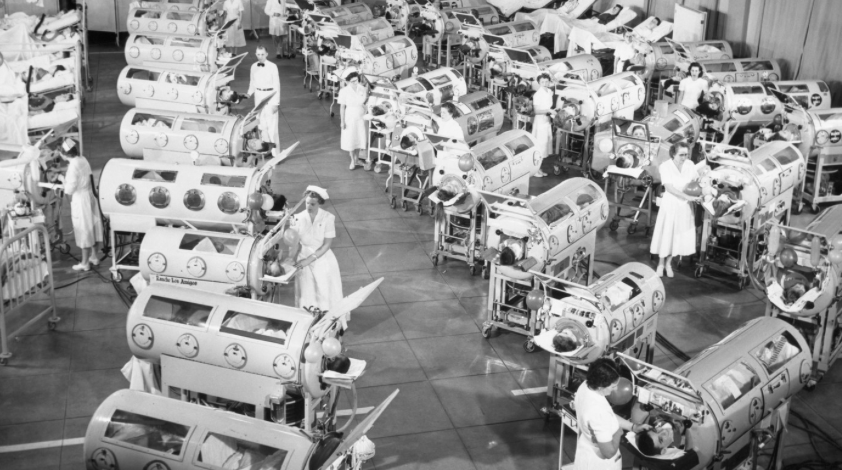
A description of onset in a six year old was published in a Guardian weekly story in early June. The experience: his neck hurt, his head pounded, in a few days his fever soared and aching pains entered his limbs; in three days more he could no longer hold a crayon, speak, swallow or cough. He was paralyzed. At the hospital he was at first left to die and then given an emergency tracheotomy to suction the mucous from his lungs. Waking 3 days later he found himself encased in a machine and under a shroud. He thought he was dead. When the covering was eventually removed all he could see were the heads of other children encased in metal canisters, “as far as you can see, rows and rows of iron lungs full of children crying in pain.”
Our own member, Teddie Pasut was a young nurse at the time and remembers those days and how horrible it was to hear so many children crying and terrified. So little could be done to help.
Poliomyelitis kills by suffocating -- not by damaging the lungs as COVID does -- but by attacking motor neurons in the spinal cord either weakening or destroying the communication between the nervous system and muscles. It caused extraordinary misery and crippled tens of thousands of Canadiansespecially between the years 1949 – 1954.
Recently there have been a lot of articles about this big outbreak of polio, but it was already seen in Canada in1910 and was recognized as early as the 1800’s in Europe.
Unlike with COVID, children under 5 were most affected. But just as with COVID and SARS, Provincial Public Health Departments quarantined the sick. Just as today, they closed schools. Children were restricted from travelling or going to movie theatres and pools. But these measures did not prevent polio’s spread. In some jurisdictions they sprayed for mosquitoes, knowing full well that it would not help, but needing to do something. In New York, during an outbreak in 1916, they killed 72,000 cats and 8,000 dogs in a month thinking they might be transmitters – they are not.
As early as 1930, Canada’s first “iron lung” was brought to The Hospital for Sick Children in Toronto. There was a rush for more iron lungs after a severe outbreak in 1937.
A recently published photo shows hundreds of iron lungs, each with a patient paralyzed and unable to breathe for themselves. Some women gave birth while confined in an iron lung and the Royal Canadian Air Force made emergency deliveries of iron lungs across the country for these births.
An estimated 11,000 people in Canada were left paralyzed by polio between 1949 and 1954 -- in just 5 years. The disease peaked in 1953 with nearly 9,000 cases and 500 deaths – it was the most serious national epidemic since the 1918 influenza pandemic. An effective vaccine against this virus did not appear until 1955 (Salk). But the last major polio epidemic in Canada occurred in 1959, with nearly 2,000 paralytic cases. Many people in Canada, including Rotarians, had polio and survived. Some are now feeling the effects of post-polio conditions.
Rotarians have not forgotten those dark years, are still fighting this terrible disease and helping its many current victims.
Excerpts from Linda Rodriguez Mc Robbie’s article about Polio Guardian Weekly, June 05/2020
Canadian stats from Canadian Public Health Association
Polio Donations
Thanks to everyone who responded to the recent, extra request for a Polio Donations. Polio is spreading again because this new Covid pandemic is preventing vaccinations. Rotary donations to the effort were also down in 2020. Our request to members was based on the cost of a typical Rotary lunch meeting. Some gave more generously than that benchmark. Special thanks to Lana and Mary for the paperwork.