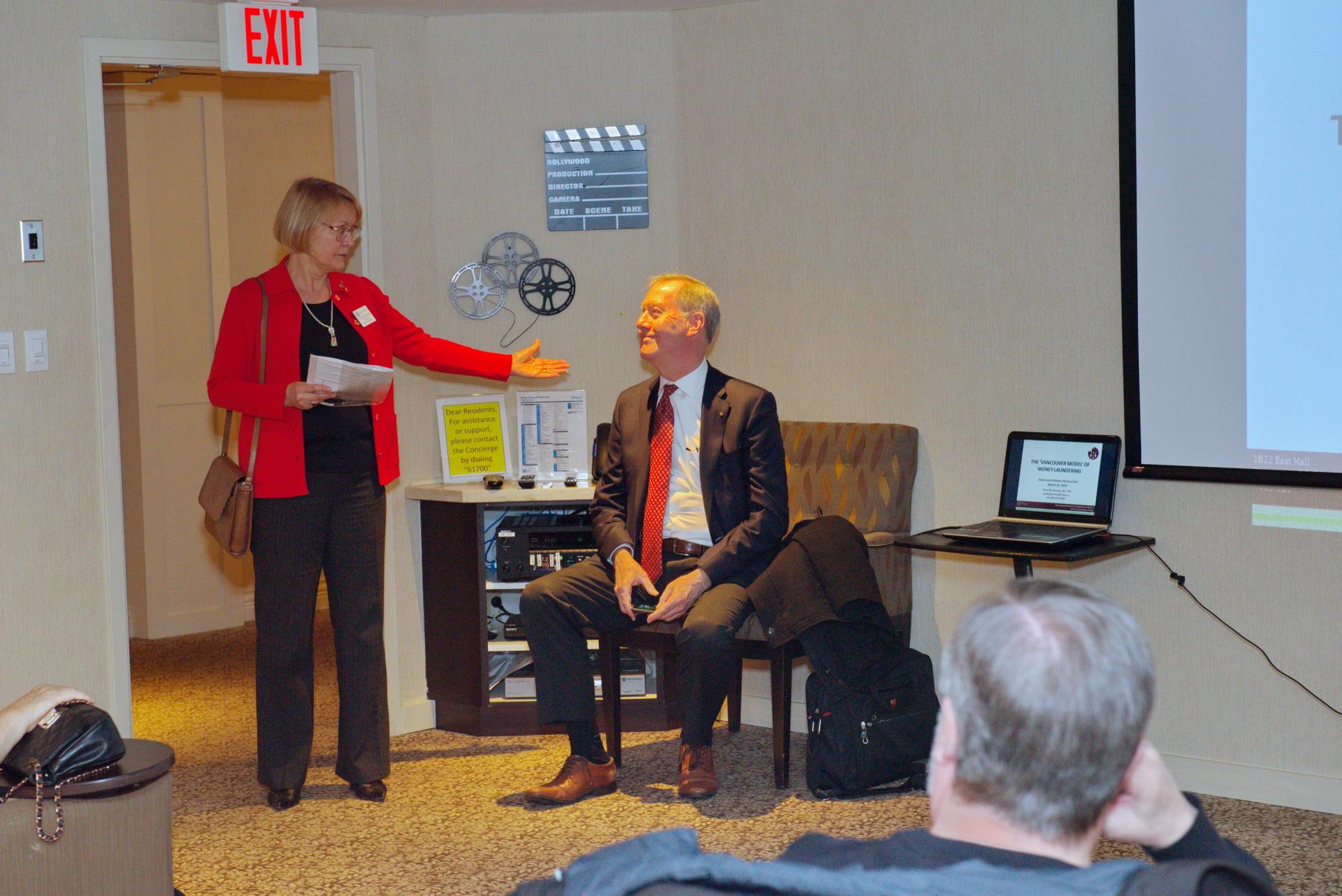
We were pleased to welcome to our august group Peter German Q.C., the retired Deputy Commissioner for the RCMP (not to mention that he was a Charter Member of the Quadra Rotary Club). His topic (somewhat enigmatically described as ‘arcane’) was, in essence, the subject of his expertise on the ever-expanding and burgeoning subject of money-laundering in B.C., especially in Vancouver. While he felt, because of our transfer to the media room at Amica, like a lecturer on a cruise ship (actually, be it said, rather appropriate!) he opened briefly on the recent hot topic of the purchase of hugely expensive luxury cars, (of which purchases there is basically no record) his core thesis was the extraordinary preference for Vancouver as a point of preference for the legion of money-launderers. The reasons are actually rather obvious: it has a seaport, a major airport, propinquity to the U.S., asian and south-asian expertise and contacts, a sophisticated banking and financial system, and a relatively lax legal system.
The legal system is a major factor in the centrality of the city as a centre for money-laundering. Firstly, if one is ‘caught’ (a difficult concept in itself), there is no ‘going to jail and throwing away the key’, as there tends to be in the US, and there is only an enfeebled asset sequestration regime. Nor indeed is there much enthusiasm either in law, politics nor economics for a strong regime in Canada for enforcement of strictures that do not much affect the average citizen. The centrality of the lottery and gambling industries in society (or, at least, in certain levels of that disparate concept) means that the limitation of international cash transfers (as is mandated in India, China and Iran) is hardly a hot topic in Canadian political circles.
Secondly, the tripartite nature of Canada (municipal, provincial and federal jurisdictions are not only confusing, but also on occasion hobble each others’ effectiveness) means that society cannot direct its sanctions in any coordinated manner towards what many consider a major social problem. As an example of the confusion, Peter pointed to the issue of the Casino industry in the Lower Mainland being the ‘responsibility' of 5 police jurisdictions. But there are other responsible entities, including GPEB and FinTRAC (a prize of no value goes to anyone who recalls for what those initials stand), all of which are more or less toothless.
Thirdly, the “old days” witnessed the the Mom and Pop loan-sharking business that operated informally but is now becoming much more professional (and, of course, lucrative). Peter’s equivalent in Australia has opined to him that because of these issues (including the generous benefit of the gambling and laundering businesses to all three levels of government, and the ‘victimless’ nature of the laundering cancer) there is little stomach in this country for effectively policing a problem that the great majority of the population see as a problem for ‘others’.
We were left with the theoretical conundrum of whether or not this is indeed a real “problem of society”. Certainly, people suffer, but only occasionally are they the members of greater polity: many are simply voluntary participants in a sub-strata that, mostly willingly (though not always), accepts the frequently fatal results of participating in a lucrative undertaking. Depressing is the information that Mexican cartels are currently moving some operations to Vancouver (N.B. ‘Vancouver’, not ‘BC’) because of the foregoing advantages.
A significant discussion, but is it one in which persons attending this informative discussion will pay much attention? Your correspondent does not proffer a response.