Dr. Barry Cooper, whose topic was "Psychopathology
Posted by Bill Bourlet
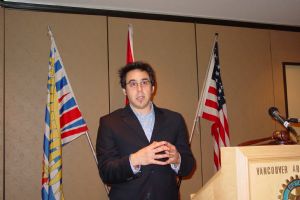
Speaker
Muriel Groves introduced our speaker, Dr. Barry Cooper, whose topic was
"Psychopathology: Snakes in Suits"
Dr. Cooper began by differentiating psychopathology from psychopathy, a
personality disorder, rather than a mental illness. The idea of
psyuchopathy has existed for at least 200 years, and was formalized in
modern psychology by Dr. Robert Hare at UBC in 1980. Dr. Hare developed
a "psychopathy checklist which enables practitioners to determine the
extent to which a person matches the characteristics of a psychopath.
This is more complicated than it might appear, since one characteristic
of psychopaths is that they lie, so it is impossible to get an accurate
assessment from a direct self-report.
There are four elements of the psychopathic personality:
1. Interpersonal manipulativeness - the psychopath uses others for his
own ends
2. Affect deficit - the psychopath does not feel guilt, remorse,
compassion, etc.
3. Impulsive lifestyle - the psychopath engages in irresponsible
behaviour
4. Antisocial behaviour - the psychopath is often criminally versatile
There are different sub-types of psychopathy, depending on which of
these four characteristics are present.
1. The Classic - this person is high on all four of the elements of
psychopathy. Dr. Cooper estimates that between 15% to 25% of inmates in
Canadian prisons are psychopaths.
2. The Manipulator - this person is high on interpersonal
manipulativeness as well as having an affect deficit while not
displaying either anti-social behaviour or an irresponsible life-style
- sometimes called the "Talker"
3. The Macho - this person has affect deficit and antisocial and has an
irresponsible life-style, but is not anti-social. Such a person can be
seen as a "Doer," someone who stops at nothing to achieve his ends.
4. Pseudo Psychopath - this person does not have affect deficit, but
behaves like a psychopath.
Research cannot say conclusively where psychopathy comes from. Twin
studies suggest that there are genetic antecedents, but other studies
also find that a traumatic childhood can lead to affect deficit and
antisocial behaviour.
Psychopathy is a big subject for research today, in part because such a
large proportion of the prison population exhibits the characteristics.
Penologists have found that psychopaths are the least likely to respond
positively to prison educational programs and the most likely to
recidivate. In business, the snakes in suits show a predictable
pattern, albeit one that is usually difficult to detect. Psychopaths
create a "psychopathic fiction" or a persona that they believe (often
correctly) will lead to their success in business. This will often
involve a faked resume and a very successful interview. Psychopaths are
often very skilled at reading the needs of the interviewer and since
they are not burdened by guilt or remorse, will say anything necessary
to score points, whether or not it is true.
Once in the organization, psychopaths typically identify pawn and
patrons. Pawns are people who can be used for the psychopath's
advancement and patrons are superiors who are identified as having the
power to promote the psychopath's advancement.
The psychopath uses lies and rumors to create enemies of the pawns
behind the scenes. He is of course careful to use people with whom the
pawn does not come in contact as the supposed source of the rumors. The
patrons are dealt with using techniques such as flattery, blaming
others for failure or taking credit for the work of others.
Eventually, both the pawn and patrons become patsies, especially if the
psychopath manages to replace the patron, or to move into another
position of power within the organization.
Dr. Cooper was thanked by Donna Webb and our meeting was adjourned at
1:30