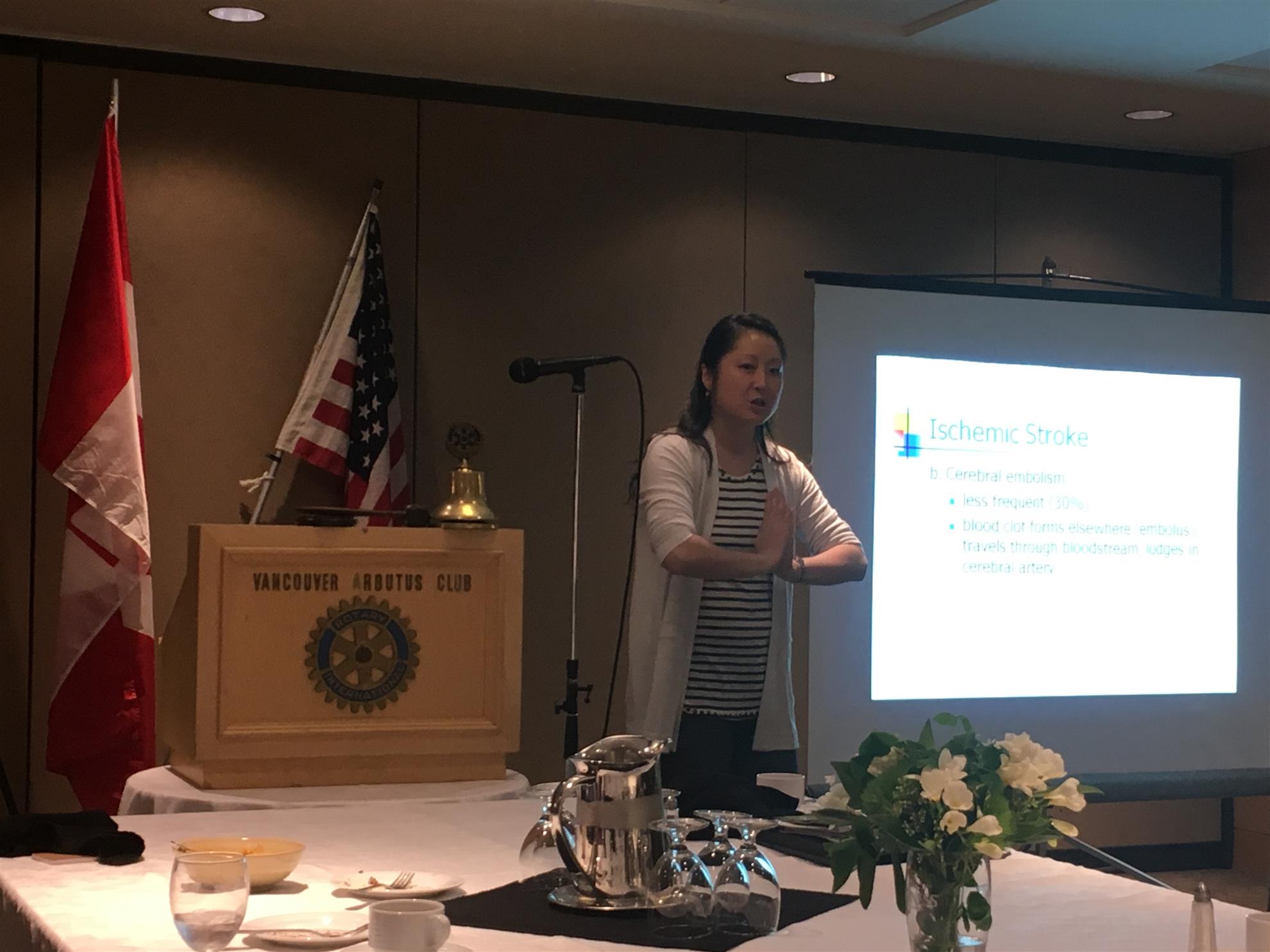
We were pleased to be enlightened by Dr. Jennifer Yao MD, FRCPC on the present knowledge and discipline of brain injuries and strokes.
We were pleased to be enlightened by Dr. Jennifer Yao MD, FRCPC on the present knowledge and discipline of brain injuries and strokes. She was given a gracious and laudatory introduction by Grant, one of our most learned and sagacious of members. The introduction was particularly effusive; it transpired that the nature of the kind introduction was not however entirely random: Dr. Jennifer is his sister.
Strokes are at this point the 3rd leading cause of death in Canada, and are fundamentally of two types Cerebrovascular Accident and Hemorrhagic stroke, the former accounting for 83% of strokes (and is also known as ’silent ischema’) and the latter for 15%. She described to us the symptoms of a stroke rupture of the blood vessels supplying the brain, showed us a cross section of a brain that had suffered a blood-clot, and also described a lacunar stroke (which is apparently longhand for a small stroke: few words in this presentation trip easily off your correspondent’s tongue, so allowance must be made for my misunderstanding both words and meanings). Underlying much of the understanding of the stroke is hypertension, and in our society the primary factors influencing the absence or otherwise of stroke likelihood are smoking, heredity, prior stroke, clotting disorders, obesity and gender (it is more common in men than in women); Dr. Yao was somewhat neutral on the question of alcohol, as some physicians say that its effect is unequivocally bad, others say that you might as well enjoy yourself, as the main factors seem to be relatively aleatory.
The treatment of a stroke is closely related to the formula Time=Brain (in other words, if you are faced with a stroke victim, one of the most important facts to be noted is the time at which the event occurs: treatment is more or less essential within 4.5 hours). And (if this is an option) get the patient to a Stroke Centre, for by no means all medical facilities have the skills or equipment to render the necessary assistance. It need hardly be added that the sequelae of strokes can run the gamut between not knowing that anything has occurred and physical catastrophe: the brain controls everything that makes us human.
And, of course, the seminal importance of the brain renders the list of common effects almost a picture of what is life and what patently is not: hemiplegia, shoulder pain, sensory loss, speech, swallowing, vision, bowel functions, emotional lability, poor insight, learning difficulty and the inability to recognize familiar objects. Medical treatments are as varied as the effects of the stroke, including medication, management of atrial fibrillation, anti-clotting agents (warfarin and xarelto), and procedures that remove plaque buildup or open blockages.
Both a stimulating and salutary lecture.
Michael Frost
michaelfrost@shaw.ca
michaelfrost@shaw.ca